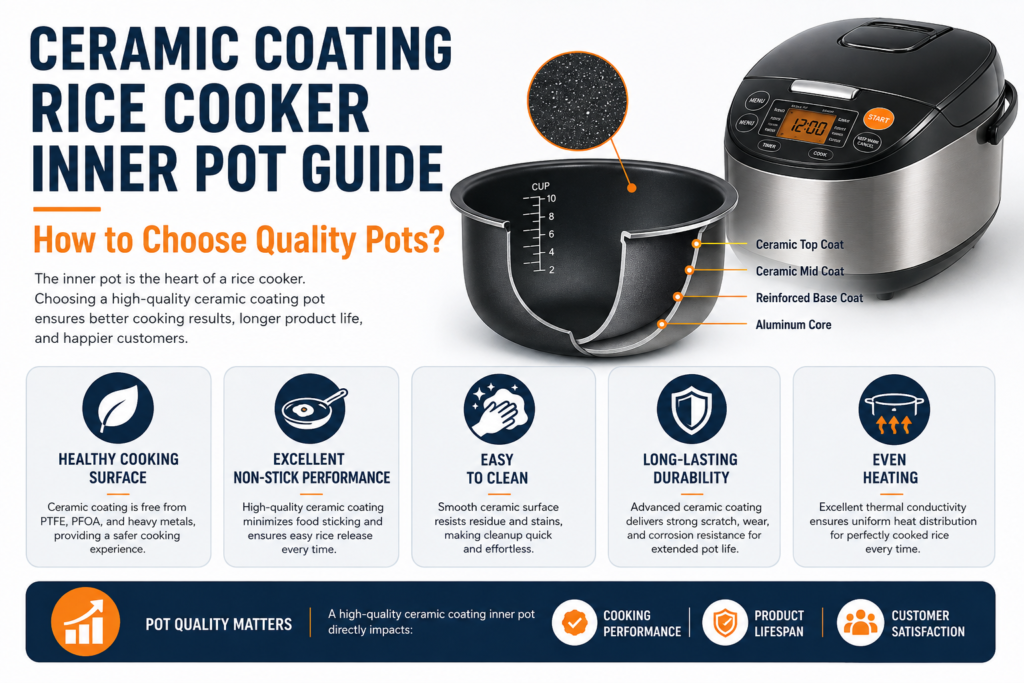
Ceramic Coating Rice Cooker Inner Pot Guide: How to Choose Quality Pots?
Last month, a buyer from Kenya sent us photos of inner pots from his previous supplier. The ceramic coating had peeled off in patches after just three months. He asked me, "How can I tell if your ceramic coating is better?" This question comes up weekly in our factory, and it reveals a critical gap: most buyers evaluate ceramic coating pots the same way they check regular Teflon pots, but the quality signals are completely different.
Ceramic coating rice cooker inner pots use mineral-based silica coatings instead of polymer-based non-stick layers. Quality judgment depends on three factory-verifiable signals: coating thickness consistency (typically 20-40 microns), substrate bonding strength, and proper curing temperature cycles. Buyers must verify these manufacturing process controls rather than accept marketing claims, because substandard ceramic coating fails through sudden delamination rather than gradual wear1, making pre-shipment verification essential for bulk orders.
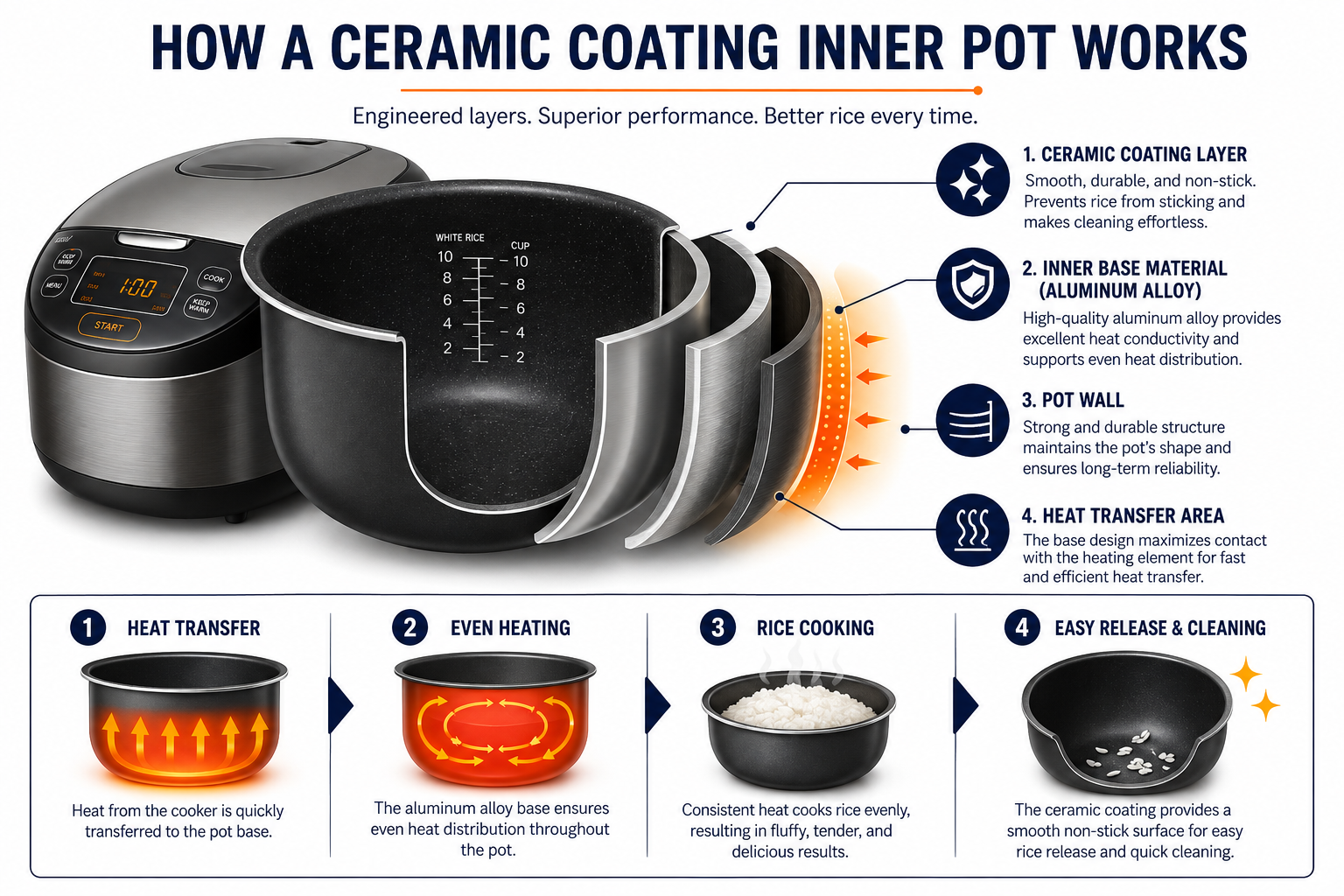
Most B2B buyers I work with assume ceramic coating is just another brand name for non-stick coating. When they compare supplier quotes, they focus on price per unit and stated warranty periods. But ceramic coating manufacturing requires completely different equipment, process controls, and quality checkpoints than Teflon or marble-pattern coatings. If you verify quality using the wrong signals, you'll miss critical defects that only show up after customers start using the pots.
What Makes Ceramic Coating Different from Other Non-Stick Coatings?
When buyers first ask about ceramic coating differences, they usually mean: "Is ceramic coating better than Teflon?" But this question assumes both coatings work the same way with different performance levels. In our production line, ceramic coating and Teflon require separate spray booths, different temperature controls, and distinct curing schedules because the materials behave completely differently.
Ceramic coating uses inorganic silica-based compounds that bond to aluminum substrate through chemical reaction at high temperatures (typically 400-420°C).2 Traditional non-stick coatings like PTFE (Teflon) use organic polymers that bond mechanically at lower temperatures (380-400°C).3 This fundamental composition difference creates distinct failure patterns: ceramic coating fails through sudden delamination when bonding is incomplete, while PTFE coatings gradually wear away through abrasion.
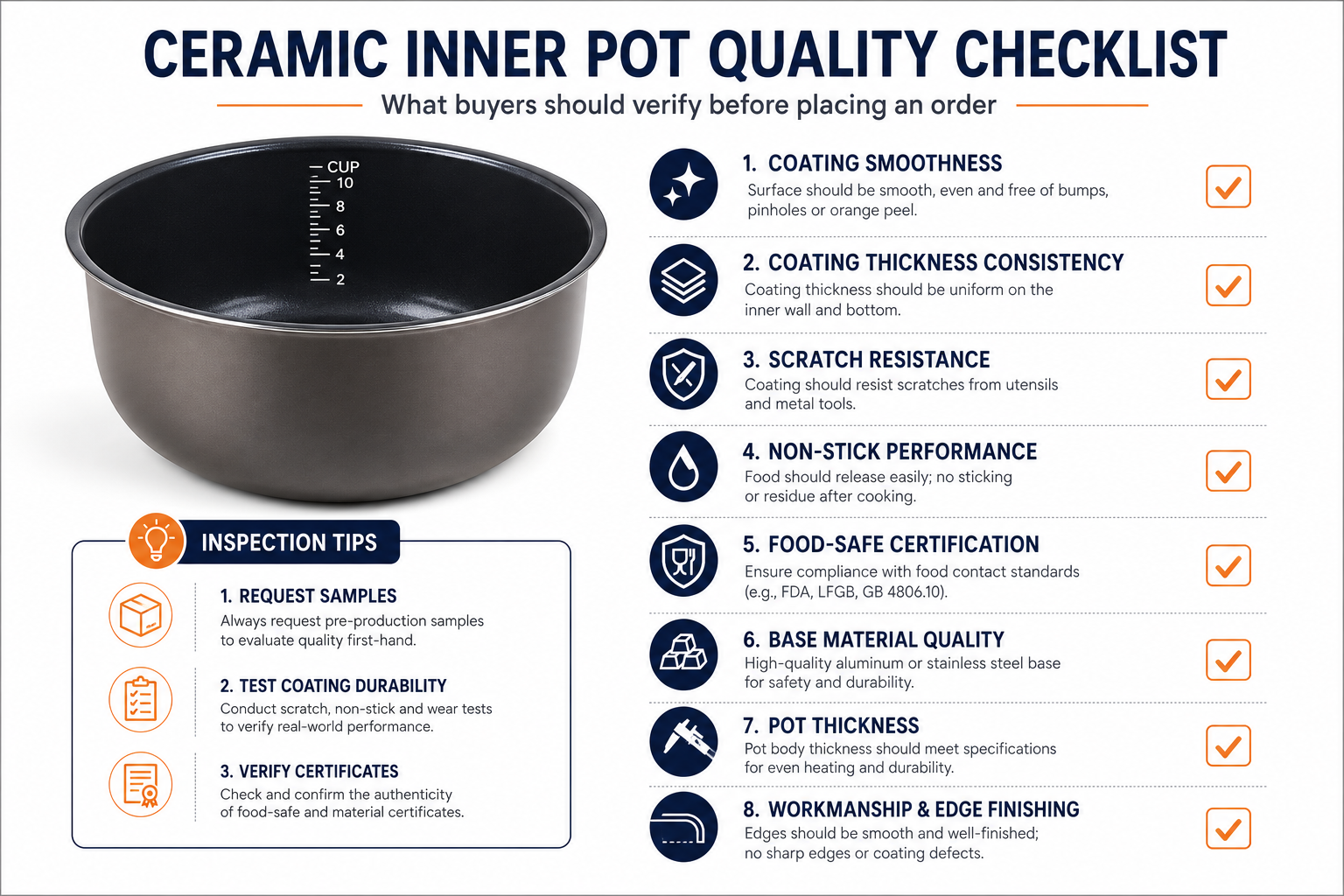
Why Coating Composition Affects Your Quality Verification Process
From quality inspection experience, the most reliable indicator of coating quality is not the coating type itself but whether the factory maintains process parameters specific to that coating chemistry. Ceramic coating requires:
- Substrate pretreatment: Acid etching or mechanical roughening creates microscopic anchor points for silica bonding.4 Without proper preparation, even thick ceramic coating will delaminate within months.
- Spray pattern control: Ceramic coating viscosity changes more dramatically with temperature than PTFE. Inconsistent spray gun distance (standard tolerance: ±10cm) creates visible thickness variations.
- Curing temperature verification: Ceramic coating chemical bonds only form above 400°C. In our production batches, we typically see suppliers running at 380°C to save electricity, which produces coating that passes initial scratch tests but fails under thermal cycling.
Buyers cannot directly verify these process parameters without factory access. However, you can identify suppliers who lack proper process control by asking specific questions about their equipment and testing protocols.
Marble Pattern Coating vs. True Ceramic Coating
Many suppliers list "marble ceramic coating" or "ceramic marble coating" in their specifications. From handling buyer inquiries about coating differences, I've found this creates the most confusion. Marble pattern coating is not ceramic coating with a decorative pattern—it's fundamentally a different product.
| Coating Type | Base Material | Application Method | Heat Resistance | Typical Failure Mode |
|---|---|---|---|---|
| True ceramic coating | Inorganic silica compounds | Sol-gel spray + high-temp cure | 400°C+ | Sudden delamination at bonding defects |
| Marble pattern coating | PTFE or PFA with mineral filler | Multi-layer spray with pattern | 260°C | Gradual surface wear; pattern fading |
| Standard PTFE coating | Pure PTFE resin | Spray or roller coating | 260°C | Gradual abrasion; eventual sticking |
The marble pattern creates visual appeal, but the coating chemistry remains PTFE-based. This matters for your business because marble pattern coatings cost 20-30% less than true ceramic coating5 but are marketed with similar durability claims. If your target market expects ceramic coating performance (higher heat tolerance, no polymer fumes), marble pattern coating will generate customer complaints regardless of how well it's manufactured.
How to Verify Coating Type Before Ordering
When you request samples from suppliers, the coating type cannot be verified through visual inspection or basic scratch tests. In our factory quality control process, we use these verification methods:
-
Heat resistance test: Place empty pot on 200°C hot plate for 30 minutes. True ceramic coating shows no discoloration or odor. PTFE-based coatings (including marble pattern) release detectable plastic smell and may show slight color shift.
-
Thickness measurement: Use coating thickness gauge (available for $50-100) on at least 5 points across the pot. True ceramic coating maintains 25-35 microns consistently. Marble pattern coating often shows 40-50 microns because PTFE requires thicker application for non-stick performance.
-
Supplier process documentation: Ask for spray booth temperature logs, curing oven temperature charts, and substrate preparation protocol. Suppliers with proper ceramic coating capability maintain these records. Suppliers rebranding PTFE coating as "ceramic" cannot provide curing data above 380°C.
From production experience, the most common issue is suppliers applying thin ceramic coating (15-20 microns) to reduce costs while claiming standard thickness. This coating passes scratch tests but fails within 6-12 months because insufficient thickness leaves substrate exposed to steam penetration.
How Thick Should Quality Ceramic Coating Be?
Buyers often ask for "the thickest possible coating" because they assume thickness directly correlates with durability. But from quality inspection experience, coating thickness optimization is more complex. Excessive thickness creates internal stress that actually increases delamination risk.
Standard ceramic coating thickness for rice cooker inner pots ranges from 20-40 microns across the cooking surface.6 Quality depends on maintaining consistency within ±5 microns across any 10cm² area, not achieving maximum thickness. Thickness below 20 microns leaves insufficient barrier against steam penetration; thickness above 45 microns increases thermal stress cracking risk7 during repeated heating cycles.
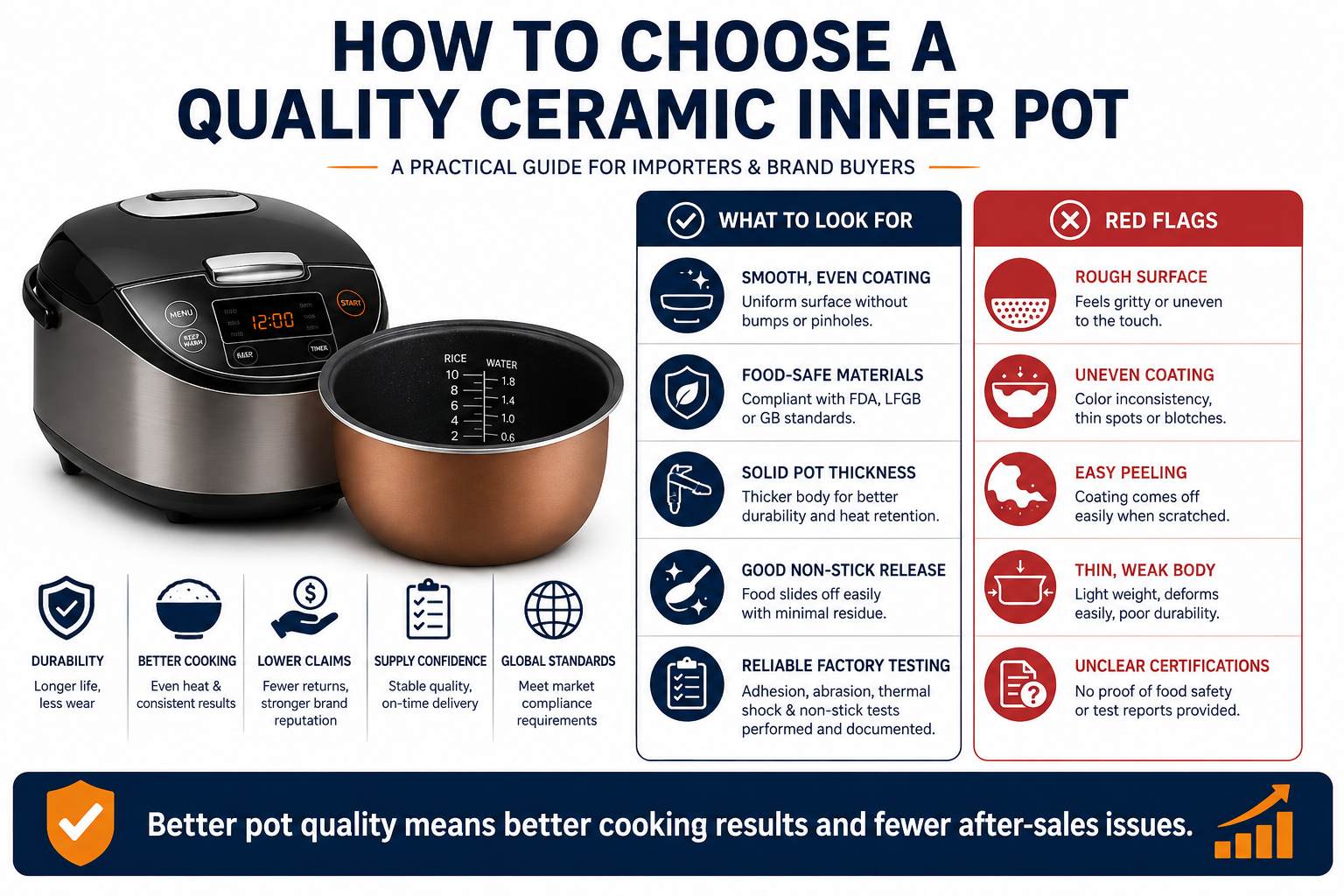
Why Coating Consistency Matters More Than Average Thickness
In our production batches, we typically see two failure patterns related to thickness variation:
Thin spot failures: Areas where coating drops below 18 microns allow water vapor to reach the aluminum substrate. Over 2-3 months of daily use, moisture penetration weakens the coating-substrate bond. The coating then delaminates suddenly, often taking adjacent areas with it. Buyers receive complaints that "the coating peeled off in one large sheet."
Thick spot failures: Areas where coating exceeds 50 microns experience higher thermal expansion mismatch with the aluminum base. During heating cycles (room temperature → 105°C → room temperature), the coating surface and base expand at different rates. After 200-300 cooking cycles, micro-cracks form and propagate.8 Buyers receive complaints that "the coating is chipping off in small flakes."
Both failure modes occur long after the pot passes your initial sample testing. This is why coating consistency is the critical manufacturing signal to verify, not just average thickness.
How to Verify Thickness Consistency When Ordering
Most buyers measure one or two points on sample pots and accept the results if thickness meets specifications. From handling buyer inquiries about coating differences, I recommend this verification protocol:
-
Grid measurement method: Divide the pot cooking surface into a 5x5 grid (25 measurement points). Measure thickness at each grid intersection. Calculate standard deviation—acceptable range is under 3 microns for production batches from factories with proper spray booth calibration.
-
Edge-to-center pattern: Measure at 1cm intervals from pot edge to center along 4 radial lines. Plot the thickness profile. Consistent coating shows relatively flat profile (±4 microns variation). Inconsistent coating shows wave patterns indicating spray gun distance problems or overspray accumulation.
-
Batch variation test: Request sample pots from 3 different production batches (different weeks or months). Measure same grid points on each batch. Batch-to-batch variation under 5 microns indicates stable process control. Variation above 8 microns suggests the factory lacks automated spray equipment or proper process monitoring.
You can purchase non-destructive coating thickness gauges for $80-150. The investment pays for itself by catching thickness consistency problems before you commit to 10,000-unit orders.
Production Process Factors That Affect Thickness
Coating thickness consistency depends on equipment and process factors that are difficult for buyers to verify directly. However, you can identify likely problems by understanding which manufacturing signals correlate with thickness consistency:
-
Automated spray equipment: Factories using robotic spray arms or rotating pot fixtures maintain better consistency (±2-3 microns) than manual spray operations (±5-8 microns). Ask suppliers whether spray booth uses automated motion control.
-
Spray parameters monitoring: Proper ceramic coating application requires real-time monitoring of spray gun pressure (typical range: 3-4 bar), coating viscosity (measured by flow cup timing), and booth temperature (20-25°C with ±2°C control). Suppliers who can provide parameter logs demonstrate process maturity.
-
Coating preparation protocol: Ceramic coating silica content settles during storage. Factories must mix coating material for 15-20 minutes before each batch and monitor viscosity before spraying. Suppliers who describe their pre-spray preparation process likely maintain consistency.
From production staff experience, the easiest red flag to spot is when suppliers cannot explain their spray booth calibration frequency. Professional operations recalibrate spray gun flow rate and pattern width weekly. Suppliers who say "we spray carefully" or "our workers are experienced" lack the process controls needed for consistent thickness.
What Tests Should Suppliers Perform to Prove Coating Quality?
When buyers request quality certificates, most suppliers provide generic test reports showing the coating passes basic standards. But from quality inspection experience, standard ceramic coating tests (scratch resistance, adhesion tape test) don't predict the actual failure modes B2B buyers face after products reach end customers.
Quality ceramic coating verification requires three factory-executed tests: cross-cut adhesion test (ASTM D3359 rating 4B or better)9, boiling water immersion test (24 hours with no delamination), and thermal shock cycling (200 cycles between 25°C and 150°C with adhesion re-test)10. These tests specifically address the primary failure mechanisms buyers encounter: poor substrate bonding, water vapor penetration, and thermal stress cracking.
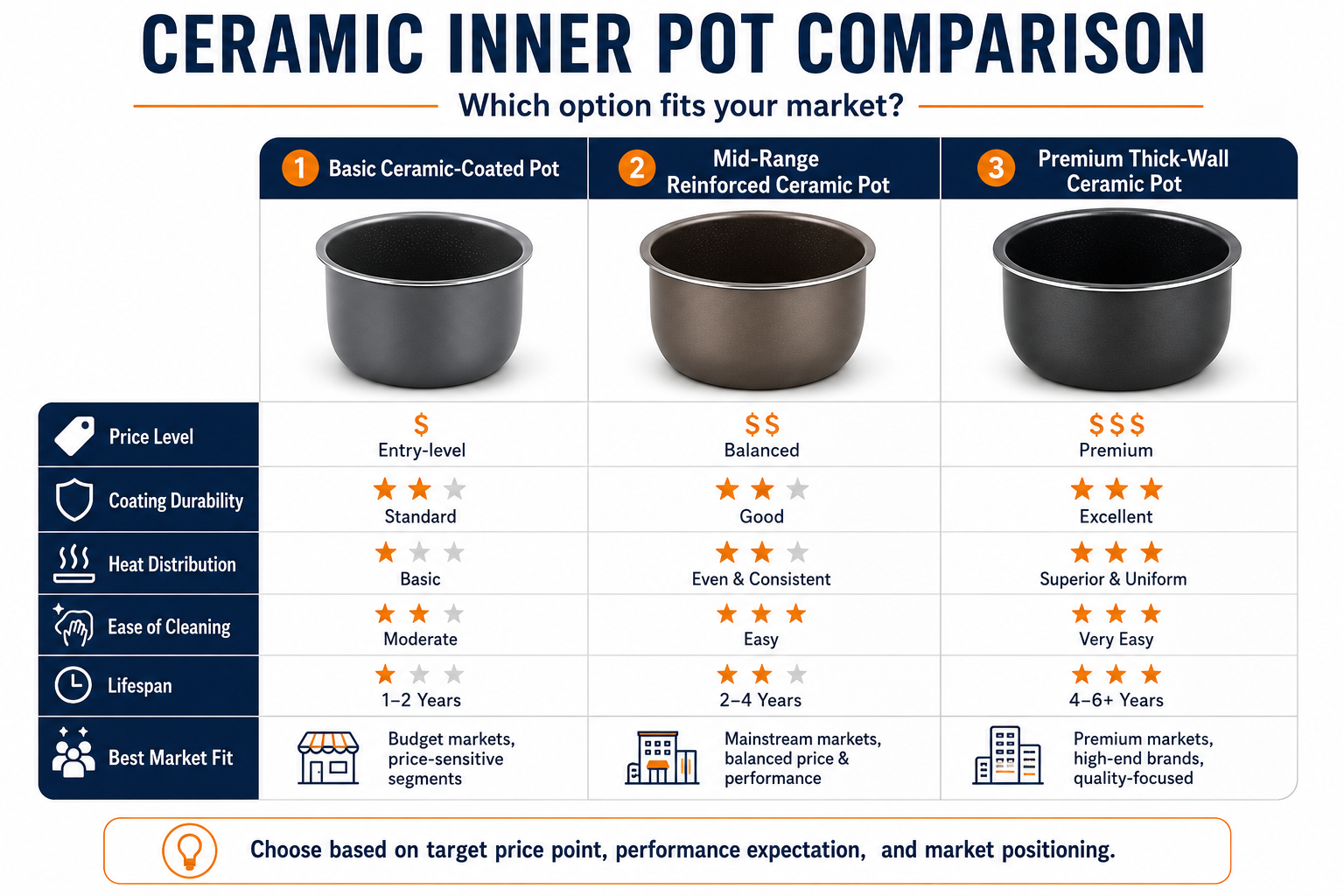
Cross-Cut Adhesion Test: Verifying Substrate Bonding
Bonding strength between ceramic coating and aluminum substrate is the single most important quality factor, yet most buyers don't know how to verify it before ordering. In our production line, properly bonded ceramic coating withstands the cross-cut test with 95% of coating squares remaining intact. Poor bonding shows immediate failure with 30-50% coating loss.
The test procedure follows ASTM D3359 standard:
- Use a multi-blade cutting tool to create a grid of 11 parallel lines in each direction (100 small squares total)
- Apply pressure-sensitive tape over the grid area
- Pull tape off at 180-degree angle with rapid motion
- Count remaining coating squares and classify result
| Test Rating | Coating Retention | Quality Indication | Expected Durability |
|---|---|---|---|
| 5B | 100% squares intact | Excellent bonding | 3+ years normal use |
| 4B | 95%+ squares intact | Good bonding | 2-3 years normal use |
| 3B | 65-95% squares intact | Marginal bonding | 1-2 years; premature edge failure risk |
| 2B | 35-65% squares intact | Poor bonding | 6-12 months; early delamination likely |
| 1B/0B | 0-35% squares intact | Failed bonding | Immediate failure after few uses |
From handling buyer inquiries about coating differences, I've found most suppliers provide samples that test at 3B rating. This passes visual inspection and basic scratch testing, but buyers receive complaints within 12-18 months when coating starts peeling at pot edges where thermal stress is highest.
When you request samples, specify that you require cross-cut adhesion test certification at 4B minimum. Suppliers who cannot provide this certification likely lack proper substrate pretreatment equipment (acid etching tanks or mechanical roughening machinery).
Boiling Water Immersion Test: Verifying Moisture Barrier
Ceramic coating serves as barrier between rice cooker steam environment and aluminum substrate. If coating has micro-porosity defects or incomplete curing, water vapor gradually penetrates to the interface and weakens bonding. This failure mode doesn't appear in dry storage testing but emerges after 2-3 months of daily cooking use.
The boiling water immersion test accelerates moisture exposure:
- Submerge coated pot in boiling water (100°C) for 24 hours continuous
- Remove pot and cool to room temperature (4 hours minimum)
- Re-test adhesion using cross-cut test at 5 locations across pot surface
- Compare adhesion rating to pre-immersion baseline
Quality ceramic coating maintains the same adhesion rating (typically 4B-5B) before and after immersion. Substandard coating drops by 1-2 rating levels, indicating that moisture has penetrated coating microstructure and degraded bonding.
From production staff experience, coating that fails this test usually has one of three manufacturing defects:
- Insufficient curing temperature: Coating cured below 400°C doesn't fully crosslink silica network, leaving molecular gaps for water penetration
- Contaminated coating material: Ceramic coating exposed to humidity during storage absorbs moisture before application, which creates pores during curing
- Substrate surface contamination: Oil, dust, or residual polishing compound on aluminum surface prevents complete coating-substrate chemical bonding
Most suppliers don't perform this test because it requires dedicated boiling equipment and adds 28 hours to QC timeline. When you ask suppliers about their moisture resistance testing protocol, lack of specific testing method is a red flag indicating limited quality control investment.
Thermal Shock Cycling Test: Predicting Long-Term Durability
Rice cooker inner pots experience repeated thermal cycling: room temperature → 105°C cooking temperature → room temperature cooling. Each cycle creates expansion and contraction stress at the coating-substrate interface. Over months of daily use, accumulated stress causes coating delamination even when initial bonding was adequate.
Thermal shock testing accelerates this aging process:
- Heat pot to 150°C in oven (20 minutes)
- Immediately plunge into 25°C water bath (thermal shock)
- Allow pot to equilibrate to room temperature (30 minutes)
- Repeat cycle 200 times (simulates approximately 8-10 months of daily use)
- Perform cross-cut adhesion test at 10 locations and compare to baseline
In our production batches, we typically see properly manufactured ceramic coating maintaining 4B adhesion rating after 200 cycles. Coating from suppliers with inadequate curing or poor substrate preparation drops to 2B-3B rating, indicating that bonding has degraded under thermal stress.
The test reveals coating quality issues that only emerge after several months in customer hands. When buyers order without verifying thermal shock performance, they discover problems after inventory has sold through, leading to high return rates and damaged reputation with end customers.
How to Verify Testing Credibility
When suppliers provide test reports, buyers face another challenge: determining whether testing was properly executed or whether reports are generic templates reused across products. From quality inspection experience, these verification questions help identify credible testing:
-
Test date and batch number: Reports should reference specific production batch numbers and test dates within 30 days of sample shipment. Generic reports with dates from months earlier suggest the supplier is reusing old documentation.
-
Testing location photos: Request photos showing the actual test setup—cutting tools for adhesion testing, boiling equipment for immersion testing, or thermal cycling apparatus. Suppliers who perform testing regularly can provide these photos within 24 hours.
-
Multiple test locations: Proper QC testing evaluates multiple points across each pot (minimum 5 locations for adhesion testing, 10 locations after thermal cycling). Reports showing single-location testing suggest minimal quality control investment.
-
Failed test disclosure: Ask suppliers about their rejection rate for coating quality. Professional factories typically reject 3-8% of batches for failed adhesion or thermal shock testing.11 Suppliers claiming zero rejection rate likely don't perform comprehensive testing.
The goal is not to become a ceramic coating chemistry expert but to identify manufacturing signals that correlate with actual durability in customer use. Suppliers who maintain proper quality control can answer these questions specifically and provide documentation without delay.
How Can You Verify Supplier Claims About Ceramic Coating Safety?
Safety claims create significant confusion
"(Inferior) Resist Adhesion", https://research.engineering.ucdavis.edu/cnm2/wp-content/uploads/sites/11/2014/07/resist_adhesion.pdf. Inorganic coatings with inadequate substrate adhesion characteristically fail through delamination, where the coating separates from the substrate in sheets or patches, contrasting with the gradual abrasive wear typical of polymer-based coatings that remain bonded during degradation. Evidence role: mechanism; source type: research. Supports: the characteristic failure mode of poorly bonded ceramic coatings through delamination. ↩
"Review on Interfacial Bonding Mechanism of Functional ...", https://pmc.ncbi.nlm.nih.gov/articles/PMC8309365/. Sol-gel derived ceramic coatings typically require curing temperatures between 400-450°C to achieve complete silica network crosslinking and chemical bonding with aluminum substrates through oxide layer formation. Evidence role: mechanism; source type: research. Supports: the chemical bonding mechanism and temperature requirements for silica-based ceramic coatings on metal substrates. Scope note: Temperature ranges vary based on specific formulation and may differ for cookware applications versus other industrial uses ↩
"Polytetrafluoroethylene", https://en.wikipedia.org/wiki/Polytetrafluoroethylene. PTFE coatings are typically sintered at temperatures between 380-420°C to achieve mechanical interlocking with prepared substrate surfaces, with the polymer melting and flowing into surface irregularities. Evidence role: mechanism; source type: research. Supports: the typical curing temperature range and bonding mechanism for PTFE-based non-stick coatings. Scope note: Exact temperatures depend on PTFE formulation and may include primer layers that cure at different temperatures ↩
"Exploring Surface Roughness and Contact Angle Effects ...", https://www.osti.gov/biblio/2373138. Surface preparation methods including acid etching and mechanical roughening increase aluminum substrate surface area and create micro-scale topography that enhances coating adhesion through mechanical interlocking in addition to chemical bonding. Evidence role: mechanism; source type: research. Supports: the role of surface preparation in enhancing coating adhesion through mechanical interlocking and increased surface area. ↩
"PTFE VS Ceramic Coating: Which One is Better for ...", https://en.pfluon.com/ptfe-vs-ceramic-coating-which-one-is-better-for-cookware/. Ceramic coatings generally command higher prices than PTFE-based coatings due to more complex application requirements and higher processing temperatures, though specific price differentials vary based on quality grade, production scale, and market positioning. Evidence role: general_support; source type: other. Supports: cost differences between different non-stick coating technologies. Scope note: The specific 20-30% cost difference represents one manufacturer's experience and may not reflect industry-wide pricing across different regions and market segments ↩
"Non-stick surface", https://en.wikipedia.org/wiki/Non-stick_surface. Ceramic non-stick coatings for cookware applications are commonly applied in the 20-50 micron range to balance non-stick performance, durability, and thermal stress management. Evidence role: general_support; source type: other. Supports: typical thickness ranges for ceramic non-stick coatings on cookware. Scope note: Specific standards may vary by manufacturer and regional regulatory requirements for food contact materials ↩
""Thermal fracture of ceramic coatings under high heat flux with ...", https://docs.lib.purdue.edu/dissertations/AAI9953733/. Coating performance involves trade-offs between barrier properties that improve with thickness and thermal stress that increases with thickness due to thermal expansion mismatch between coating and substrate, though specific critical thresholds depend on coating composition and substrate properties. Evidence role: mechanism; source type: research. Supports: the relationship between coating thickness and failure mechanisms including moisture penetration and thermal stress. Scope note: The specific 20 and 45 micron thresholds appear to be empirically derived for this application and may not apply universally to all ceramic coating formulations ↩
"The mechanics of coating delamination in thermal gradients", https://groups.seas.harvard.edu/hutchinson/papers/TBC-CMASdelam.pdf. Repeated thermal cycling of coatings on metal substrates can lead to fatigue-induced cracking due to cyclic thermal expansion mismatch stresses, with crack initiation timing dependent on coating thickness, thermal expansion differential, and temperature range. Evidence role: mechanism; source type: research. Supports: the mechanism by which repeated thermal cycling causes coating failure through crack formation. Scope note: The specific 200-300 cycle range appears to be based on observational experience rather than published research for this specific application ↩
"Cross Hatch Adhesion Test: ASTM D3359",
. ASTM D3359 describes standardized procedures for measuring coating adhesion using tape test methods, with ratings from 5B (best, no coating removal) to 0B (worst, greater than 65% removal), though the standard was developed primarily for architectural coatings. Evidence role: definition; source type: other. Supports: the ASTM D3359 test method and rating classification system for coating adhesion. Scope note: The standard does not specifically address cookware applications or ceramic coatings, so rating interpretation may require adaptation ↩"Influence of heating temperature and time on mechanical ...", https://pmc.ncbi.nlm.nih.gov/articles/PMC11324993/. Thermal shock testing is commonly used to evaluate coating adhesion and predict long-term durability by accelerating thermal stress-induced failure mechanisms, though specific cycle counts and temperature ranges are typically established based on expected service conditions. Evidence role: general_support; source type: other. Supports: the use of thermal shock cycling to assess coating durability and bonding integrity. Scope note: The equivalence between 200 test cycles and actual months of use depends on usage patterns and is not standardized across the cookware industry ↩
"Exceeding Modern Quality Control Standards for Today's ...", https://www.winonapowder.com/blog/exceeding-modern-quality-control-standards-for-todays-powder-coating-projects. Manufacturing operations with robust quality control systems typically experience rejection rates in the low single-digit percentages, as completely eliminating defects is economically impractical while excessively high rejection rates indicate process control problems. Evidence role: general_support; source type: other. Supports: typical rejection rates in quality-controlled coating manufacturing operations. Scope note: The specific 3-8% range represents industry observation rather than a published standard and may vary significantly based on product complexity and quality requirements ↩