What Rice Cooker Barcode and Sticker Requirements Should Importers Confirm Before Ordering?
Most importers treat rice cooker barcodes and stickers as final packaging details, but they're actually import, channel, and production-control requirements. Confirming them after production starts can cause compliance mismatches, reprinting, relabeling, and shipment delays.
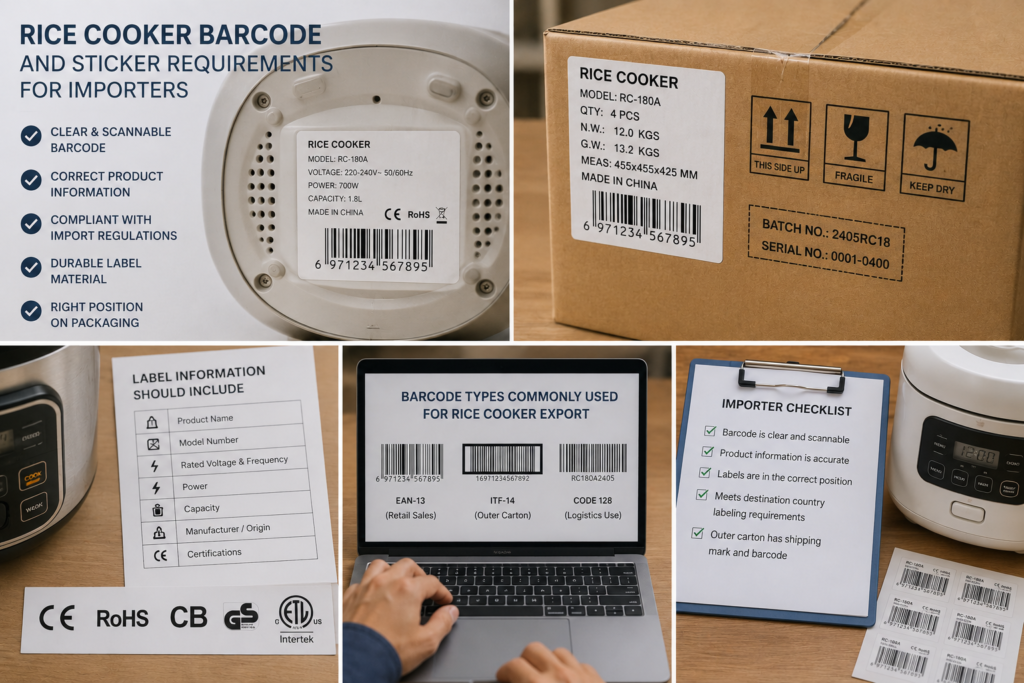
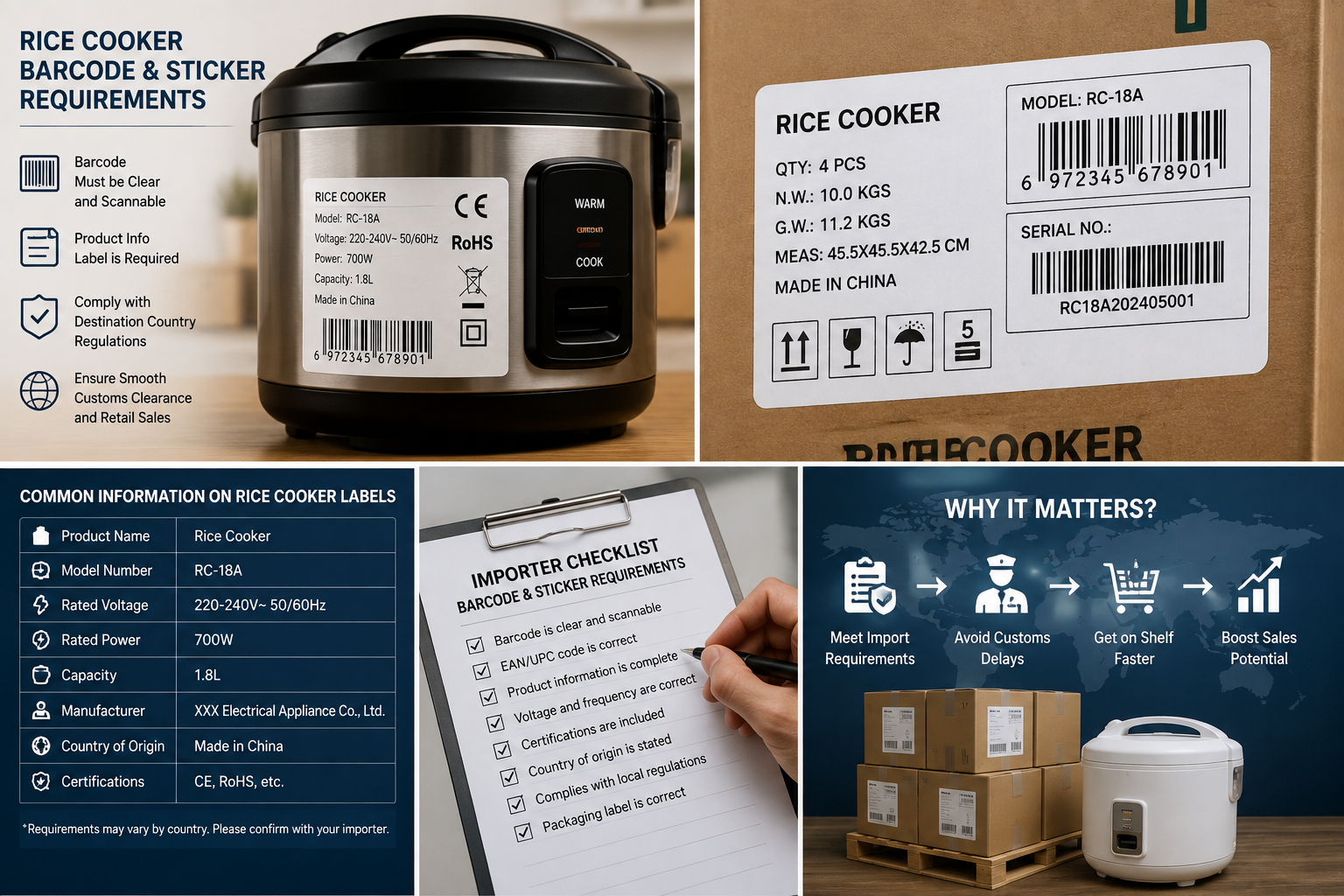
Barcodes and stickers are not one simple label. They form a layered system: product nameplate, color box sticker, outer carton mark, barcode format, brand and model information, and retailer or platform labels. Each serves a different purpose, and importers must confirm all of them before sampling and mass production to avoid rework and cost increase.
Understanding this layered approach helps importers avoid the most common preventable mistake: changing label files after production has started. When that happens, factories must reprint, relabel, or even scrap printed packaging materials. This article walks through each label layer, explains what importers should confirm, and shows how a rice cooker OEM manufacturer like us helps turn customer requirements into production-ready files.
Why Do Rice Cooker Labels and Barcodes Need Early Confirmation?
Rice cooker labels carry product identity and safety information. Unlike promotional stickers, they must meet destination-market import rules, retailer channel requirements, and sometimes platform listing standards before goods can enter warehouses or retail shelves.
Importers should confirm label content early because rice cookers are electrical appliances with voltage, power, plug type, capacity, and certification marks that vary by market1. Wrong or missing label information can block customs clearance, fail retailer audits, or prevent online platform listing2.
In our daily OEM work, we receive customer-provided label requirements and convert them into nameplate artwork, color box sticker files, outer carton mark layouts, and barcode formats for production. But we rely on importers to verify those requirements match their destination market, retailer, supermarket, or online platform rules. The factory executes confirmed files; the importer owns market compliance responsibility.
Label confirmation delays often surface during pre-production meetings, when importers realize they have not checked retailer barcode formats, platform label templates, or local voltage marking rules. By then, sampling timelines extend, and mass production risks increase. Early confirmation prevents this.
What Happens When Label Files Change After Production Starts?
When label files change after mass production begins, the factory must stop, reprint nameplates or stickers, relabel finished products, or repack color boxes and outer cartons. This adds labor cost, material waste, and delivery delay.
I once worked with an importer who changed the barcode format three days before shipment because their retailer required a different symbology. We had to relabel 5,000 units manually, which delayed shipment by one week and increased labor cost. The importer absorbed the extra cost, but the brand reputation suffered because the retailer delayed shelf placement.
Label version control is a production risk, not just a design task. Confirming all label requirements before sampling protects both importer and factory from avoidable rework.
What Label Layers Must Importers Confirm for Rice Cookers?
Rice cooker labeling is not one sticker. It is a system of multiple label layers, each serving a different function in import, channel, and production control.
Importers must confirm six label layers: product nameplate, color box sticker, outer carton mark, barcode format and placement, brand and model information, and retailer or platform-specific labels. Each layer has different content, placement, material, and compliance requirements.
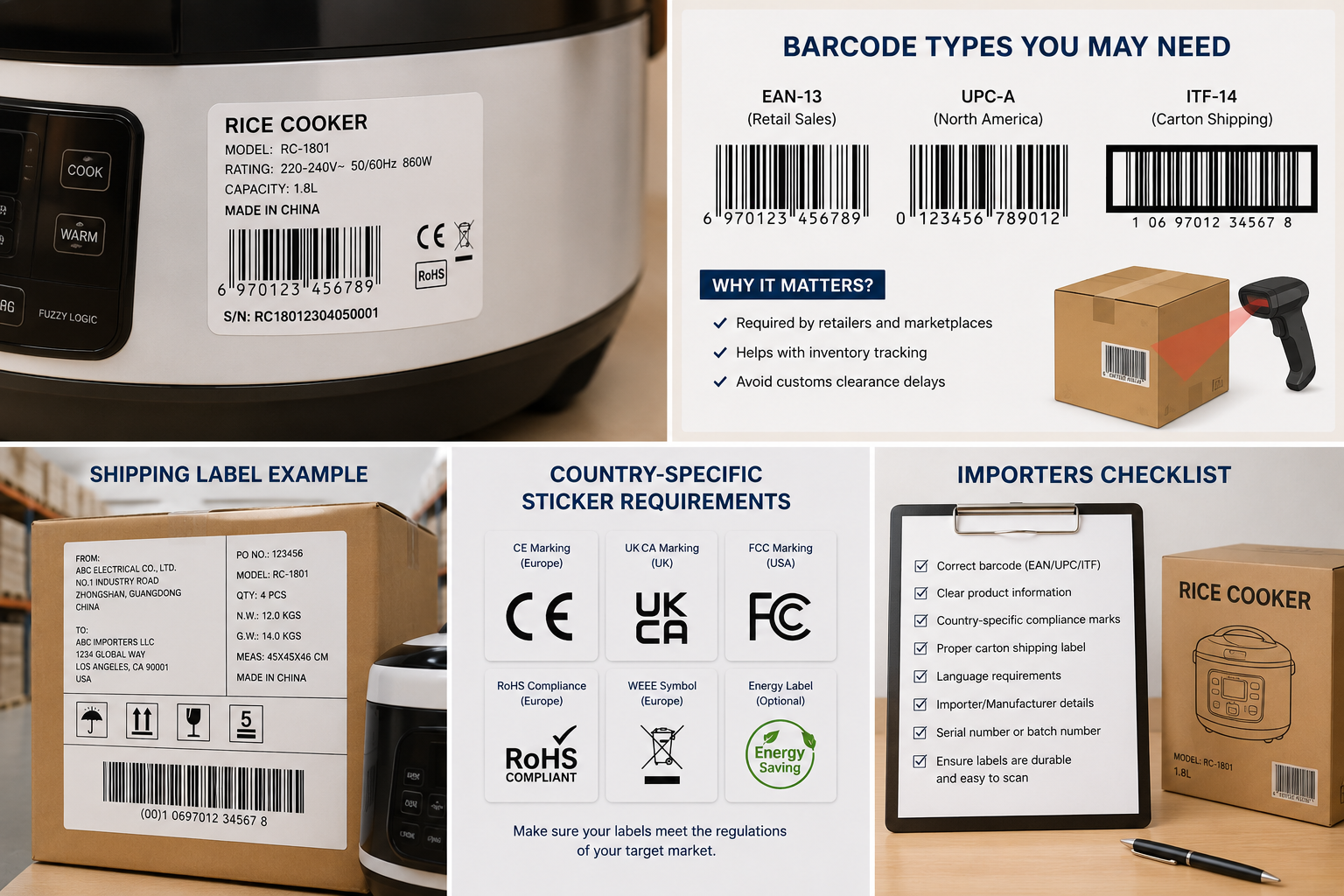
The table below summarizes each label layer, its purpose, typical content, and who usually provides the requirement:
| Label Layer | Purpose | Typical Content | Requirement Source |
|---|---|---|---|
| Product nameplate | Safety and regulatory information permanently attached to the appliance | Brand, model, voltage, power, frequency, capacity, certification marks, manufacturing date | Destination-market import rules, certification body, importer branding |
| Color box sticker | Additional retail or channel information applied to consumer packaging | Barcode, retail price, promotion label, batch code, expiry date (if required) | Retailer, supermarket, online platform, importer internal tracking |
| Outer carton mark | Logistics and warehouse information for shipping and inventory | Product name, model, quantity per carton, gross/net weight, carton dimensions, destination, batch number | Importer logistics team, freight forwarder, warehouse system |
| Barcode format | Product identification for point-of-sale and inventory systems | UPC, EAN-13, EAN-8, GS1-128, or retailer-assigned code | Retailer, online platform, importer barcode registration |
| Brand and model information | Product identity and consumer recognition | Brand name, model number, product name, capacity, color, SKU | Importer branding strategy, product line design |
| Retailer or platform label | Channel-specific compliance or listing requirements | Specific barcode placement, label size, font, color, language, or template | Retailer audit checklist, platform seller manual, supermarket supplier guide |
Each layer requires a different confirmation step. Importers should gather all requirements before ordering, then provide them to the factory during the quotation or sampling stage.
How Should Importers Confirm Product Nameplate Requirements?
The product nameplate is the most critical label layer. It is permanently attached to the rice cooker body, usually on the bottom or back panel, and carries safety and regulatory information required by destination-market import authorities.
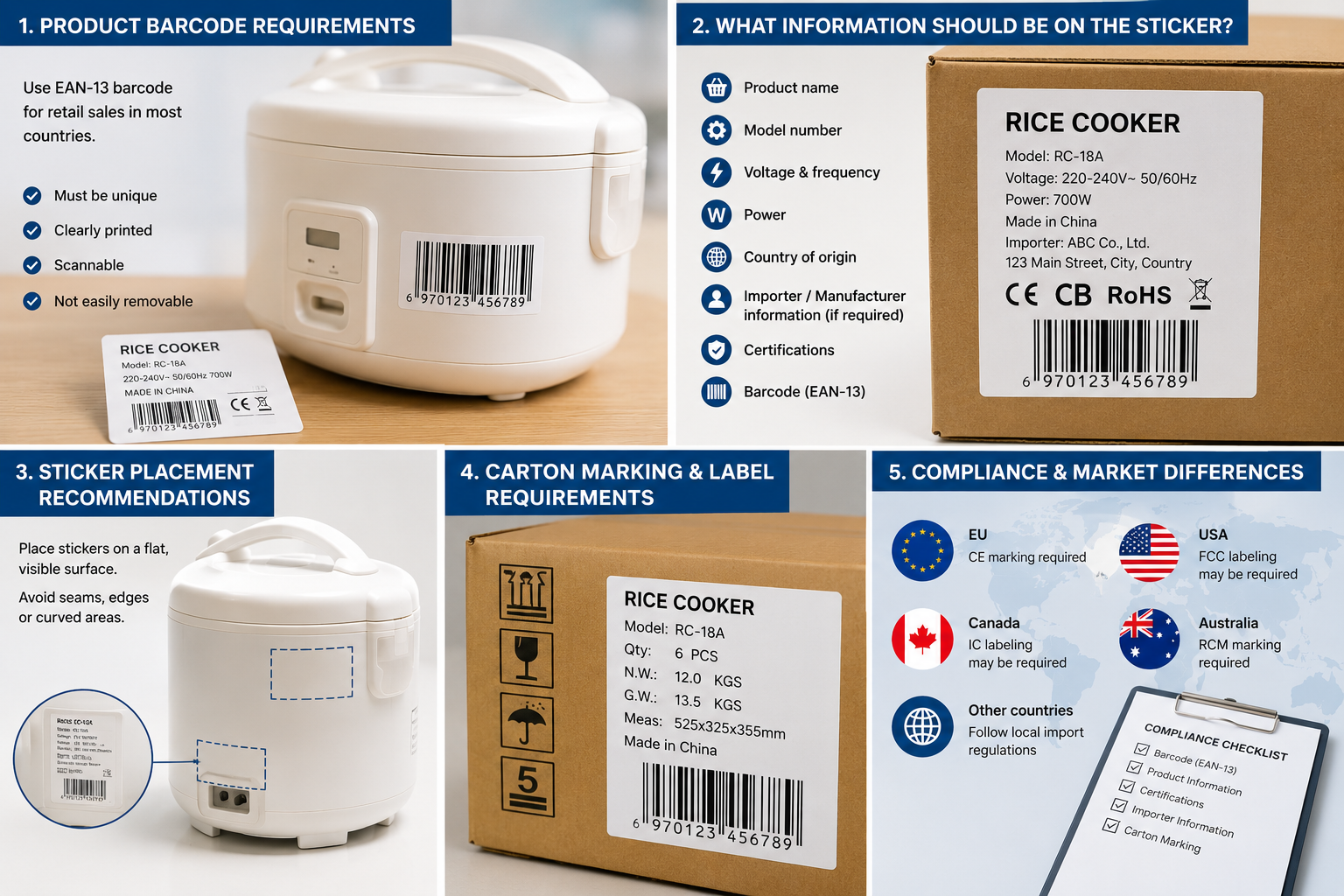
Importers should confirm nameplate content with their certification consultant, import broker, or local regulatory authority. Typical nameplate content includes brand name, model number, voltage, power, frequency, capacity, certification marks (such as CE, UKCA, CB, or local marks), manufacturer information, and manufacturing date or batch code.
We produce nameplates using aluminum or PET material with adhesive backing. Nameplates must survive high-temperature, high-humidity environments and remain legible throughout the product's lifetime3. Content, font size, spacing, and placement must meet certification body requirements, which vary by market.
For example, European markets require specific CE marking size and placement rules4, while some Middle Eastern markets require Arabic language content5. African markets may require local importer information6. Importers must verify these rules locally and provide confirmed artwork to the factory before sampling.
How Should Importers Confirm Color Box Sticker Requirements?
Color box stickers provide additional retail or channel information that is not printed on the color box itself. They are usually applied after production, either at the factory or at the destination warehouse, to allow flexibility for different retailers or promotions.
Importers should confirm sticker content with their retailer, supermarket, or online platform. Typical sticker content includes barcode (discussed separately below), retail price, promotion label, batch code, expiry date (if required by local food safety rules for electrical appliances used in food preparation)7, or retailer-specific information.
Sticker material, size, placement, and adhesive strength must match the color box surface and warehouse handling conditions. Stickers that peel off during shipping or storage create relabeling work at destination, which increases cost and delays shelf placement.
We produce color box stickers using coated paper or synthetic material with permanent or removable adhesive, depending on customer requirements. Importers should provide sticker artwork files in PDF or AI format with exact dimensions, bleed, and color specifications.
How Should Importers Confirm Outer Carton Mark Requirements?
Outer carton marks provide logistics and warehouse information for shipping and inventory control. They help freight forwarders, customs brokers, and warehouse staff identify products, verify quantities, and track batches.
Importers should confirm carton mark content with their logistics team, freight forwarder, or warehouse system. Typical carton mark content includes product name, model number, quantity per carton, gross weight, net weight, carton dimensions, destination port or warehouse code, and batch number or production date.
Carton marks are usually printed directly on corrugated cartons using flexographic or offset printing8. Content must be legible, durable, and placed on visible carton surfaces (usually two adjacent sides for easy identification in stacked pallets).
We print carton marks according to customer-provided layouts. Importers should provide carton mark artwork in vector format with exact text, font, size, and placement specifications. Changes to carton mark content after carton production require reprinting or manual relabeling, which delays packing and shipment.
How Should Importers Confirm Barcode Format and Placement Requirements?
Barcodes are the most frequently discussed label element, but they are also the most frequently misunderstood. Barcode format, symbology, number registration, and placement all vary by retailer, online platform, and destination market.
Importers should confirm barcode requirements with their retailer, supermarket, or online platform before ordering. Typical barcode symbologies include UPC-A (North America retail), EAN-13 (international retail), EAN-8 (small product packaging), and GS1-128 (logistics and supply chain tracking)9.
Many importers assume any barcode works everywhere, but that is incorrect. Retailers and platforms often require specific barcode formats registered with GS1 or their own proprietary systems10. Using an unregistered or wrong-format barcode can prevent product listing or point-of-sale scanning.
We print barcodes on color box stickers, carton labels, or directly on packaging materials according to customer-provided files. Barcode quality must meet ISO/IEC 15416 or GS1 verification standards to ensure reliable scanning11. Importers should provide barcode numbers, symbology, size, placement, and verification grade requirements before production.
Barcode placement also matters. Retailers often specify minimum barcode size, quiet zone (blank space around the barcode), color contrast (usually black bars on white background), and placement location12 (usually bottom right corner of color box back panel). Importers should confirm these details and provide them to the factory in a clear specification document.
How Should Importers Confirm Retailer or Platform-Specific Label Requirements?
Many retailers, supermarkets, and online platforms have their own label requirements beyond general barcode and sticker rules. These requirements are often documented in retailer supplier manuals, platform seller guides, or audit checklists.
Importers should request label requirement documents from their retailer or platform before ordering. Typical platform-specific requirements include barcode placement templates, label size and color specifications, required language and font, product photography or rendering placement, promotion label formats, and batch or expiry date formats.
For example, some European supermarket chains require specific barcode placement and label templates for all electrical appliances. Some Middle Eastern online platforms require Arabic language labels and specific product photography. Some African retailers require local importer contact information on color boxes.
We cannot know all retailer and platform requirements across all markets. That is why we rely on importers to verify and provide confirmed requirements before production. The factory executes according to confirmed files; the importer owns channel compliance responsibility.
Importers should consolidate all retailer and platform requirements into one label specification document, including artwork files, placement diagrams, and approval records, then share it with the factory during pre-production meetings.
How Does a Rice Cooker OEM Manufacturer Help Importers Execute Label Requirements?
As a rice cooker OEM manufacturer, we regularly help importers turn label requirements into production-ready files and mass-production execution. Our process includes four steps: requirement confirmation, artwork design, sample approval, and mass production.
We start by collecting all label requirements from the importer, including product nameplate, color box sticker, outer carton mark, barcode, and retailer or platform-specific labels. Then we design artwork files, produce physical samples for importer approval, and execute mass production after approval. This process prevents label version mismatches and reduces rework risk.
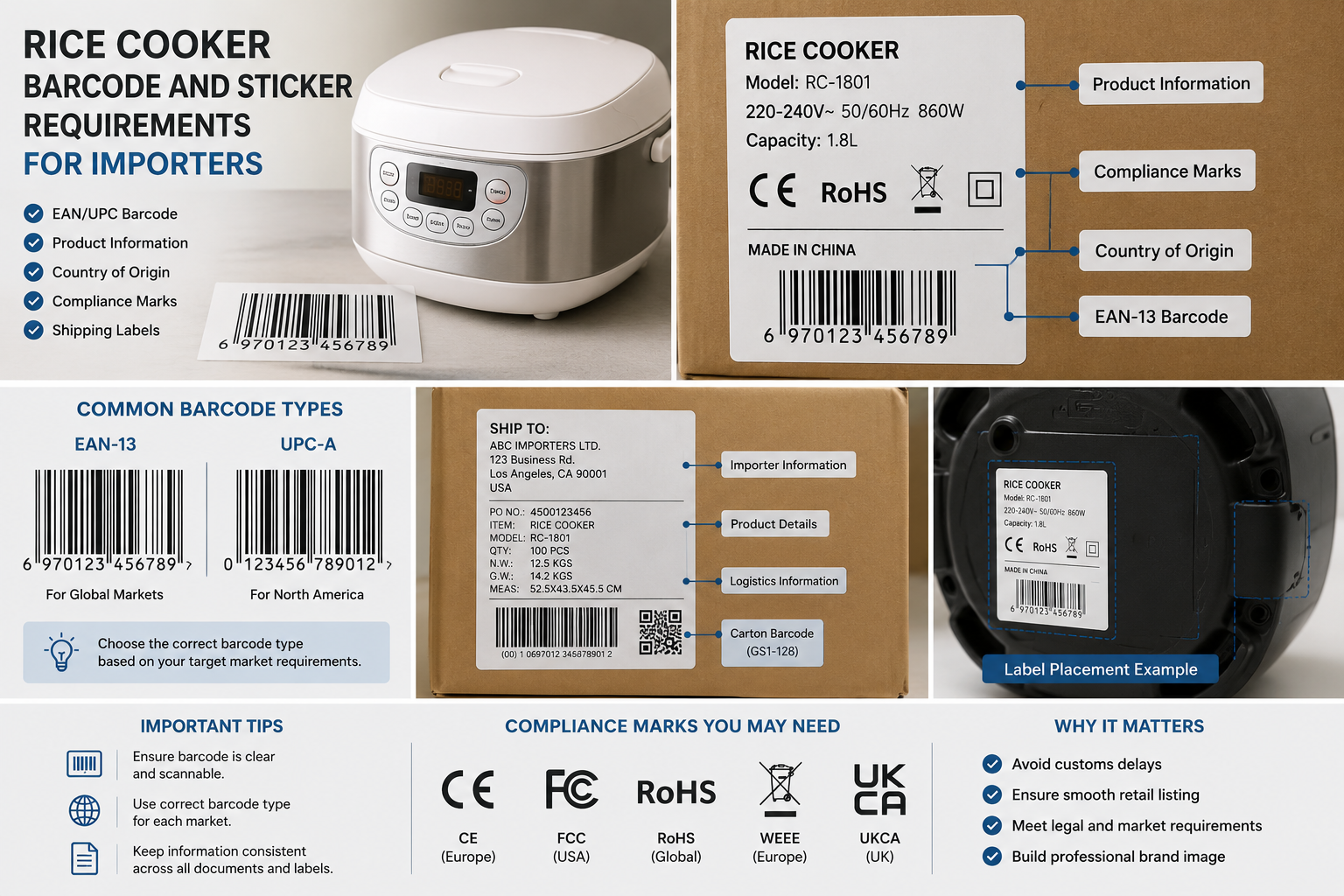
During requirement confirmation, we ask importers to provide destination market, target retailer or platform, certification marks, barcode numbers and symbology, brand and model information, and any retailer-specific label templates or requirements. We also ask importers to confirm language, font, color, and material preferences.
During artwork design, we convert importer requirements into nameplate artwork (usually in AI or PDF format), color box sticker layouts, outer carton mark files, and barcode graphics. We verify barcode quality using GS1 barcode verification software and check artwork files against importer-provided specifications.
During sample approval, we produce physical samples with actual nameplates, stickers, and carton marks applied, then send them to the importer for verification. Importers should check all label content, placement, color, material, and adhesive strength, and provide written approval before mass production starts.
During mass production, we execute according to approved artwork files and sample standards. We perform inline quality checks to verify label printing quality, barcode scanning reliability, and sticker adhesion. We also maintain label version records for traceability and future reorder reference.
This process protects both importer and factory from label version mismatches, reprinting, and relabeling. Importers who provide clear, confirmed requirements at the start save time, reduce cost, and ensure smooth channel entry.
What Documents Should Importers Provide to the Factory for Label Production?
To execute label requirements accurately, we need importers to provide specific documents and files during the quotation and pre-production stages.
Importers should provide product nameplate artwork (in AI, PDF, or EPS vector format), color box sticker artwork, outer carton mark layout, barcode numbers and symbology, brand and model information, retailer or platform label templates or specification documents, and written approval of all artwork files before production.
Importers should also provide label material and adhesive specifications, placement diagrams showing exact label location on product, packaging, and cartons, language and font requirements, and color matching standards (such as Pantone codes).
The more complete the documentation, the fewer revision rounds and the faster the production timeline. Incomplete or unclear requirements lead to back-and-forth communication, design revisions, and delayed sampling.
We recommend importers prepare a label specification checklist before contacting factories, consolidating all requirements into one document with artwork files attached. This checklist becomes the master reference for quotation, sampling, and mass production.
Conclusion
Rice cooker barcodes and stickers are not last-minute packaging tasks but multi-layered requirements that importers must confirm before ordering to avoid compliance issues, reprinting, and shipment delays.
"List of IEC standards - Wikipedia", https://en.wikipedia.org/wiki/List_of_IEC_standards. International standards organizations such as IEC establish electrical safety requirements that vary by jurisdiction, requiring manufacturers to adapt voltage ratings, power specifications, and certification marks to destination market regulations. Evidence role: general_support; source type: institution. Supports: International electrical safety standards require market-specific voltage, power, and certification marking for household appliances. Scope note: This supports the general principle of market-specific electrical requirements rather than rice cooker-specific regulations ↩
"Marking of Country of Origin on U.S. Imports", https://www.cbp.gov/trade/rulings/informed-compliance-publications/marking-country-origin-us-imports. Customs and border protection agencies worldwide require accurate product labeling including country of origin, safety certifications, and technical specifications as part of import clearance procedures, with non-compliance potentially resulting in shipment delays or rejection. Evidence role: general_support; source type: government. Supports: Customs authorities require accurate product labeling for clearance and compliance verification. ↩
"16 CFR § 1211.18 - UL marking requirements. - Law.Cornell.Edu", https://www.law.cornell.edu/cfr/text/16/1211.18. IEC standards for household electrical appliances require rating plates and markings to be durable, legible, and resistant to normal use conditions including exposure to moisture and temperature variations expected during the appliance's service life. Evidence role: general_support; source type: institution. Supports: International standards require durable, legible marking on electrical appliances. Scope note: This supports general durability requirements for electrical appliance markings rather than specific rice cooker nameplate standards ↩
"CE marking - Wikipedia", https://en.wikipedia.org/wiki/CE_marking. European Union regulations establish minimum height requirements for CE marking (at least 5mm unless specified otherwise in relevant directives) and require visible, legible, and indelible placement on products or their data plates. Evidence role: general_support; source type: government. Supports: EU regulations specify CE marking dimensions and placement requirements. ↩
"United Arab Emirates - Labeling/Marking Requirements", https://www.trade.gov/knowledge-product/united-arab-emirates-labelingmarking-requirements. GCC Standardization Organization technical regulations require product labels and user information for consumer goods to include Arabic language content alongside other languages, covering safety information, technical specifications, and usage instructions. Evidence role: general_support; source type: government. Supports: Gulf Cooperation Council countries require Arabic language on product labels. ↩
"TTB.gov South Africa | TTB: Alcohol and Tobacco Tax and Trade ...", https://www.ttb.gov/import-export/itd/international-affairs-resources-for-south-africa. Consumer protection and import regulations in several African countries and regional economic communities require imported products to display local importer or distributor contact information on labels to facilitate consumer recourse and regulatory enforcement. Evidence role: general_support; source type: government. Supports: Various African jurisdictions require importer identification on product labels. Scope note: This describes a general regional trend rather than citing specific country regulations ↩
"Food Product Dating - Food Safety and Inspection Service - USDA", http://www.fsis.usda.gov/food-safety/safe-food-handling-and-preparation/food-safety-basics/food-product-dating. Certain regulatory frameworks require manufacturing or best-before date marking on products that contact food, though electrical appliances are typically subject to electrical safety rather than food safety expiry date requirements. Evidence role: general_support; source type: government. Supports: Some jurisdictions require date marking on food contact products. Scope note: Food safety expiry date requirements typically apply to food contact materials and consumables rather than durable electrical appliances ↩
"Corrugated Carton Printing: 5 Common Printing Methods Explained", https://gentlever.com/corrugated-carton-printing-methods-explained/. The packaging industry employs flexographic printing as the dominant method for corrugated carton printing due to its speed and cost-effectiveness, with offset printing used for higher-quality graphics, though both methods are standard for carton marking applications. Evidence role: general_support; source type: other. Supports: Flexographic and offset printing are established methods for corrugated packaging. ↩
"EAN/UPC barcodes - GS1", https://www.gs1.org/standards/barcodes/ean-upc. GS1, the global standards organization for supply chain identification, defines UPC-A for North American retail point-of-sale, EAN-13 for international retail, EAN-8 for space-constrained packaging, and GS1-128 for logistics and supply chain information encoding. Evidence role: definition; source type: institution. Supports: GS1 defines standard barcode symbologies for different retail and supply chain applications. ↩
"GS1 US: Barcodes Powered by GS1 Standards", https://www.gs1us.org/. GS1 provides globally unique identification numbers that major retailers worldwide require for product listing and point-of-sale systems, with companies obtaining GS1 Company Prefixes to generate compliant product barcodes. Evidence role: general_support; source type: institution. Supports: Major retailers require GS1-registered barcodes for product identification. Scope note: This addresses GS1 registration requirements but does not specifically document proprietary retailer systems ↩
"ISO/IEC 15416:2016 - Automatic identification and data capture ...", https://www.iso.org/standard/65577.html. ISO/IEC 15416 establishes the methodology for grading the print quality of linear barcodes, providing standardized parameters for assessing barcode readability and scanner performance. Evidence role: definition; source type: institution. Supports: ISO/IEC 15416 defines barcode print quality grading methodology. ↩
"Using color | U.S. Web Design System (USWDS)", https://designsystem.digital.gov/design-tokens/color/overview/. GS1 General Specifications establish minimum barcode dimensions, mandatory quiet zones (blank margins) for scanner recognition, color contrast requirements with dark bars on light backgrounds for optimal readability, and placement guidelines for different packaging types. Evidence role: general_support; source type: institution. Supports: GS1 standards define barcode dimensions, quiet zones, and color specifications. ↩