How Does Packaging Design Help Rice Cooker Sales?
Many importers ask us about reducing packaging cost when sourcing rice cookers. They worry the color box price adds too much to the landed cost. But we have seen that packaging problems can hurt sales and create after-sales complaints that cost much more than the box itself.
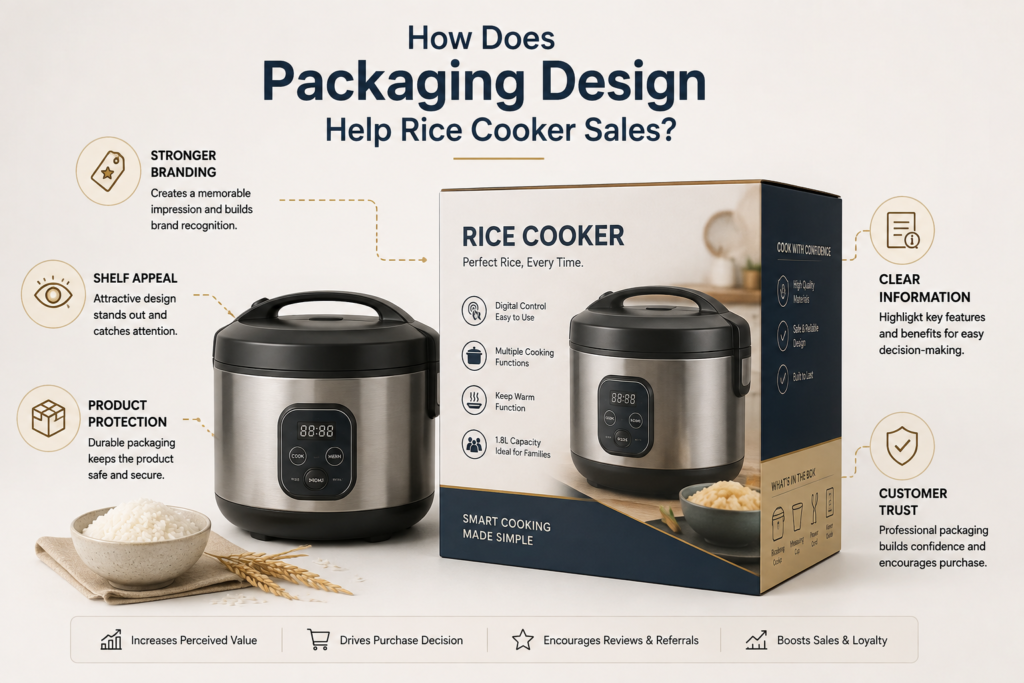
Good rice cooker packaging helps buyers understand the product faster, choose confidently, and receive the product safely. When packaging fits the target market and sales channel, importers reduce consumer confusion, weak shelf appeal, and delivery complaints. Poor packaging creates avoidable problems even when the rice cooker quality is excellent.
Packaging is not decoration. It is part of the product experience that starts before the consumer opens the box. When you source rice cookers for resale, your packaging choice affects how consumers understand your product, trust your brand, and rate their purchase experience.
Why Do Importers Often Underestimate Packaging Impact?
In packaging customization discussions with importers, buyers often focus first on cost. They compare the FOB price with packaging and without packaging, then ask if a cheaper carton option exists. This is normal commercial thinking. Every cost item affects margin.
Packaging cost should be judged against sales support and after-sales risk, not only unit price. A box that saves 0.30 USD but creates confusion, damage complaints, or slow shelf movement may cost much more in lost sales and customer service time.
We remind customers to consider target-market language and consumer understanding. A rice cooker is not a simple product. Consumers need to know capacity, power requirement, cooking functions, safety features, and whether it fits their cooking habits. If the packaging does not communicate these clearly in the local language and format, the consumer may choose a competitor product that feels easier to understand. Or they buy your product, then call customer service with basic questions that the packaging should have answered.
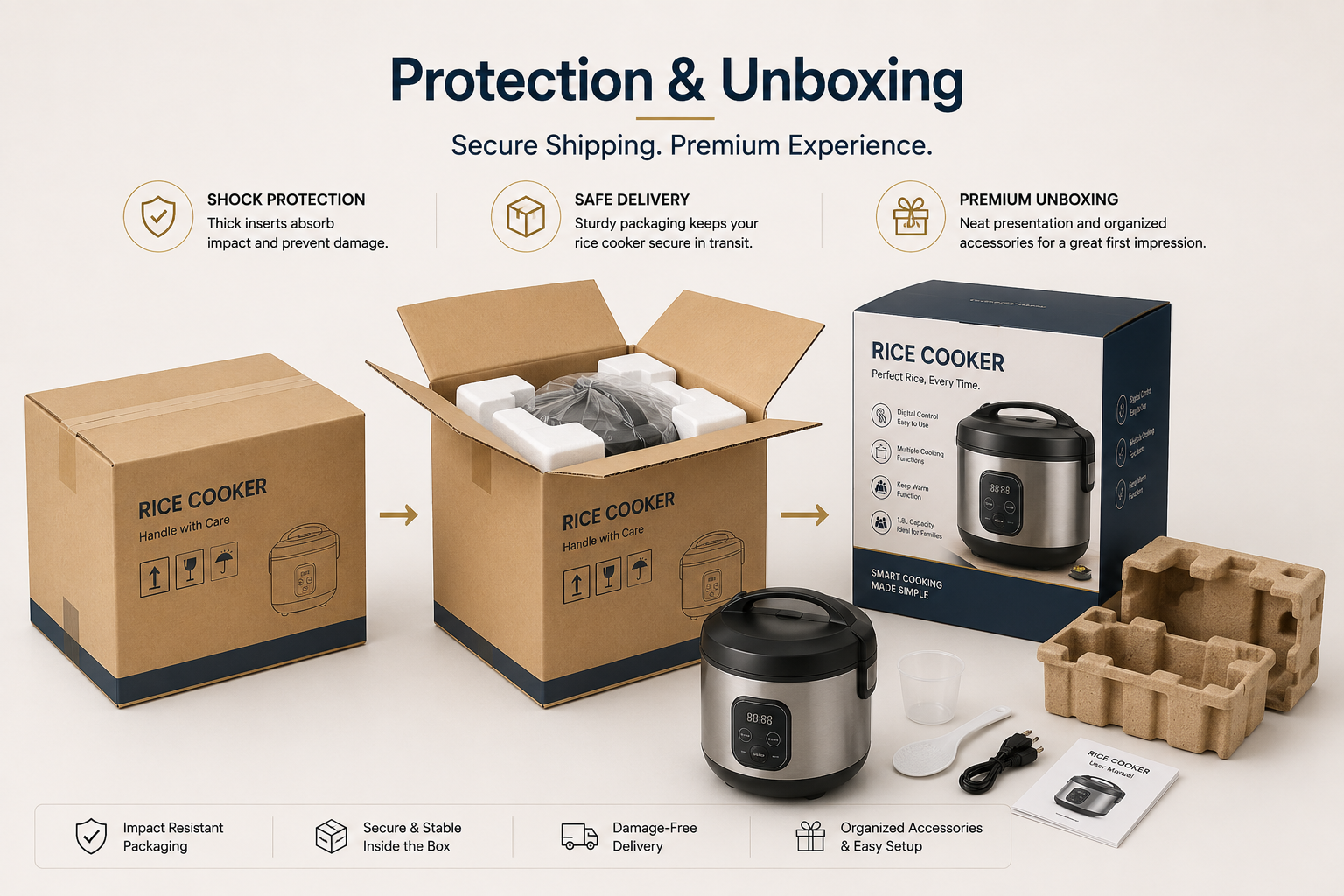
Packaging also affects delivery condition. Rice cookers have glass lids, inner pots, and electronic controls. Damage during shipping creates returns, refunds, and negative reviews. A carton that saves small money but allows movement and impact damage will hurt your reputation and profit. We have worked with importers who changed their mind about "cheapest carton" after receiving the first batch of customer complaints about broken lids and dented bodies. The replacement cost and lost trust were much higher than the packaging saving.
Another reason importers underestimate packaging is separation of sourcing and sales teams. The person negotiating with us may focus on factory price. The person selling to retailers or consumers later discovers packaging problems: wrong language, missing required labels, unclear product photos, weak structural protection. By then, the inventory is already shipped. Fixing packaging problems mid-campaign is expensive and slow.
Finally, many importers assume packaging is a standard item. They expect the factory to provide "normal rice cooker packaging" without specifying market needs. But normal packaging in one market may fail in another. A box designed for Middle East wholesale distribution does not work well for African e-commerce sales. Regional consumer habits, retail environments, and regulatory requirements differ. Good packaging starts with clear communication about where and how the product will be sold.
What Information Must Rice Cooker Packaging Communicate Clearly?
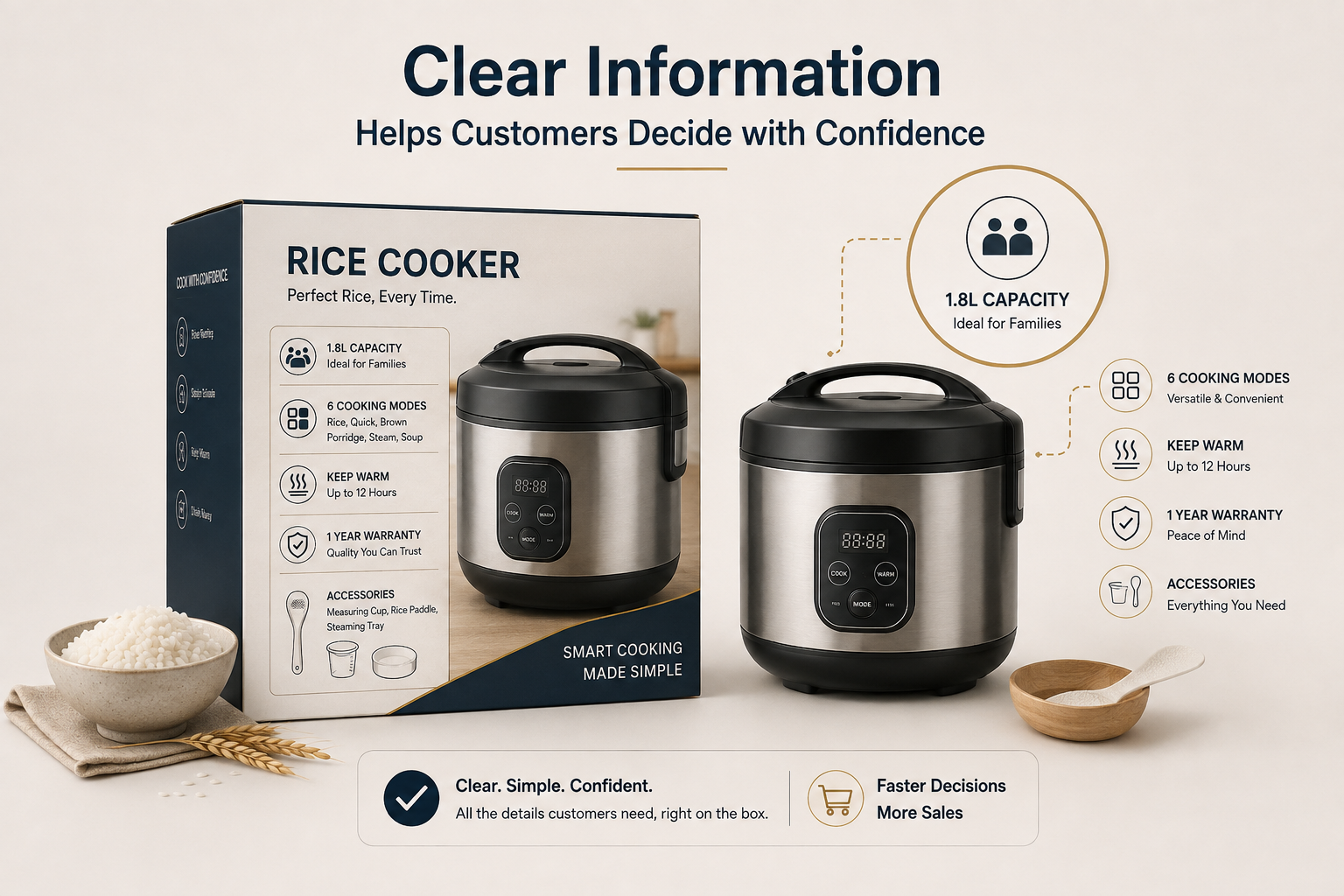
Rice cooker packaging must help the consumer understand the product quickly. In wholesale and retail channels, consumers compare multiple products in a short time. In e-commerce, they scroll through many listings. Clear packaging information reduces decision friction and increases purchase confidence.
Essential information includes capacity, key functions, suitable use cases, safety cues, and brand trust signals. All must be visible in the local buyer's language and match local buying habits. Missing or unclear information creates doubt, and doubt reduces sales.
Here is what consumers need to see and understand:
| Information Type | Why It Matters | Common Mistakes |
|---|---|---|
| Capacity | Consumers need to know if the cooker fits their family size. "3L" may not mean much; "serves 4-6 people" is clearer. | Using only liter measurement without portion guidance, or showing capacity in a different measurement system than the target market uses. |
| Key Functions | Consumers compare rice cookers by what they can cook. "Multi-function" is vague; "rice, porridge, soup, steam, cake" is specific. | Listing too many functions in small text, or using technical terms the average consumer does not understand. |
| Power and Voltage | Wrong voltage means the product cannot be used. This must be obvious before purchase. | Printing voltage information in small text on the bottom or side where it is hard to see during purchase decision. |
| Safety Certifications | Consumers in many markets check for safety marks before buying electrical products. Missing marks create doubt. | Forgetting to include local certification marks like UKCA, CE, or CB on the packaging, even when the product has the certification. |
| Brand Identity | Clear brand name and consistent visual identity build recognition and trust over time. | Using generic design that makes the product look like unbranded commodity, or changing packaging style too often. |
| Usage Scenarios | Photos or illustrations showing the rice cooker in use help consumers imagine it in their own kitchen. | Using factory photos with industrial background, or showing the product alone without context. |
Language choice is critical. We work with importers selling to Arabic-speaking markets, French-speaking African regions, and English-speaking Southeast Asia. The same rice cooker needs different packaging language for each market. Some importers try to save cost by using only English on packaging for non-English markets. This reduces consumer confidence. They wonder if the product is really meant for their market, or if instructions and support will be available in their language.
Local buying habits also matter. In some markets, consumers care very much about energy efficiency labels. In others, they look first for capacity and price. In some regions, consumers prefer packaging with detailed specification tables. In others, they respond better to simple visual communication. Good packaging design matches these habits. When we discuss customization with importers, we ask them to describe their typical customer and how that customer shops. This helps us suggest packaging layout and information hierarchy that fits the market.
Safety information deserves special attention. Rice cookers involve heat, electricity, and steam. Consumers need to see that the product is safe before they buy it. Certification marks should be visible on the main panel, not hidden on the bottom. Safety instructions should be clear and placed where the consumer will see them. Some importers want to maximize the space for marketing messages and minimize space for safety information. We remind them that unclear safety communication can create liability issues and damage brand reputation if any incident occurs.
Brand trust signals include not only the brand name and logo, but also origin information, quality promises, and contact details for customer support. Consumers in many markets have learned to distinguish between established brands and unknown products. If your packaging looks generic or provides no way to contact the brand, consumers may assume the product is low quality or has no after-sales support. Even if you are a new brand, clear contact information and quality language help build trust.
How Do Packaging Needs Differ Across Sales Channels?
Packaging requirements change significantly depending on whether you sell through wholesale distribution, retail stores, or e-commerce platforms. Using the same packaging for all channels creates problems. Each channel has different space, display, and delivery conditions.
Wholesale packaging should support easy product recognition and efficient distribution. Retail packaging needs stronger shelf communication. E-commerce packaging must also consider image presentation and delivery condition.
Let me explain each channel requirement in detail.
Wholesale Channel Packaging
Wholesale buyers purchase in quantity and resell to smaller retailers. They care about efficient handling, storage, and transportation. Packaging must protect the product during multiple handling steps and warehouse storage. Information needs are different from end-consumer retail.
Wholesale packaging should show model number, capacity, and key specifications clearly on the outer carton. Warehouse workers need to identify products quickly when filling orders. If they must open cartons to check which model is inside, handling time increases and carton condition deteriorates. We suggest printing model information on multiple sides of the carton, not just one end.
Carton stacking strength matters more in wholesale than in direct consumer sales. Products may be stored for weeks or months in warehouses before reaching retail. Weak cartons lead to crushed boxes and damaged products. The bottom units in a pallet stack carry significant weight. We test carton strength and suggest appropriate paper grade based on the expected distribution journey. Saving money on carton material often creates damage problems later.
Wholesale packaging should also consider retail unpacking. When the small retailer receives the carton, will they display the product in the original color box, or will they unpack and display the rice cooker itself? If they display the color box, the outer carton must protect the color box from scuffs and tears during wholesale handling. If they unpack the product, the color box becomes less critical but inner protection must be excellent so the product looks new when removed from packaging.
Some importers use plain brown cartons for wholesale and rely on color box quality for retail appeal. Others print carton graphics to match brand identity, so even the wholesale cartonage supports brand recognition. The right choice depends on your distribution model and brand strategy. We discuss this during customization planning.
Retail Store Packaging
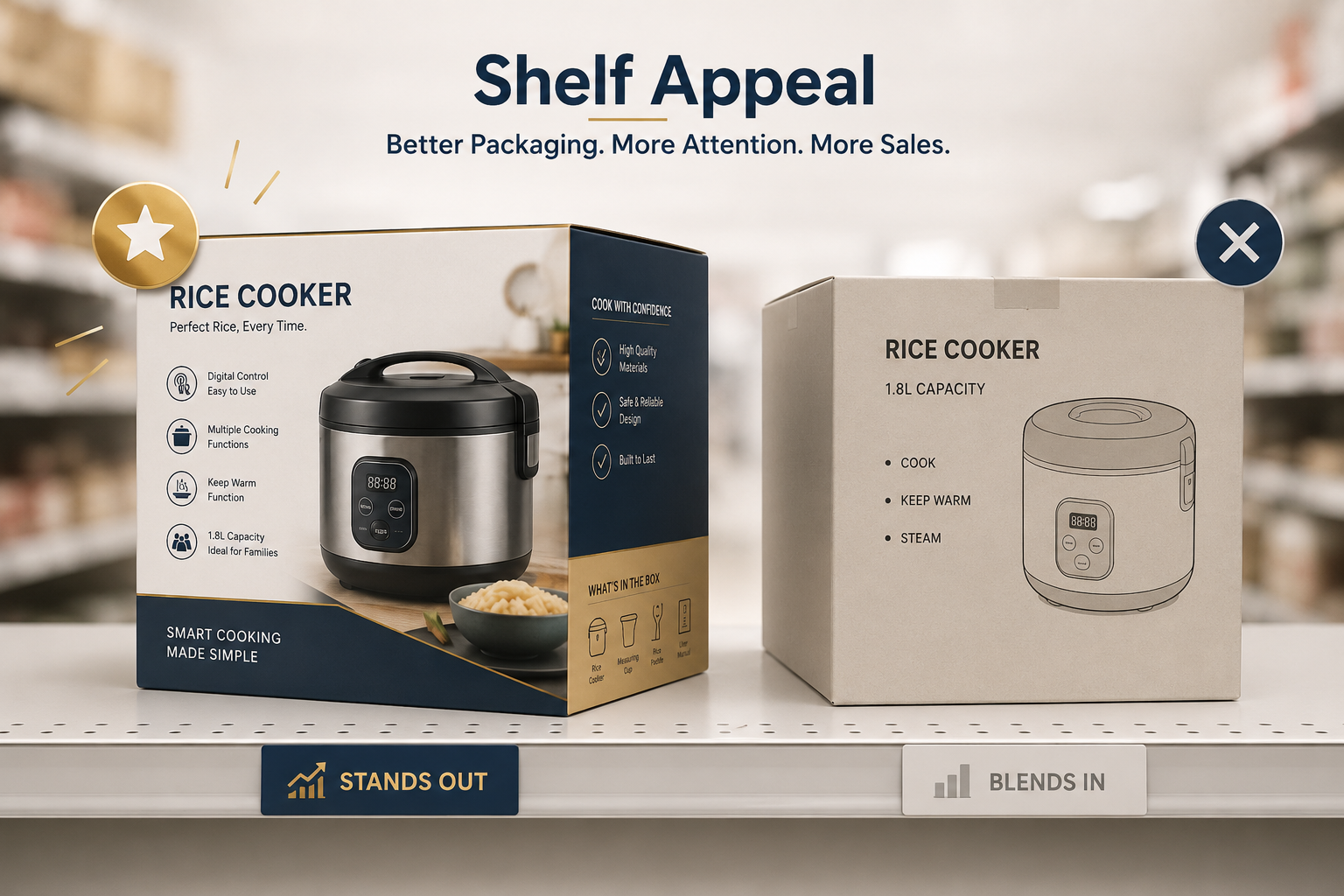
Retail packaging competes for attention on shelves. Consumers see multiple brands and models at the same time. Your packaging must communicate product benefits quickly and stand out visually without looking chaotic.
Shelf presence depends on box size, color scheme, and information layout. A box that is too small may be overlooked. A box that is too large wastes shelf space and may cause retailers to stock fewer units. We work with importers to optimize box dimensions so they fit standard shelf depths while providing good visibility.
Color choice affects retail performance. Different markets respond to different color associations. In some regions, red and gold suggest quality and celebration. In others, blue and white suggest trust and moderation. We do not have universal rules, but we encourage importers to research local color preferences and competitor packaging before finalizing design. What works in Middle East retail may not work in African retail.
Front panel layout should follow a clear hierarchy. The most important information should be visible from 2-3 meters away, the distance from which consumers first notice products on a shelf. This usually means capacity, key function, and brand name. Secondary information like certifications, technical specifications, and additional features can be smaller but must still be readable at purchase distance.
Retail packaging should also include comparison-friendly information. Consumers often pick up two boxes and compare them side by side. If your key selling points are hard to find or poorly explained, the consumer may choose the competitor product that communicates more clearly. We suggest organizing information in consistent locations across your product range, so consumers who know one product can easily understand another.
Some retailers require specific packaging features: hang holes for peg display, shelf-ready packaging that opens to become a display unit, or standardized carton sizes that fit their warehouse systems. If you know your target retail chain requirements, share these during OEM customization discussions. Adding features later requires new tooling and delay.
E-commerce Packaging
E-commerce packaging must work both as marketing material and shipping protection. Consumers first see your product as photos of the packaging. Then the packaging must protect the product during courier delivery. These are two different jobs.
For online images, packaging must photograph well. Colors should be clear and accurate in photos. Key information must be readable in product listing images, which are often viewed on mobile phone screens. Glossy finishes may create unwanted reflections in photos. Matte finishes often photograph better but may feel less premium in person. We discuss these tradeoffs with importers who focus on e-commerce sales.
E-commerce packaging faces rougher handling than retail packaging. Couriers drop boxes, stack them irregularly, and transport them in varied temperature and humidity conditions. Inner protection must prevent movement of the rice cooker, inner pot, and glass lid. We use molded pulp or foam separators to hold components firmly. Cheaper packaging may allow components to shift and strike each other during transport, causing chips, cracks, or scratches.
Unboxing experience matters in e-commerce. Customers often film or photograph unboxing. They share impressions on social media or review platforms. Packaging that looks premium and opens smoothly creates positive first impressions. Packaging that is difficult to open, messy with loose foam pieces, or looks cheaper than expected creates disappointment before the customer even tests the rice cooker.
Some e-commerce platforms have packaging requirements: maximum box dimensions, weight limits, or mandatory label formats. Amazon, for example, has detailed requirements for products enrolled in FBA (Fulfillment by Amazon). If you sell through such platforms, your packaging must meet their standards or you will face rejection, relabeling costs, and fulfillment delays. Share platform requirements with your OEM factory early in the design process.
E-commerce packaging should also consider return rates. If packaging is hard to open, customers may damage the box or product during unpacking. If they decide to return the product, damaged packaging reduces the likelihood of successful resale or refund approval. Some importers use dual-layer packaging: an outer shipper carton for delivery protection and an inner color box that remains pristine for potential returns.
Finally, e-commerce packaging must fit cost-effective shipping. Oversized boxes increase volumetric weight charges from couriers. Reducing box size by even a few centimeters can move the product into a lower shipping cost bracket. We help importers optimize packaging dimensions to protect the product while minimizing air space and shipping cost.
When Should Importers Discuss Packaging Requirements With OEM Factories?
Many importers treat packaging as a detail to finalize after product specifications and price are agreed. This creates problems. Packaging affects cost, production lead time, and market fit. Good packaging discussion should happen early in the sourcing process, ideally before the quotation is finalized.
A useful packaging discussion should start before quotation is finalized. Target market, sales channel, language, brand positioning, and packaging requirements should be provided together with product specifications.
Here is why early discussion matters and what information helps us provide accurate quotations and suitable recommendations.
Why Early Packaging Discussion Saves Time and Money
If you provide packaging requirements after confirming the product order, changes may require new tooling, design revisions, and production delays. Color box printing plates, carton dies, and foam molds all require tooling. If we prepare standard tooling and you later request changes for market fit, new tooling costs money and adds lead time.
Early discussion also allows us to suggest cost-effective solutions. For example, if you tell us your target market is price-sensitive wholesale and you need to minimize packaging cost, we can recommend efficient structural designs and printing methods from the start. If you tell us the product will be sold in premium retail, we can suggest finishes and materials that create appropriate shelf presence without overbuilding.
Some packaging features affect product specifications. If you need a specific carton size to fit shipping container utilization, we can adjust product accessories or inner tray design to achieve that box dimension. If you need a particular certification mark visible on packaging, we confirm that the product actually has that certification. Finding out late that the product lacks required certification wastes packaging design work and may delay the entire order.
Early packaging discussion also helps us schedule production properly. Custom printing and carton production have their own lead times. If we receive packaging requirements late, packaging may become the bottleneck that delays shipment even when the rice cookers are ready. When we know packaging needs from the start, we order materials and schedule printing to align with product assembly.
What Information Helps OEM Factories Design Suitable Packaging
When you contact us for a quotation, including packaging requirements in your initial inquiry helps us provide complete and accurate proposals. Here is what we need to know:
Target Market and Language: Which country or region will you sell to? What language should the packaging use? Are there any mandatory label requirements or safety mark placements required by local regulations? For example, rice cookers for the UK need UKCA marks visible on packaging. Products for Saudi Arabia need Arabic language information and specific compliance marks. Knowing this from the start ensures we design compliant packaging.
Sales Channel: Will you sell through wholesale, retail stores, e-commerce, or multiple channels? If multiple channels, which is the primary channel? This determines whether we optimize for warehouse handling, shelf impact, or courier delivery. It also affects the level of graphic design detail and finish quality we recommend.
Brand Identity: Do you have brand name, logo files, and color requirements? Will you provide complete design, or do you need us to suggest layout? Some importers have full brand guidelines and design teams. Others need our help to create professional-looking packaging from basic logo and color choices. Knowing your design capability helps us plan the right level of support and include any design service costs in the quotation.
Budget Range: What is your target packaging cost per unit? This helps us suggest materials and printing methods that fit your budget while still meeting market requirements. If you need very low cost, we can offer economical solutions like simple color printing and standard carton construction. If you can invest more, we can suggest premium finishes, custom structural designs, or enhanced protection features.
Order Quantity and Frequency: How many units will you order initially, and do you plan repeat orders? Packaging tooling costs can be amortized over larger quantities. If you order small quantities, tooling costs per unit will be higher. If you plan regular repeat orders, investing in better tooling quality makes sense because you will use it many times. This information helps us recommend the right balance between initial tooling investment and per-unit packaging cost.
Special Requirements: Do you need specific features like hang holes, window cutouts, multilingual printing, or special protective inserts? Do you have size restrictions from shipping containers or retail shelf standards? Any such requirements should be mentioned early so we can design accordingly and quote accurately.
When importers provide this information upfront, we can respond with detailed quotations that include suitable packaging solutions,