Worried about your rice cooker shipment being delayed? Inconsistent manuals and labels can cause customs or retail rejection. We can help you get it right before production starts.
Handling export manuals and labels for rice cookers is a key risk-control step. It involves ensuring consistency across the rating label, color box, and manual for details like model name, voltage, and importer information, far beyond simple translation. This prevents delays and rejections.
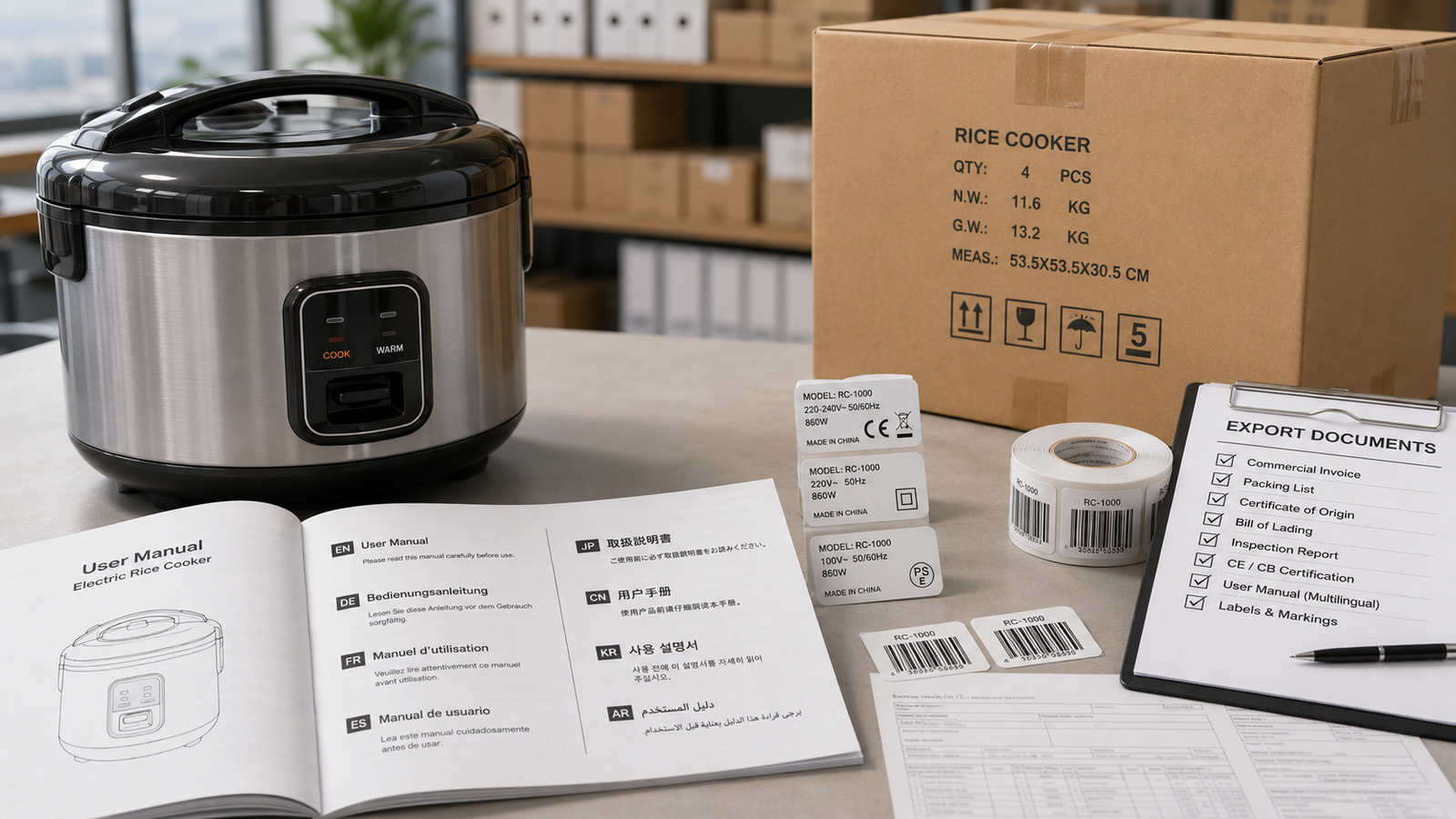
I've seen many buyers think this part is simple. They give us a logo and say "translate it." But over the years, I've learned that a little more work upfront saves a lot of headaches later. Let's break down what really needs to be done to avoid problems with customs, retailers, and your customers.
Do Importers Underestimate Manual and Label Requirements?
Think a simple translation and your logo are enough for your manual? This common mistake can lead to market entry barriers and unexpected costs when more is required.
Yes, importers often underestimate these requirements. Many markets demand more than a basic translation. They may need detailed safety warnings, local recipes, warranty cards1, and specific importer details. Preparing for this complexity early is crucial for a smooth launch.
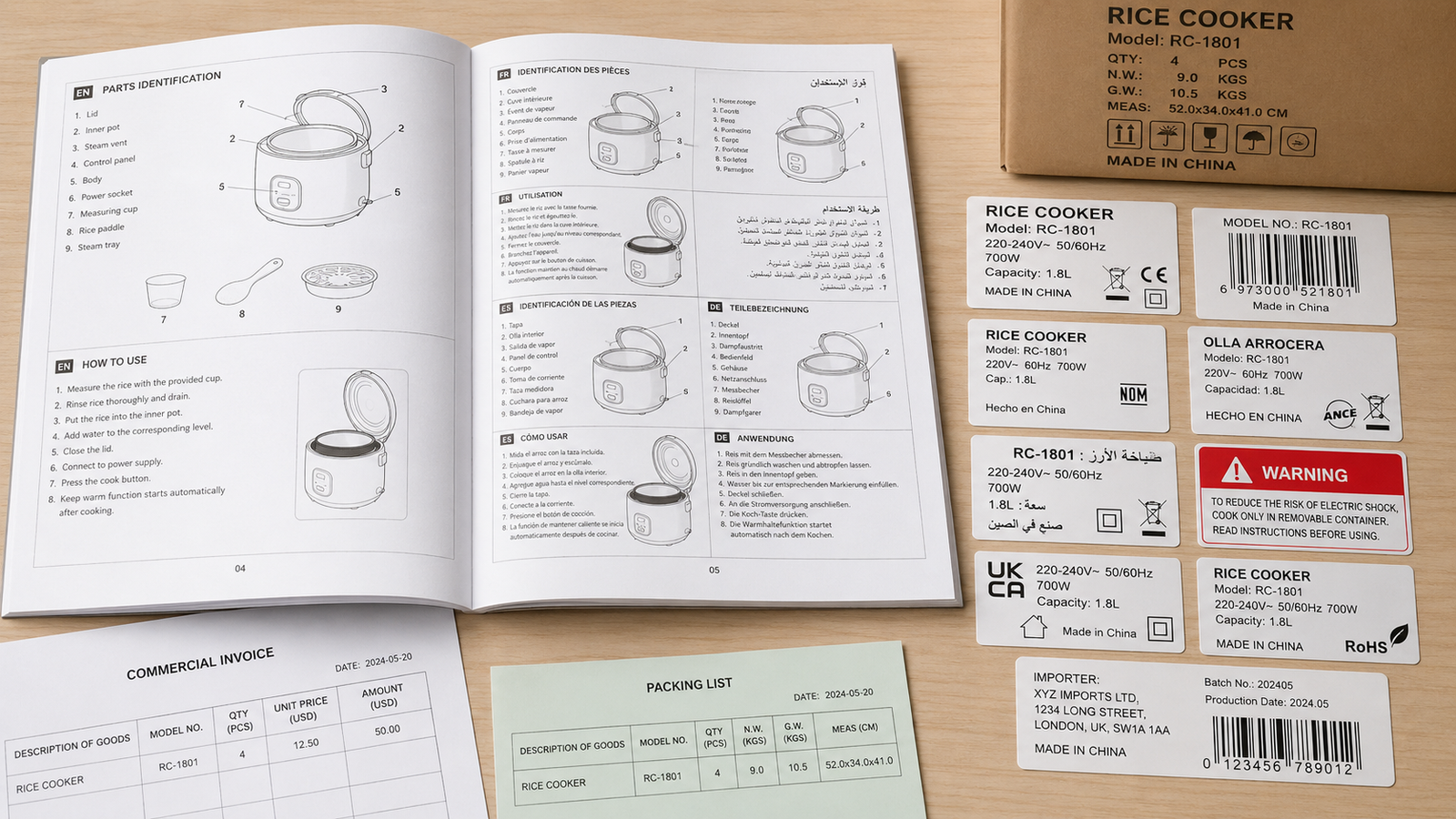
Based on my experience, many buyers assume the basics are enough. They believe that if they just tell us to put their logo on the product, translate the controls into the local language, add "Made in China," and paste on a certification mark, the job is done. In reality, this is just the starting point. These elements are necessary, but they are rarely sufficient for a successful market launch.
I remember a specific order for a European client. At first, they sent over just their brand logo and asked for a simple German translation of the basic functions. Weeks later, their legal team came back with a new request. Their local distributor required a 20-page manual. This manual needed five locally popular rice recipes2, detailed warranty information, and specific recycling symbols3. This change caused a delay while we sourced, wrote, and translated all this new content. It taught us a valuable lesson: always ask what the final retailer or end-market requires, not just what the importer thinks is needed. It’s about meeting consumer expectations and local retail standards.
What's the Biggest Risk with Product Documentation?
Ever had a small error cause a huge production delay? A tiny mismatch between your product label and packaging can halt your entire shipment, costing you time and money.
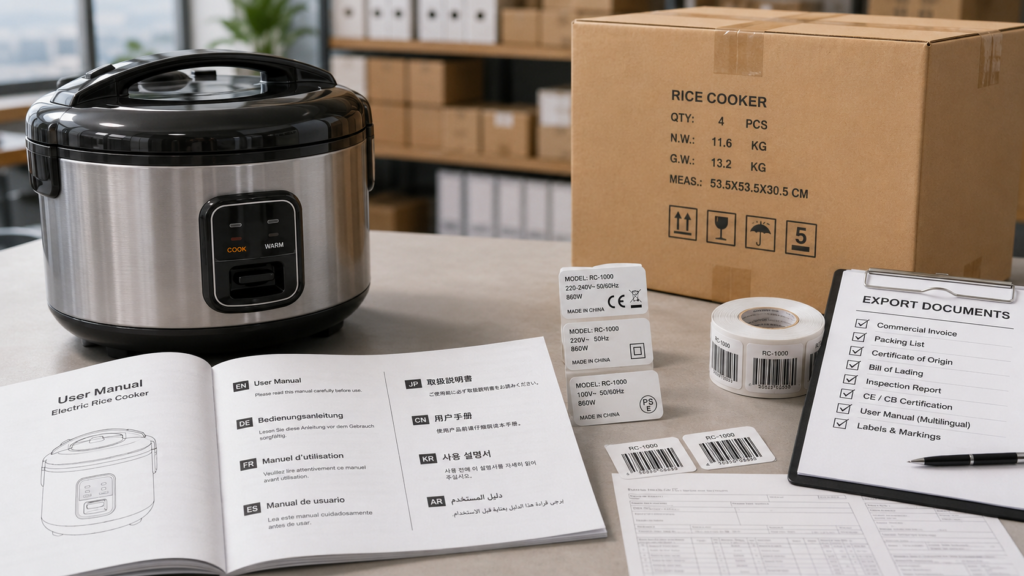
The biggest risk is inconsistency. Details like the model name, voltage, power rating, and importer address must be identical on the rating label, the color box, and in the user manual4. A mismatch can lead to customs holds, retailer rejection, or costly reprints5.
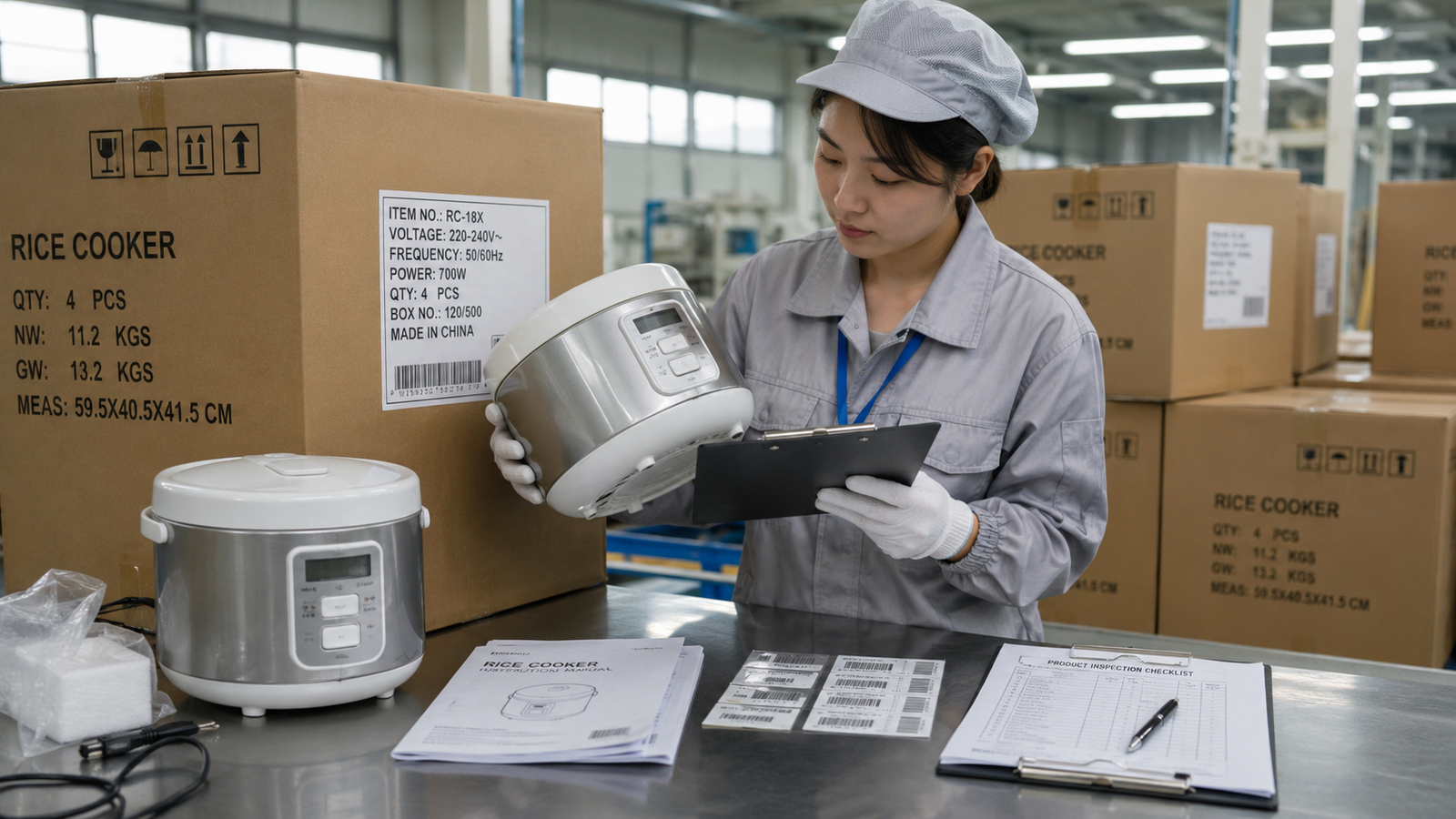
Every piece of documentation tells a story about your product. That story must be the same everywhere. Think about the journey of your product. A customs officer might pick up the rice cooker, look at the rating label on the bottom, and then compare that information to the details printed on the color box. A warehouse manager at a large retail chain might scan the barcode on the box to log the product into their system. A customer at home will look at the manual to find the model number for a warranty claim. If the information is different in any of these places, it creates problems. For example, if the color box says the cooker is 700W but the rating label on the unit says 650W, that single difference could be enough for an entire shipment to be flagged or rejected.
To prevent this, we use a simple but effective checklist before we print anything. We ask the client to review and approve every single detail across all materials.
| Item to Check | Rating Label | Color Box | User Manual |
|---|---|---|---|
| Model Name | ✔️ | ✔️ | ✔️ |
| Voltage/Frequency | ✔️ | ✔️ | ✔️ |
| Wattage | ✔️ | ✔️ | ✔️ |
| Brand/Trademark | ✔️ | ✔️ | ✔️ |
| Importer Details | Often Required | Often Required | Often Required |
| Country of Origin6 | ✔️ | ✔️ | ✔️ |
| Barcode (EAN/UPC7) | No | ✔️ | No |
Do Certifications Cover All Manual and Label Rules?
You have your CB or CE certification, so you think you're all set. But what if your packaging is still rejected? Certification marks are just one piece of the puzzle.
No, certifications do not automatically cover all manual and label requirements. A CE mark, for example, proves the product meets safety standards8, but it doesn't specify your manual's language, your importer details for the packaging, or channel-specific warnings. These must be confirmed separately.

Think of a CB, CE, or GS certificate as a passport for your product's technical safety9. It proves to authorities that the appliance is well-built and won't cause electrical hazards. It is a critical step for market access, and our factory is experienced in manufacturing products that meet these standards. We help our clients get the right documents for their target markets. However, this "passport" doesn't include the "visa" required by every specific retail store or country's packaging laws. The certification proves the product is safe, but it doesn't mean the packaging is commercially ready.
A certification body doesn't care about your brand name, your color box design, or if you included a recipe for Jollof rice10. But your West African distributor certainly does. The certification process checks for mandatory technical safety warnings in the manual, but it won't tell you that Amazon requires a specific type of barcode label for their warehouses11. It won't tell you that a French retailer requires the full legal name and address of the importer to be printed clearly on the box12. These are commercial and local regulatory requirements that you must get from your buyer, distributor, or sales channel.
What Information Should Buyers Provide Early?
Tired of last-minute production scrambles? Missing key information at the start is a common cause of delays. Providing the right details upfront ensures a smooth process from day one.
Buyers should provide key information before production begins. This includes the target country, sales channel (retail vs. online), brand and model names, full importer details, barcode numbers, and any specific requirements for manuals, recipes, or warranty cards. Early clarity prevents costly changes.
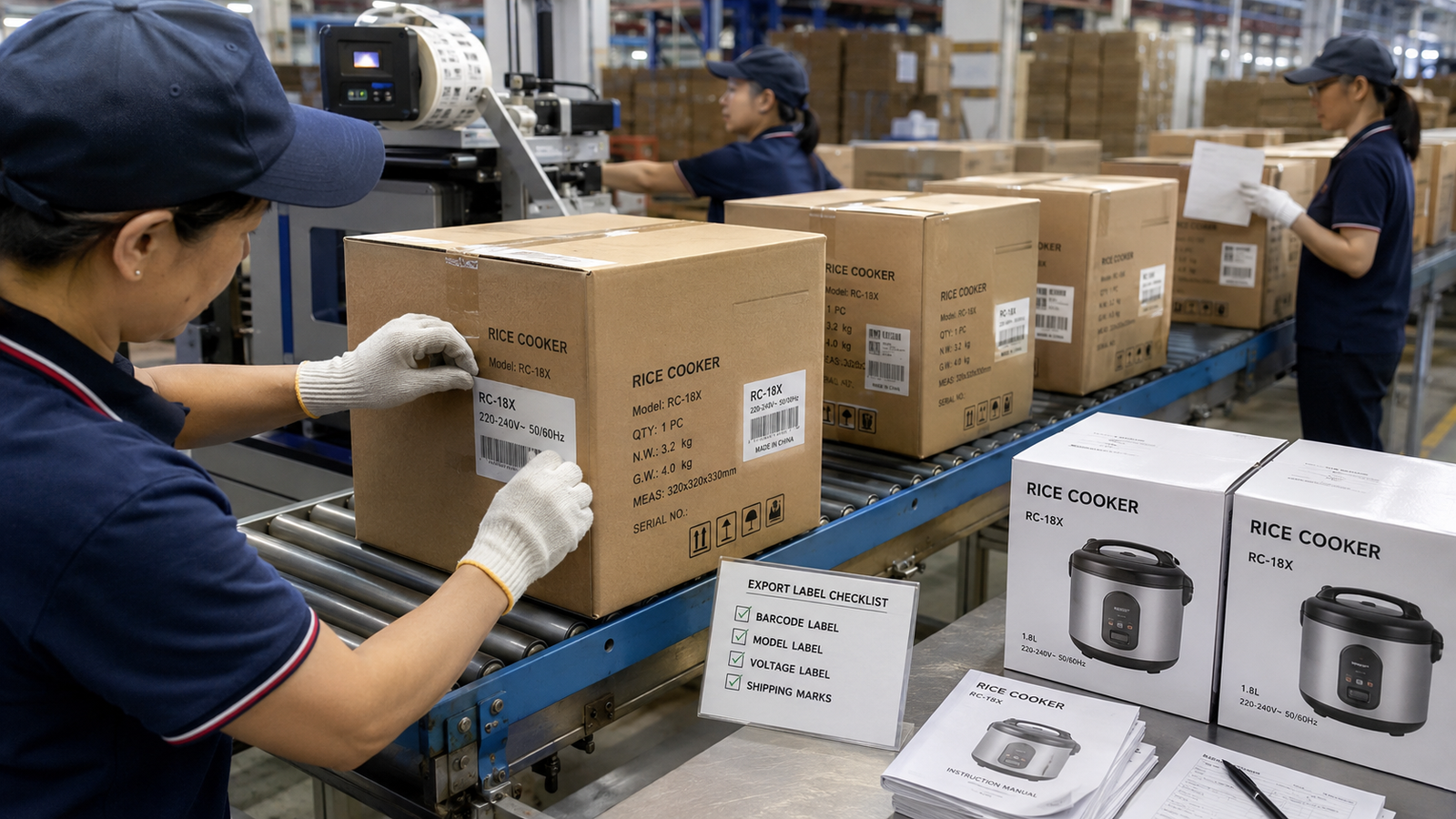
The best projects I have worked on always start with a clear "documentation brief" from the buyer. This doesn't need to be a complicated, formal document. It is just a list of the essential information we need to do our job correctly. When we have this information, we can plan production properly and avoid stopping the assembly line to ask a question. I see it as a shared responsibility. We bring our manufacturing expertise, and the buyer brings their specific market knowledge. When we combine these two things early, the project runs smoothly. It helps us make sure that the product you receive is exactly what your market expects, right down to the fine print on the warranty card.
To make this easy, we guide our partners to confirm these key points as early as possible:
- Target Market: Which country or countries will you sell in?
- Sales Channel: Is this for online platforms, supermarkets, or small independent shops?
- Branding: What is the final brand and model name to be printed?
- Importer Info: Who is the legal importer? We need their official name and address for the packaging.
- Packaging Files: Do you have a barcode (EAN/UPC), final artwork, or a layout design?
- Manual Content: Do you need special languages, local recipes, or specific warranty text?
This upfront communication is the single best way to guarantee an on-time shipment.
Conclusion
Getting your rice cooker manuals and labels right is a team effort. Clear communication before production ensures your product is ready for market without any costly delays or surprises.
"Businessperson's Guide to Federal Warranty Law", https://www.ftc.gov/business-guidance/resources/businesspersons-guide-federal-warranty-law. In the United States, the Magnuson-Moss Warranty Act (15 U.S.C. §§ 2301–2312) governs written warranties on consumer products, requiring that warranty terms be made available prior to purchase and meet specific disclosure standards; in the EU, Directive 2019/771 on the sale of goods establishes minimum statutory guarantee rights and regulates commercial guarantee disclosures. Evidence role: mechanism; source type: government. Supports: That consumer protection legislation in major markets imposes requirements on the form and content of warranties provided with consumer goods.. Scope note: Warranty card requirements vary substantially by jurisdiction; the article's reference to warranty cards as a documentation element is accurate in general terms, but the specific legal obligations differ by destination market. ↩
"consumer perception of three smart cooking devices in the EU - PMC", https://pmc.ncbi.nlm.nih.gov/articles/PMC10521106/. Retail buyer specifications and distributor agreements for small kitchen appliances frequently include content requirements for accompanying manuals beyond minimum regulatory obligations, such as locally relevant recipes or usage tips, as documented in trade and consumer product compliance literature; these requirements are channel-specific and not governed by a single standard. Evidence role: general_support; source type: other. Supports: That distributors and retailers in specific markets may require appliance manuals to include locally relevant content such as recipes as a condition of listing.. Scope note: This claim is based on anecdotal industry experience as described in the article; no published study or regulatory document specifically mandates recipe inclusion in rice cooker manuals for European markets. ↩
"EU - Labeling/Marking Requirements", https://www.trade.gov/country-commercial-guides/eu-labelingmarking-requirements. Directive 2012/19/EU on waste electrical and electronic equipment (WEEE) requires that electrical and electronic equipment placed on the EU market be marked with the crossed-out wheeled bin symbol, indicating that the product must not be disposed of as unsorted municipal waste; this marking obligation applies to the product or its packaging. Evidence role: mechanism; source type: government. Supports: That EU law requires electrical and electronic equipment sold in Europe to bear the crossed-out wheeled bin symbol indicating separate collection obligations under the WEEE Directive.. ↩
"Specific Guidelines: ENERGY STAR Recognition Marks", https://www.energystar.gov/partner-resources/brand-guidelines/recognition-marks. IEC 60335-1, the international standard for safety of household and similar electrical appliances, specifies mandatory marking requirements including rated voltage, rated power input, and other electrical parameters that must be legibly and durably marked on the appliance; consistency with accompanying documentation is expected for regulatory compliance. Evidence role: mechanism; source type: institution. Supports: That international standards for household electrical appliances specify mandatory information, including rated voltage and power, that must appear on the appliance's rating plate.. Scope note: The standard governs markings on the appliance itself; requirements for identical reproduction across color box and manual may additionally derive from national regulations or retailer specifications not covered by IEC 60335-1 alone. ↩
"I ordered goods from abroad, but the seller said they are being held ...", https://www.help.cbp.gov/s/article/Article-1171. Customs authorities in major import markets, including U.S. Customs and Border Protection, identify incorrect or inconsistent product labeling as a basis for detaining or refusing entry to imported goods; see CBP guidance on marking and labeling requirements for imported merchandise. Evidence role: mechanism; source type: government. Supports: That labeling and documentation errors are recognized grounds for customs holds or refusal of entry for imported consumer goods.. Scope note: Government guidance describes the regulatory basis for holds but does not provide aggregate statistics on how frequently rice cooker or small appliance shipments are affected specifically. ↩
"19 CFR Part 134 -- Country of Origin Marking - eCFR", https://www.ecfr.gov/current/title-19/chapter-I/part-134. In the United States, 19 U.S.C. § 1304 and implementing regulations at 19 C.F.R. Part 134 require that every article of foreign origin imported into the U.S. be marked with its country of origin in a conspicuous place; similar requirements exist under EU customs law and the laws of other major import markets. Evidence role: mechanism; source type: government. Supports: That customs regulations in major import markets require imported goods to be marked with their country of origin.. Scope note: Specific marking requirements, including placement and permanence, vary by country and product category; the article's general statement is accurate but the applicable rule differs by destination market. ↩
"EAN Numbers and UPCs: What is the Difference? | GS1 US", https://www.gs1us.org/upcs-barcodes-prefixes/ean-vs-upc. GS1, the international standards organization for supply chain identification, administers the EAN-13 and UPC-A barcode standards, which are the predominant formats used for retail point-of-sale scanning and inventory management globally; assignment of a valid GS1 company prefix is required to generate compliant barcodes. Evidence role: definition; source type: institution. Supports: That EAN (European Article Number) and UPC (Universal Product Code) are globally standardized barcode formats administered by GS1 and used for retail product identification.. ↩
"CE marking - Wikipedia", https://en.wikipedia.org/wiki/CE_marking. According to the European Commission, CE marking signifies that a product conforms to EU legislation and meets applicable safety, health, and environmental requirements, enabling free movement of goods within the EEA; see European Commission, 'CE marking,' Internal Market, Industry, Entrepreneurship and SMEs. Evidence role: definition; source type: government. Supports: That CE marking indicates conformity with applicable EU health, safety, and environmental protection legislation for products sold in the European Economic Area.. ↩
"Geprüfte Sicherheit - Wikipedia", https://en.wikipedia.org/wiki/Gepr%C3%BCfte_Sicherheit. The IECEE CB Scheme, administered by the IEC System of Conformity Assessment Schemes, facilitates mutual recognition of safety test results across participating national certification bodies; the GS mark is a voluntary German safety certification under the Product Safety Act (ProdSG), distinct in scope and jurisdiction from both the CB Scheme and EU CE marking. Evidence role: definition; source type: institution. Supports: That the CB Scheme is an international system for mutual acceptance of test results for electrical and electronic equipment, distinct from CE marking and the German GS mark.. Scope note: The three schemes differ substantially in geographic scope and legal status; grouping them as equivalent may oversimplify their distinct regulatory roles. ↩
"Report Name:2025 Rice Supplementary Annual Update for ...", https://apps.fas.usda.gov/newgainapi/api/Report/DownloadReportByFileName?fileName=2025%20Rice%20Supplementary%20Annual%20Update%20for%20West%20Africa_Dakar_Senegal_SG2025-0011. Rice is a major staple crop and dietary component across West Africa, with the region being one of the largest rice-consuming areas in sub-Saharan Africa according to FAO food balance data; this cultural significance supports the commercial rationale for including locally relevant rice recipes in appliance documentation targeting West African consumers. Evidence role: general_support; source type: research. Supports: That rice is a staple food in West Africa, making locally relevant rice preparation content a plausible and commercially meaningful addition to appliance documentation for that market.. Scope note: No published standard or regulation mandates Jollof rice recipe inclusion in appliance manuals; the claim reflects a commercial best practice rather than a regulatory requirement, and the article presents it as an illustrative example rather than a universal rule. ↩
"FBA barcode requirements - Amazon Seller Central", https://sellercentral.amazon.com/help/hub/reference/external/G201100910?locale=en-US. Amazon's Seller Central documentation specifies that products sent to Fulfillment by Amazon (FBA) warehouses must carry an Amazon barcode (FNSKU) or a manufacturer barcode, with detailed requirements for label placement, size, and format; non-compliant labeling can result in shipment rejection at the fulfillment center. Evidence role: case_reference; source type: other. Supports: That Amazon requires sellers using its fulfillment network to apply specific barcode labels, such as FNSKU labels, to products before they are accepted into fulfillment centers.. Scope note: Amazon's requirements are subject to change and vary by product category and seller account type; the article's characterization is directionally accurate but may not reflect current or complete specifications. ↩
"EU - Labeling/Marking Requirements", https://www.trade.gov/country-commercial-guides/eu-labelingmarking-requirements. EU Regulation (EC) No 765/2008 and sector-specific directives, including the Low Voltage Directive 2014/35/EU, require that the name and registered address of the importer be indicated on the product or its packaging for goods placed on the EU market; this requirement applies across member states including France. Evidence role: mechanism; source type: government. Supports: That EU regulations require the name and address of the importer to be indicated on consumer products or their packaging sold within the EU.. Scope note: Specific formatting or placement requirements may vary by product category and applicable directive; the article's reference to French retailers may conflate national retail practice with the underlying EU regulatory obligation. ↩