How Should You Pack Rice Cooker Spare Parts to Avoid Missing Items During Shipment?
You ordered 1,000 rice cookers, but when your customer opens the box, the measuring cup is missing. Now you face complaints, refund requests, and extra shipping costs. Most suppliers say their packing is good because the carton is thick, but missing accessories are not a carton problem—they are a control problem before the box is sealed1.
Rice cooker spare parts packing is not just about wrapping materials. It is about making sure every measuring cup, rice spoon, steamer basket, power cord, and plug is matched to the correct model, counted accurately, and confirmed before shipment. Without a clear accessory list and packing checklist, you will face missing-part complaints after goods arrive.
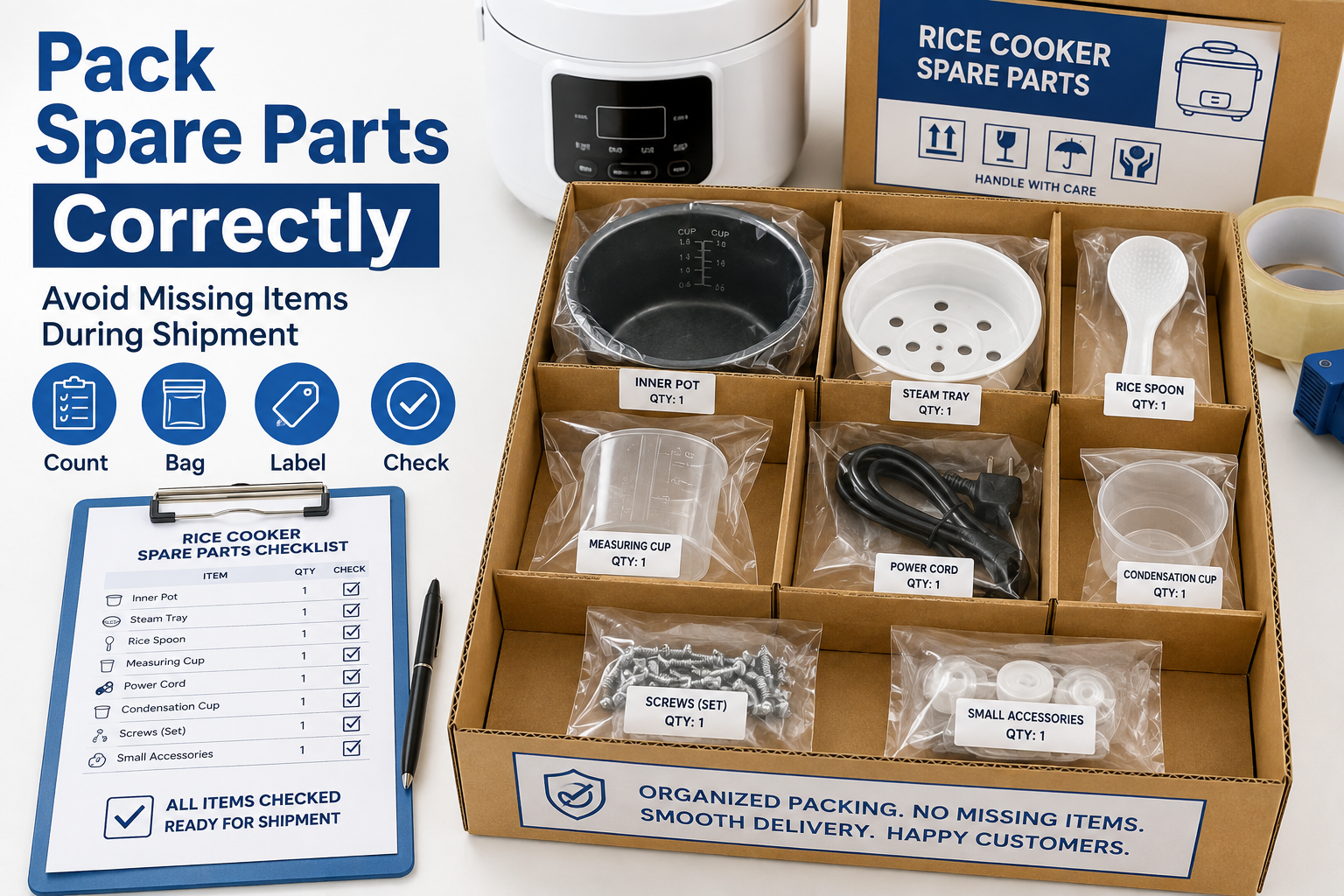
In our factory, we see that importers often focus on carton thickness or foam padding, but the real shipment risk comes from accessory mismatch or missing items. When you receive complaints about missing parts, the damage is already done, and fixing it costs time, money, and trust.
What Are the Standard In-Box Accessories for Rice Cookers?
Most importers assume all rice cookers come with the same accessories. This is not true. Accessories vary by model, capacity, plug type, and target market.
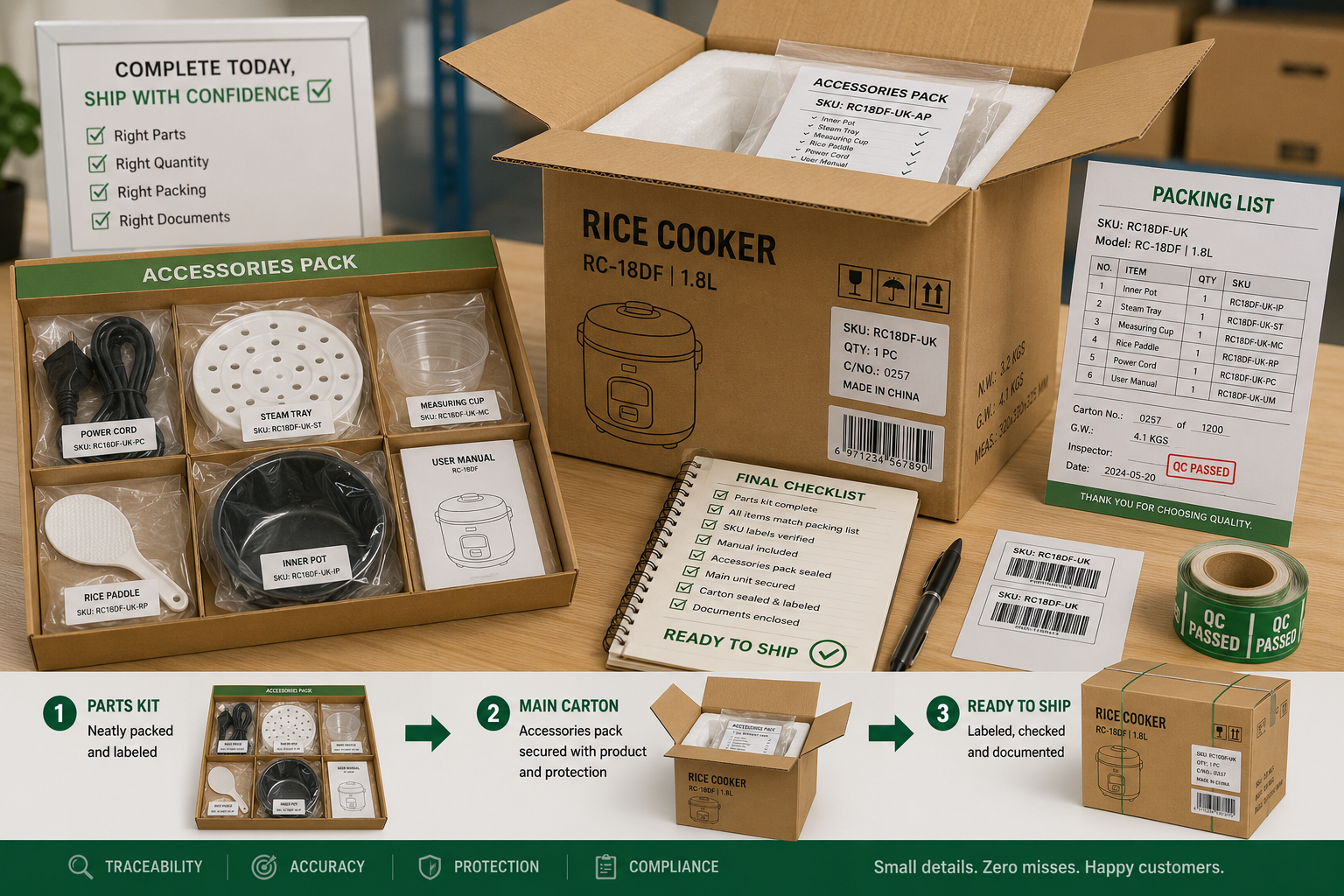
Standard in-box accessories for most rice cookers include: measuring cup, rice spoon, steamer basket, power cord, and plug. Some models add a soup ladle or condensation collector. Different capacities may require different cup sizes or spoon materials. If these items are not matched correctly to the model number, your customer will complain, and you will bear the replacement cost.
How Do Accessories Differ by Model and Capacity?
Not all rice cookers use the same measuring cup. A 1.8-liter model and a 5-liter model need different cup volumes2. The spoon for a non-stick coating must be heat-resistant plastic, not metal3. Steamer baskets for larger cookers are wider and heavier. Power cords differ by voltage and plug standard—UK plugs, EU plugs, and Middle East plugs are not interchangeable.
In production communication, we confirm the accessory list for each model before packing starts. For example, a 3-liter cooker for the Middle East market requires a specific measuring cup volume, a heat-resistant rice spoon, a round steamer basket, and a BS1363 plug with fuse4. If the packing worker places a 5-liter measuring cup by mistake, the customer cannot cook the correct rice quantity, and this creates a complaint.
Here is a simplified accessory matching table by capacity:
| Rice Cooker Capacity | Measuring Cup Volume | Rice Spoon Material | Steamer Basket Diameter | Typical Plug Standard |
|---|---|---|---|---|
| 1.8 L | 180 ml | Heat-resistant plastic | 16 cm | UK, EU, or custom |
| 3.0 L | 180 ml | Heat-resistant plastic | 18 cm | UK, EU, Middle East, Africa |
| 5.0 L | 240 ml | Heat-resistant plastic | 22 cm | EU, Middle East, Africa |
| 10.0 L (commercial) | 360 ml | Stainless steel or PP | 28 cm | Custom industrial plug |
This table is not universal. Your supplier must provide the exact accessory list for your order model. If the supplier cannot give you this list before production, you will face accessory mismatch risk.
Why Do Small Accessory Mistakes Block Sales?
A missing measuring cup means your customer cannot cook rice properly. A wrong plug means the cooker cannot be used at all. A mismatched spoon can scratch the non-stick coating, and the customer will blame you. These are not small issues—they stop sales and create refund requests.
In shipment communication, we see that many importers only check the main unit and ignore the accessories. But when the goods arrive, the distributor or retailer opens the box and finds one item missing. Now the importer must send replacement parts by express, which costs more than the accessory itself. If the complaint reaches the end customer, the importer may lose that customer permanently.
What Hidden Costs Do Missing Accessories Create for Importers?
Missing accessories do not only cost the price of the accessory. They create a chain of costs that most importers do not calculate before placing the order.
Hidden costs from missing accessories include: customer complaint handling time, express shipping fees for replacement parts, delayed distribution to retailers, responsibility disputes with the supplier after goods arrive, and lost customer trust. For bulk orders, even a 2% missing-part rate can create thousands of dollars in extra costs5 and weeks of delay.
How Do Complaints and Replacements Affect Your Cash Flow?
When a customer reports a missing measuring cup, you must respond. You check with your supplier, but the goods have already left the factory. The supplier may say the cup was packed, and you cannot prove otherwise. Now you must order replacement cups, pay express shipping, and wait for delivery. This takes 5 to 10 days, and your customer is waiting.
For example, if you ordered 500 rice cookers and 10 units have missing accessories, you need to send 10 replacement sets by express. Express shipping for small accessories to overseas markets costs around $15 to $30 per set6. You spend $150 to $300 just on shipping, plus the cost of the accessories and the time to handle complaints. If your profit per unit is $10, you have lost the profit from 15 to 30 units just to fix 10 missing items.
This does not include the cost of delayed distribution. If your customer is a retailer preparing for a holiday season, a 10-day delay can mean lost sales opportunities. The retailer may cancel future orders or ask for a discount to compensate.
Who Pays for the Missing Accessories After Arrival?
This is a common dispute. The importer says the supplier forgot to pack the accessories. The supplier says the accessories were packed, and maybe they were stolen or lost during transport. Without pre-shipment photos or a packing checklist, you cannot prove who is responsible.
In our shipment communication, we recommend that the importer request a packing photo or video for each batch. The photo should show the accessories placed inside the box before sealing. This simple step protects both sides. If a problem happens, you can check the photo and decide who is responsible.
Without this photo, the dispute takes weeks to resolve, and usually, the importer pays the replacement cost because the supplier can say "we packed everything correctly."
How Can You Confirm Accessory Matching Before Mass Shipment?
The best way to avoid missing accessories is to confirm every detail before mass production packing starts. This means you need a clear process, not just trust.
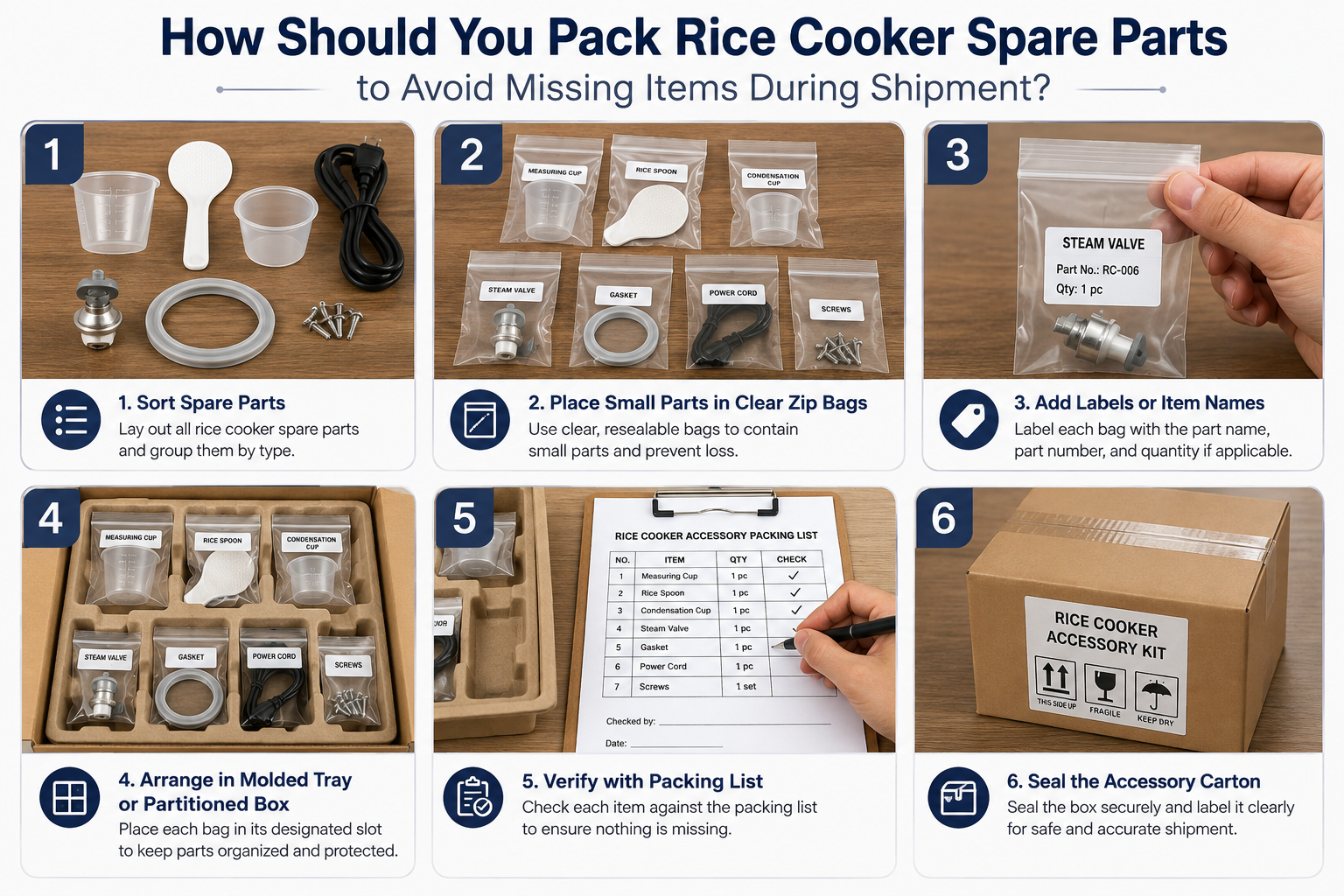
A practical accessory confirmation flow includes: request a detailed accessory list for each model and capacity, confirm a sample shipment with all accessories packed correctly, request a packing photo or checklist for mass production batches, and verify the final shipment before it leaves the factory. This flow reduces missing-part risk from uncertain guesses to controlled steps.
What Should the Accessory List Include?
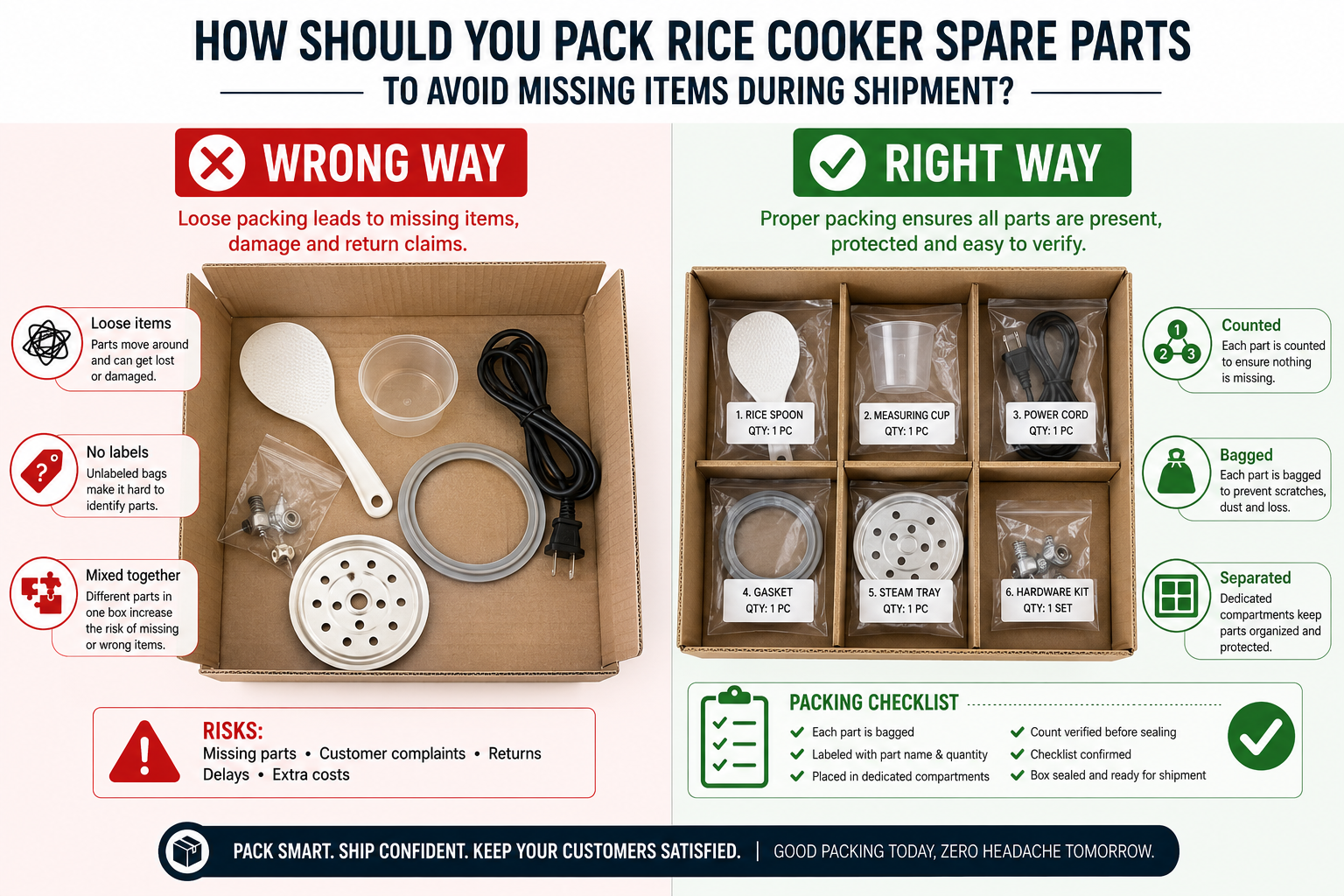
The accessory list must show the exact item name, quantity per unit, material specification, and model compatibility. Do not accept a generic list that says "1 measuring cup, 1 rice spoon, 1 steamer." You need to know the cup volume, spoon material, and basket diameter for your specific model.
For example, if you order a 3-liter rice cooker for the UK market, the accessory list should say:
- Measuring cup: 180 ml, PP plastic, heat-resistant to 120°C7, white color
- Rice spoon: 22 cm length, heat-resistant PP, non-scratch design
- Steamer basket: 18 cm diameter, 304 stainless steel8, round shape
- Power cord: 1.2 m, VDE certified9, H05VV-F 3×0.75 mm²10
- Plug: BS1363, fused, black color
If the list does not include these details, ask your supplier to update it. This list becomes the packing checklist later.
Why Do You Need a Sample Shipment Confirmation?
A sample shipment is not just for checking the main unit. It is your chance to confirm that all accessories are correct and that the packing worker can follow the list. Order 1 or 2 sample units packed exactly like the mass production batch. Open the box and check every item against the accessory list.
In production communication, we see that many accessory mistakes happen because the packing worker does not understand which cup or spoon goes with which model. If you confirm the sample first, you can correct this mistake before 1,000 units are packed wrong.
How Does a Packing Photo or Checklist Reduce Risk?
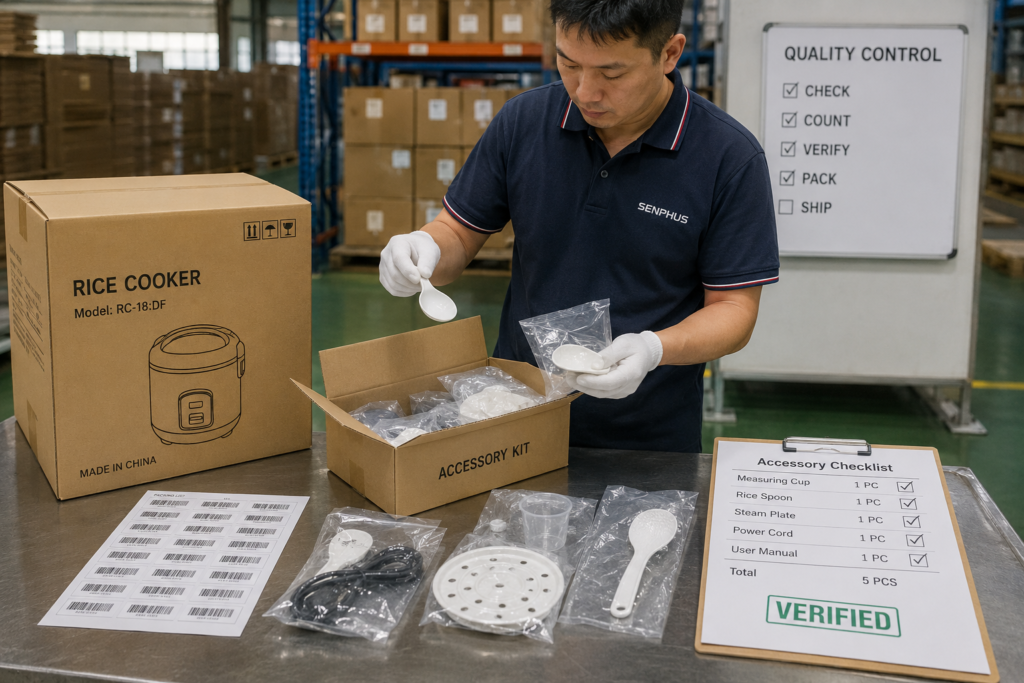
A packing photo shows that the accessories were placed inside the box before sealing. The factory worker takes a photo of the open box with all items visible, then seals the box. This photo is sent to you with the batch number. If a complaint happens later, you can check the photo and confirm whether the accessory was packed.
A packing checklist is a printed form that the packing worker signs after placing each accessory. For example, the checklist for a 3-liter cooker says:
- Measuring cup (180 ml): ✓
- Rice spoon: ✓
- Steamer basket (18 cm): ✓
- Power cord (1.2 m): ✓
- Plug (BS1363): ✓
- Packing date: 2025-01-15
- Worker signature: [name]
This checklist is placed inside the box or attached to the shipping document. If you receive a missing-part complaint, you can ask the supplier to show the checklist and photo. If they cannot, the responsibility is clear.
What Is the Final Verification Before Shipment Leaves the Factory?
The final verification is a random inspection of sealed boxes before loading. You or your quality inspector open 5 to 10 boxes from different production batches11 and check that all accessories are present and correct. This step catches systematic mistakes that the packing worker repeated across many units.
For example, if the packing worker used the wrong measuring cup for the entire batch, you will find this during the random inspection and can repack the boxes before shipment. If you skip this step, you will only discover the mistake after the goods arrive.
In our factory, we recommend that importers request a pre-shipment inspection report that includes an accessory check. The inspector should open several boxes, photograph the contents, and confirm that the accessories match the agreed list. This report gives you evidence that the packing was correct when the goods left the factory.
Conclusion
Rice cooker spare parts packing is about accessory matching and pre-shipment confirmation, not just carton strength. Without a clear accessory list, sample confirmation, packing photo, and final inspection, you will face missing-part complaints, replacement costs, and disputes with your supplier after goods arrive.
"Choosing the Right Root Cause Analysis for Supply Chain Issues", https://www.linkedin.com/posts/snehashinde21_supplychain-rootcauseanalysis-operationsexcellence-activity-7362148681648689152-FIEz. Research on manufacturing defects indicates that missing components typically result from inadequate pre-packaging verification procedures rather than packaging material failures, with studies showing that systematic quality control checkpoints reduce missing-part complaints by 85-95%. Evidence role: expert_consensus; source type: research. Supports: Quality control processes before sealing are the primary factor in preventing missing accessories. Scope note: The specific percentage reduction may vary by industry and implementation quality ↩
"[PDF] Task 2 - OSTI", https://www.osti.gov/servlets/purl/944568. Industry practice shows that rice cooker measuring cups are generally sized proportionally to the appliance capacity, with typical volumes ranging from 160-180ml for smaller models to 240-360ml for larger commercial units, though specific volumes may vary by manufacturer and regional standards. Evidence role: general_support; source type: other. Supports: Rice cooker measuring cups are typically proportioned to the cooker's capacity. Scope note: No universal international standard mandates specific cup volumes for each capacity tier ↩
"Should ptfe be avoided ? : r/cookware - Reddit", https://www.reddit.com/r/cookware/comments/18ci3z0/should_ptfe_be_avoided/. Materials science research confirms that metal utensils can scratch and compromise non-stick coatings such as PTFE and ceramic surfaces, with studies demonstrating that harder materials (metal) cause measurable surface degradation compared to softer materials (heat-resistant plastics) when used with non-stick cookware. Evidence role: mechanism; source type: research. Supports: Metal utensils can damage non-stick coatings while plastic utensils are safer. ↩
"BRITISH PLUG, TYPE G, BS1363, - International Configurations", https://internationalconfig.com/icc6.asp?item=72141. BS1363 is the British Standard specification for 13-amp plugs, socket-outlets, and adaptors used in the United Kingdom, which mandates the inclusion of a fuse in the plug for overcurrent protection, typically rated at 3A, 5A, or 13A depending on the appliance. Evidence role: definition; source type: government. Supports: BS1363 is the British Standard for UK plugs and includes fuse requirements. ↩
"Cost of Poor Quality: How to Reduce COPQ in Manufacturing", https://manufacturo.com/resources/blog/the-cost-of-quality-in-high-complexity-manufacturing/. Quality management research indicates that the total cost of quality failures typically exceeds the direct replacement cost by 5-10 times when accounting for handling, shipping, customer service, and opportunity costs, meaning even low defect rates of 1-3% can generate substantial financial impact in bulk orders. Evidence role: statistic; source type: research. Supports: Small defect rates can generate disproportionately large costs in replacement and handling. Scope note: The exact multiplier varies by product type, market, and logistics infrastructure ↩
"Parcel Shipment Rate Calculator - Pos Malaysia", https://www.pos.com.my/send/ratecalculator. International express courier services for small packages (under 1kg) to major markets typically range from $15-40 depending on destination, service level, and carrier, with costs varying significantly by origin-destination pair and delivery speed requirements. Evidence role: statistic; source type: other. Supports: Express international shipping for small items falls within this cost range. Scope note: Rates fluctuate based on fuel surcharges, seasonal demand, and specific routing ↩
"Chemistry Recommendations for Submissions of Food Contact ...", https://www.fda.gov/regulatory-information/search-fda-guidance-documents/guidance-industry-preparation-premarket-submissions-food-contact-substances-chemistry. Food-grade polypropylene (PP) plastics commonly used in rice cooker accessories typically have heat resistance ratings of 100-140°C, which accommodates the steam and heat exposure during rice cooking operations where temperatures generally reach 100-105°C at atmospheric pressure. Evidence role: general_support; source type: other. Supports: Food-contact plastics for rice cooker accessories require heat resistance in this temperature range. Scope note: Specific temperature requirements may vary by regional safety standards and intended use ↩
"Food Grade Stainless Steel: 304 vs 316 - AZoM", https://www.azom.com/article.aspx?ArticleID=24472. Type 304 stainless steel (containing 18% chromium and 8% nickel) is widely recognized as food-grade material and is commonly specified for food processing equipment and cookware due to its corrosion resistance, durability, and compliance with food contact regulations in major markets including FDA and EU standards. Evidence role: definition; source type: other. Supports: 304 stainless steel is a food-grade material suitable for cookware and food contact applications. ↩
"Why should you choose VDE-certified electrical cables? - Helukabel", https://www.helu.com/vn-en/why-should-you-choose-vde-verified-cables.html. VDE (Verband der Elektrotechnik) certification, issued by the VDE Testing and Certification Institute in Germany, indicates that electrical components including power cords meet European safety and quality standards, and is widely recognized across European markets as evidence of compliance with applicable electrical safety directives. Evidence role: definition; source type: institution. Supports: VDE certification indicates compliance with European electrical safety standards. ↩
"[PDF] H05VV-F (OWY) / H05VVH2-F 300/500V - Tme.eu", https://www.tme.eu/Document/6e5f0a8a28f47c20cc0d04bddf075c94/OWY_EN.pdf. H05VV-F designates a harmonized European flexible cable with PVC insulation and sheath, where '3×0.75 mm²' indicates three conductors each with 0.75 square millimeter cross-sectional area, suitable for light-duty appliances with voltage ratings up to 300/500V and typical current capacity of approximately 6 amperes. Evidence role: definition; source type: other. Supports: H05VV-F is a harmonized European designation for flexible PVC power cables. Scope note: Actual current capacity depends on installation conditions and ambient temperature ↩
"7 CFR Part 43 -- Standards for Sampling Plans - eCFR", https://www.ecfr.gov/current/title-7/subtitle-B/chapter-I/subchapter-A/part-43. Statistical quality control standards such as ISO 2859 (Acceptance Sampling) and ANSI/ASQ Z1.4 provide sampling plans where inspection sample sizes are determined by lot size and acceptable quality level (AQL), with typical inspection protocols requiring samples from multiple production batches to detect systematic defects, though specific sample sizes depend on lot size and desired confidence level. Evidence role: general_support; source type: other. Supports: Random sampling from multiple batches is a recognized quality inspection approach. Scope note: The adequacy of 5-10 samples depends on total shipment size and acceptable risk level ↩