Every year I talk to importers who want to add intelligent rice cookers to their catalog, but half of them walk away because they're terrified of the circuit board. They picture expensive after-sales repairs, customer complaints about "complicated technology," and warehouse returns that cut into their margins. I understand that concern—when you're responsible for thousands of units in a foreign market, every potential failure point feels like a business risk. But after seven years at KENLY handling pre-sales questions about intelligent control systems, I've learned that importers are often worried about the wrong things.
Intelligent electric rice cookers use microcontroller-based temperature sensors and programmable heating curves to control cooking stages automatically, replacing mechanical bimetallic thermostats with digital logic that adjusts heat output in real time. This control method reduces cooking failures caused by contact degradation, spring fatigue, and thermostat drift—the three main sources of customer complaints in mechanical rice cookers. For importers, the after-sales risk shifts from frequent cooking performance problems to occasional electronic component issues, which proper quality control can prevent during manufacturing.
Most buyers focus on what happens if the circuit board fails. But the better question is: how often does consistent cooking performance fail in mechanical models, and what does that cost you in customer satisfaction? When I walk importers through our testing procedures—withstand voltage testing, electric parameter testing, assembly process control—I'm showing them how we address the exact failure modes they're worried about. Let me explain how intelligent control actually works and why the reliability concerns are usually based on incomplete information.
What Is an Intelligent Electric Rice Cooker and How Does It Differ from Mechanical Models?
When importers ask me this question, they usually mean "why should I pay more for it?" Fair question. The price difference exists, and you need to justify it to your retail buyers or regional distributors.
An intelligent electric rice cooker uses a microcontroller circuit board, temperature sensor (usually a thermistor), and programmable heating element control to manage cooking stages automatically. Unlike mechanical rice cookers that rely on a bimetallic thermostat and magnetic switch to detect when water boils away, intelligent models continuously monitor temperature and adjust heat output throughout the cooking process.
Why the Control Method Matters for After-Sales Risk
Mechanical rice cookers use a spring-loaded bimetallic strip that bends when the temperature exceeds a certain threshold—usually around 103°C, which indicates water has boiled away. That mechanical motion triggers a magnetic switch that cuts power to the heating element and shifts to "warm" mode. Simple, proven, cheap.
But that simplicity creates three failure modes I see constantly in after-sales data:
-
Contact degradation: The mechanical switch contacts oxidize over repeated heating cycles, causing inconsistent triggering. Some batches cook perfectly, others undercook or overcook. Customers don't understand why "sometimes it works, sometimes it doesn't."
-
Spring fatigue: The spring that holds the bimetallic strip in position gradually weakens. The trigger temperature drifts upward, meaning the rice cooker switches off later than designed. Result: burnt rice, burnt heating plate, customer complaints.
-
Bimetallic strip drift: The metal composition changes slightly after hundreds of heating cycles. The switch-off point becomes unpredictable. Some units in your shipment work fine for six months, then suddenly start failing.
These aren't dramatic failures—no sparks, no safety issues—but they generate the steady drip of customer complaints that damage your brand reputation. When I worked with a Malaysian distributor who sold 8,000 mechanical rice cookers last year, he told me 6% came back with "rice not cooked properly" complaints within the first year. That's 480 units. Even if you only replace half of them under warranty, the logistics cost and customer trust damage add up.
Intelligent control eliminates these mechanical wear points. The temperature sensor (a thermistor) doesn't degrade through mechanical motion—it measures electrical resistance, which changes predictably with temperature. The microcontroller compares that resistance value to its programmed cooking curve and adjusts heating element power accordingly. No springs, no bimetallic strips, no mechanical switches that wear out.
The Trade-Off Nobody Talks About
I won't pretend circuit boards never fail. They do. But the failure mode is different: when an electronic component fails, the entire unit stops working. The customer knows immediately something is wrong. When a mechanical thermostat drifts, the customer gets six weeks of mediocre rice before they realize it's the cooker's fault, not their cooking technique.
From a warranty management perspective, I'd rather handle a clear electronic failure than fifty complaints about "rice doesn't taste right." The first one I can control through incoming component inspection and withstand voltage testing. The second one is harder to prevent because mechanical wear happens gradually.
How Does an Intelligent Electric Rice Cooker Actually Work? Step-by-Step Cooking Process
I usually explain this to importers by walking through what happens when you press the "cook" button. It helps them understand which parts need quality control attention.
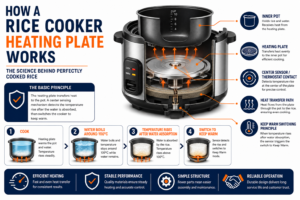
An intelligent rice cooker executes a multi-stage cooking program: pre-heating (gradual temperature rise to preserve nutrients), boiling (high heat until water absorption completes), simmering (reduced heat for starch gelatinization), and heat retention (low power to maintain serving temperature). The microcontroller monitors temperature continuously and adjusts heating element power at each stage according to programmed curves stored in its memory.
Stage 1: Pre-Heating Phase
When you press "cook," the microcontroller activates the heating element at partial power—typically 40–60% of maximum wattage. The thermistor (mounted on or near the heating plate) measures temperature every few seconds and sends resistance values to the microcontroller.
The goal here is gradual temperature rise—taking 10–15 minutes to reach boiling point instead of blasting full power immediately. Why? Because slow heating allows water to penetrate the rice grains more evenly. Importers targeting premium markets care about this; buyers in price-sensitive markets often don't, so KENLY offers both fast-cooking and slow-heating program options depending on your target customer.
During this phase, the failure risk comes from poor thermistor contact with the heating plate. If the sensor doesn't accurately read heating plate temperature, the microcontroller makes decisions based on wrong data. That's why our assembly process control includes inspection of thermistor mounting—we check mechanical pressure, thermal paste application, and sensor wire routing to prevent damage during assembly.
Stage 2: Boiling Phase
Once temperature reaches approximately 90°C (the exact threshold varies by program), the microcontroller switches to full power. Water boils vigorously, creating convection currents that help cook rice evenly.
This phase continues until the thermistor detects a temperature spike—usually to 103–105°C—which indicates water has been absorbed or evaporated. Mechanical rice cookers use the same principle, but they rely on a single fixed trigger point. Intelligent controllers can adjust: if you selected "soft rice" mode, the trigger temperature might be 102°C (leaving slightly more moisture). For "hard rice" or mixed grain modes, it might wait until 106°C.
The critical quality control point here is heating element stability. If the heating plate has uneven coating or poor contact with the inner pot, hot spots develop. The thermistor reads one temperature while the rice experiences another. Result: burnt bottom, undercooked top. KENLY's heating plate inspection includes coating uniformity checks and inner pot contact surface inspection to reduce this failure mode.
Stage 3: Simmering and Starch Gelatinization
After the boiling phase ends, intelligent rice cookers don't immediately switch to "warm" mode. Instead, they maintain temperature between 85–95°C for 10–20 minutes (depending on program). This allows starch gelatinization to complete—basically, letting the rice finish cooking gently without adding more water.
Mechanical rice cookers skip this step. Once the thermostat trips, they immediately drop to warm mode (around 60–70°C). That's why mechanical cookers sometimes produce slightly undercooked rice even though the water is gone—the rice didn't have time to finish gelatinizing.
For importers, this stage is where intelligent control delivers the cooking quality improvement that justifies the price premium. But it's also where circuit board failures become visible: if the microcontroller crashes or the temperature sensor gives erratic readings during simmering, the rice either burns or stays undercooked.
That's why KENLY's withstand voltage testing and electric parameter testing focus on component behavior under sustained heat exposure. We're not just testing whether the circuit board works when cool—we're testing whether it works reliably after sitting near a 100°C heating plate for 45 minutes straight.
Stage 4: Heat Retention Mode
After simmering completes, the microcontroller switches to heat retention—typically maintaining temperature between 60–75°C depending on program settings. The heating element cycles on and off to maintain this range.
Mechanical rice cookers handle this the same way: a separate bimetallic thermostat controls warm mode. The failure modes are similar (contact degradation, temperature drift), but the customer impact is lower because warm mode performance is less critical than cooking performance.
Program Variations and Customization
Intelligent rice cookers store multiple programs in microcontroller memory: white rice, brown rice, porridge, soup, steam, quick cook, cake, and others. Each program uses different heating curves, temperature thresholds, and stage durations.
For OEM buyers, this creates a customization opportunity: KENLY can adjust program parameters based on your target market's cooking habits. Southeast Asian markets might prefer softer rice with higher moisture content. South American markets might prioritize faster cooking time. We modify the temperature thresholds, pre-heating duration, and simmering time accordingly.
The trade-off is complexity: more programs mean more firmware testing requirements. KENLY's approach is to offer a base program set that's been validated through cooking performance testing, then add customized programs only when order quantities justify the additional testing work (usually 3,000+ units).
What Are the Main Components in an Intelligent Rice Cooker System?
When importers worry about reliability, they're really worried about specific components failing. Let me walk through the critical parts and what actually goes wrong.
The core components of an intelligent rice cooker system are: microcontroller circuit board (controls logic and heating), temperature sensor/thermistor (measures cooking temperature), heating element and heating plate (generates heat), power supply circuit (converts AC to DC for microcontroller), control panel (buttons and display), and inner pot with magnetic switch (detects pot presence and triggers safety cutoff).
Microcontroller Circuit Board: The Brain
This is the component importers fear most, and I understand why: if it fails, you need someone who can diagnose electronics, not just replace a mechanical part.
The microcontroller (usually an 8-bit or 16-bit MCU) runs firmware that executes cooking programs. It reads thermistor resistance values, converts them to temperature, compares temperature to programmed curves, and switches the heating element on or off via relay or TRIAC (a solid-state switch).
What Actually Fails
From KENLY's quality control data and after-sales tracking, circuit board failures fall into three categories:
-
Incoming component defects: The MCU, relay, TRIAC, capacitors, or resistors arrive from suppliers with latent defects. These components work during factory testing but fail within the first 100 hours of use. KENLY's incoming material inspection includes sampling and electrical parameter testing to catch defective batches before assembly.
-
Soldering defects: Poor solder joints create intermittent connections that fail when the circuit board heats up during cooking. This shows up as random shutdowns or erratic behavior. KENLY's assembly process control includes solder joint visual inspection and, for export batches over 5,000 units, selective X-ray inspection of critical joints.
-
Voltage spike damage: Power surges or voltage fluctuations damage sensitive components. This is why withstand voltage testing (applying high voltage to test insulation and component tolerance) is critical. KENLY tests 100% of finished units at voltages above normal operating range to ensure components can survive typical power quality issues.
Importers ask me: "What's the actual failure rate?" I can't give you a single number because it depends on component quality, assembly quality control, and market power grid conditions. What I can tell you is that CB and CE certification require manufacturers to demonstrate that circuit boards survive specified voltage surges, temperature ranges, and humidity levels. If your supplier has valid CB and GS certifications, they've already passed those tests. If they don't have certifications, that's your answer about reliability.
Temperature Sensor (Thermistor): The Eyes
The thermistor is a resistor whose resistance changes predictably with temperature. Intelligent rice cookers typically use NTC (negative temperature coefficient) thermistors—as temperature rises, resistance drops.
The microcontroller applies a small voltage across the thermistor, measures the resulting current, calculates resistance, and converts that to temperature using a lookup table or formula stored in firmware.
What Actually Fails
Thermistors themselves rarely fail—the ceramic or polymer sensing element is robust. What fails is:
-
Mechanical mounting: If the thermistor doesn't maintain consistent contact with the heating plate, it reads air temperature instead of plate temperature. The microcontroller makes wrong decisions. KENLY's assembly inspection includes checking thermistor mounting pressure and thermal paste application.
-
Wire damage: The thin wires connecting the thermistor to the circuit board can break during assembly or long-term vibration. KENLY's wire routing inspection prevents sharp bends near solder joints and checks strain relief.
-
Calibration drift: Over thousands of heating cycles, some thermistors shift their resistance-temperature curve slightly. This causes gradual cooking performance changes (rice cooks a little softer or harder than initially). High-quality thermistors minimize this drift. KENLY sources thermistors from suppliers with automotive-grade specifications to reduce long-term drift.
Heating Element and Heating Plate: The Hands
The heating element (usually a coiled wire embedded in the heating plate) converts electrical energy to heat. Intelligent rice cookers use the same basic heating elements as mechanical models—this component isn't more failure-prone in intelligent designs.
What matters is how the microcontroller controls power delivery. Some designs use relay switching (on/off control), others use TRIAC phase control (variable power by adjusting how much of each AC cycle gets through). Phase control creates more precise temperature management but adds electronic complexity.
KENLY offers both options. Relay-based control is cheaper and easier to repair (you can visually see if the relay failed). Phase control is smoother and reduces thermal stress on the heating plate, but if the TRIAC fails, diagnosis requires someone with electronics knowledge.
Quality Control Focus
Heating plate quality control focuses on:
- Coating uniformity: Non-stick coating or oxide coating prevents inner pot sticking and improves heat transfer. Uneven coating creates hot spots.
- Heating element resistance: Must match specifications to deliver correct wattage. KENLY's electric parameter testing measures cold resistance and hot resistance for every unit.
- Contact surface flatness: If the heating plate isn't flat, the inner pot rocks or has poor thermal contact. This reduces cooking efficiency and makes the thermistor read incorrectly.
Power Supply Circuit: The Foundation
Intelligent rice cookers need low-voltage DC power (usually 5V or 12V) for the microcontroller, display, and control panel. The power supply circuit converts AC line voltage (110V, 220V, or other regional standards) to stable DC.
This circuit includes transformers, rectifiers, voltage regulators, and filter capacitors. It runs continuously as long as the rice cooker is plugged in—even when not cooking—so components must handle long-term thermal stress.
What Actually Fails
Power supply failures usually show as complete unit shutdown (no display, no response to buttons) or intermittent resets during cooking. Common causes:
-
Electrolytic capacitor aging: Filter capacitors dry out over time, especially in hot environments. Ripple voltage increases, voltage regulation degrades, microcontroller crashes. KENLY specifies capacitors rated for 105°C operation with high ripple current tolerance to extend lifespan.
-
Transformer insulation breakdown: Poor-quality transformers develop internal shorts over time. Withstand voltage testing catches weak insulation before shipment.
For importers targeting tropical markets (high ambient temperature and humidity), power supply component quality matters more than for temperate climates. KENLY recommends specifying higher-grade capacitors and extended temperature range components for those markets—slight cost increase, significant reliability improvement.
Control Panel and User Interface
The control panel includes push buttons, membrane switches, or touch controls, plus LED indicators or LCD displays. Intelligent rice cookers have more complex interfaces than mechanical models because they need to let users select programs and view status.
This is actually one area where mechanical rice cookers have an advantage: a simple mechanical switch is harder to break than membrane switches or touch sensors. But the failure rate difference is smaller than importers expect—most control panel issues come from moisture ingress or mechanical damage during shipping, not inherent design weakness.