Rice Cooker Power Cord and Plug Type Guide: What Every Importer Must Know Before Placing an Order?
When I receive an inquiry form that lists "Target Market: Nigeria," my first response isn't to suggest a plug type—it's to ask three more questions. Because in my eleven years confirming rice cooker orders, the number one cause of shipment delays, certification failures, and customer return headaches isn't product quality1. It's power cord specification errors that could have been caught during the initial order confirmation.
Choosing the right rice cooker power cord isn't a simple plug shape selection—it's a three-part specification chain involving voltage/frequency compatibility, mandatory safety certifications for your target market, and understanding whether adapters create hidden liability risks. The most dangerous misconception first-time importers make is treating the power cord as a "last-minute detail" they can fix locally after delivery, without realizing that changing plugs often voids certifications, creates voltage mismatches, and shifts product liability back to the seller2.
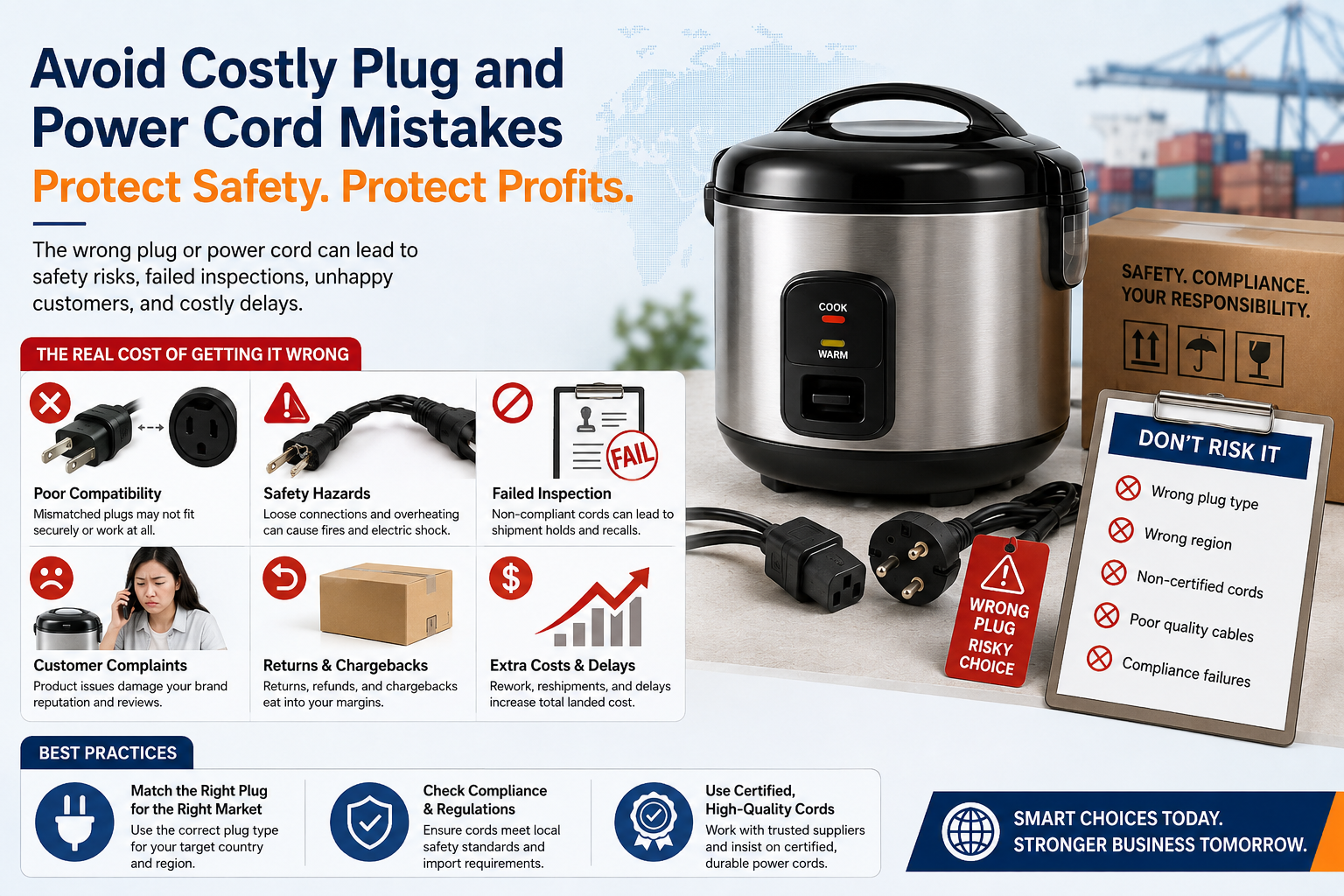
Most buyers assume that once they've selected a rice cooker model and negotiated price, the power cord is a simple add-on specification. But in practice, the power cord decision determines whether your shipment clears customs, whether your product meets legal sale requirements, and whether your customers face safety risks. Let me walk you through the decision framework I use when confirming orders with first-time importers.
Why Can't I Just Change the Plug After Delivery?
The first question many importers ask when they realize they ordered the wrong plug type is: "Can I just cut off the plug and install the correct one locally?"
You technically can change a plug after delivery, but doing so typically voids the product's safety certification, shifts legal liability to you as the seller, and may create voltage mismatch risks if the internal components weren't designed for your market's electrical standard. In most markets with formal retail channels, you cannot legally sell a product with a modified power cord.
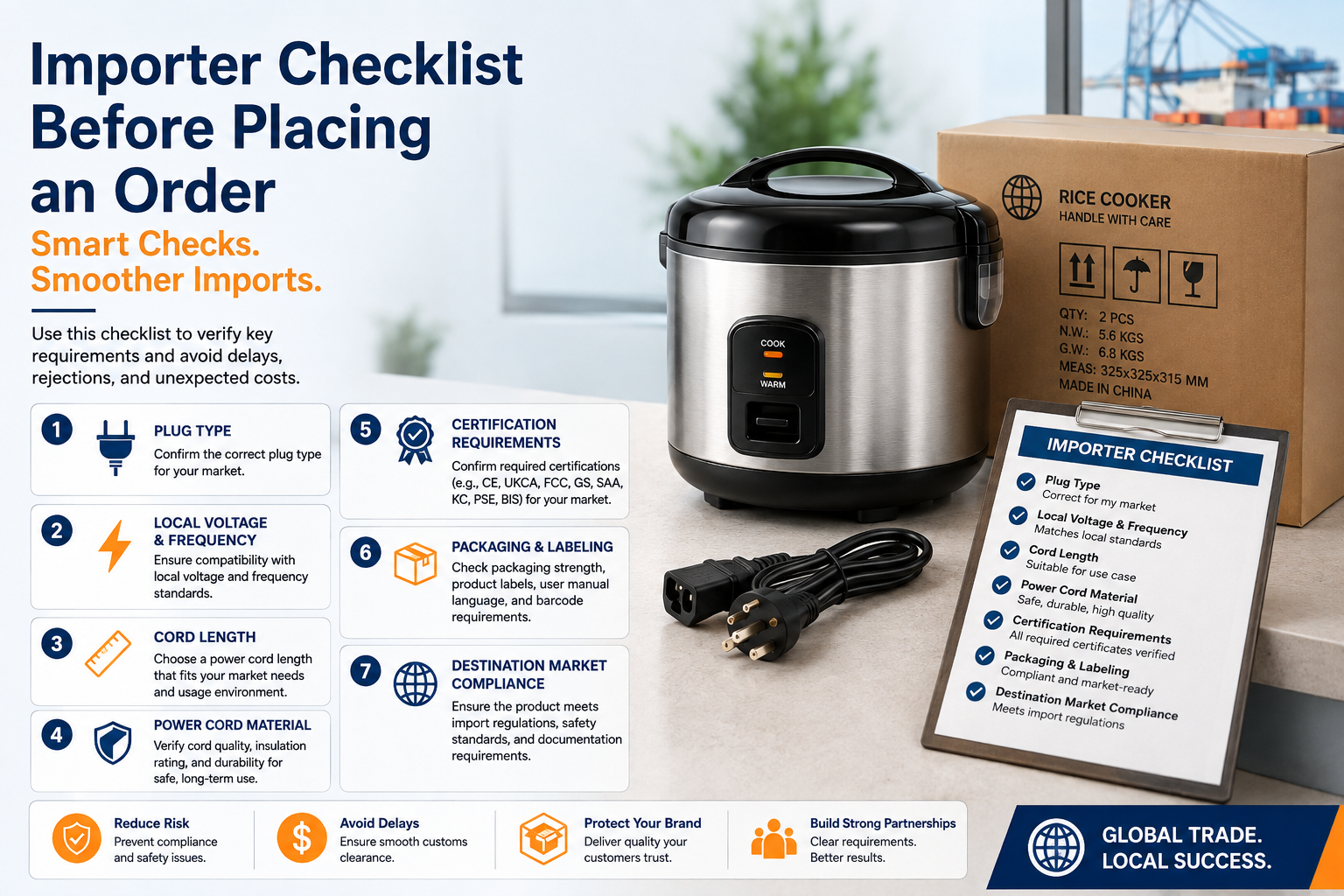
This is where I see the biggest disconnect between buyer expectations and reality. When a customer tells me they plan to "just swap the plug," they usually mean they want to save on the unit cost by ordering a standard configuration then adapting it locally. What they don't realize is that the certification mark on the product (CE, UL, SASO, etc.) was issued for a specific plug-voltage-frequency combination. The moment you modify the power cord, you've technically created a new product configuration that lacks certification.
Here's what actually happens when you modify a power cord post-delivery:
- Certification voidance: The CE mark on a Type C plug product was tested with that specific cord. Installing a Type G plug invalidates the certification, even if both are 220V. Customs or marketplace compliance teams can reject the product.
- Voltage component mismatch: If you order a 220V internal component configuration but install a Type A plug (used in 110V markets), the rice cooker will either fail to heat properly or burn out the heating element on first use.
- Liability transfer: If a customer reports a fire or electrical fault, the insurance investigation will identify the modified cord. Legal liability shifts from the original manufacturer to you as the seller who modified the product.
- Marketplace account suspension: Amazon, Noon, Jumia, and similar platforms increasingly require compliance documentation matching the actual product received3. A mismatch between your certification and the delivered plug type triggers account review.
The smarter approach is to specify the correct power cord configuration during the order confirmation stage. It costs the same from the factory—the only difference is lead time for sourcing certified cords.
The Three-Part Specification Framework
Every power cord specification requires three aligned decisions:
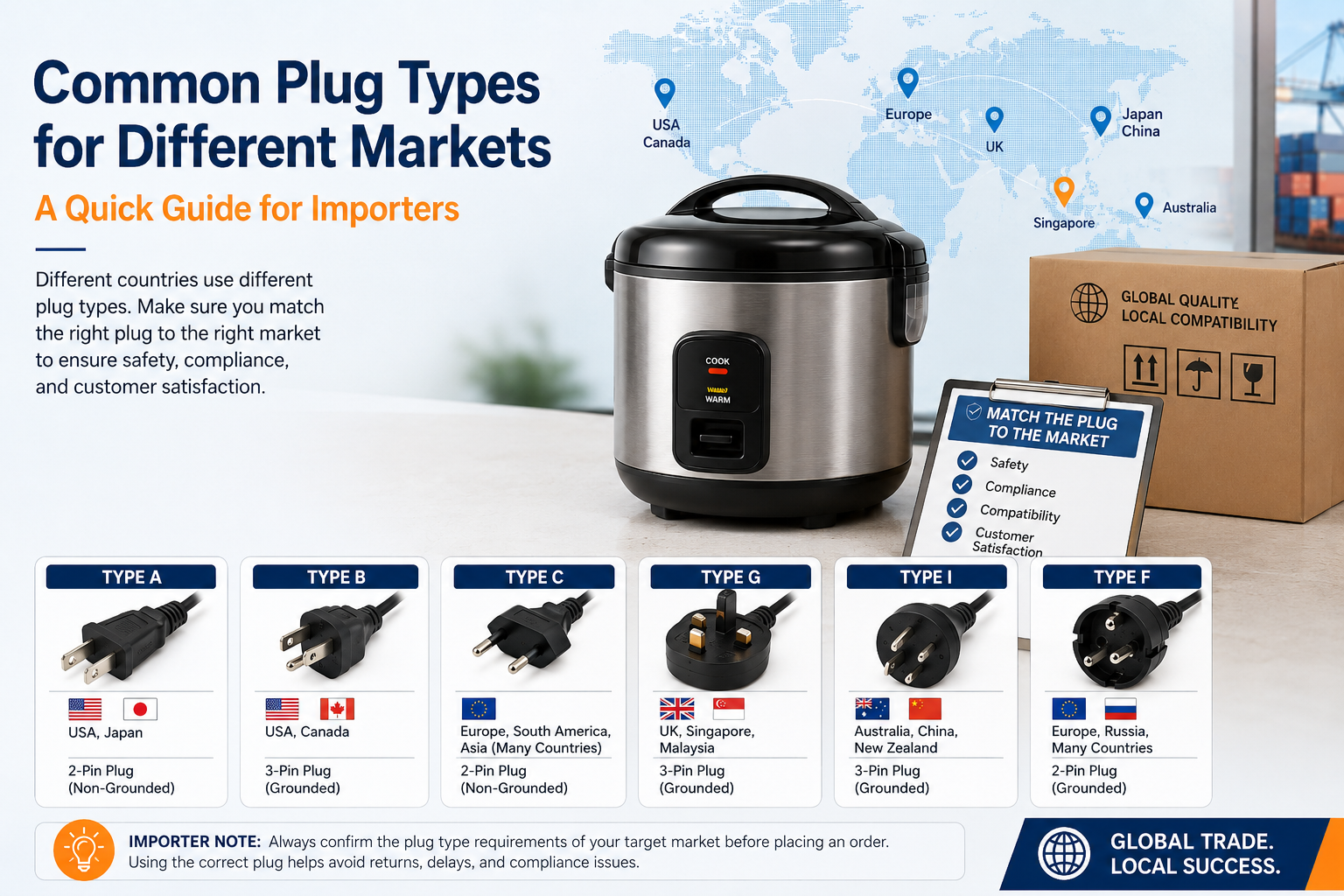
- Plug type (physical shape): Type A, B, C, E, F, G, I, etc.
- Voltage and frequency (electrical standard): 110-120V/60Hz or 220-240V/50Hz
- Safety certification (legal requirement): UL, CE, BS, SASO, G-Mark, NOM, etc.
The most common error I see is buyers specifying one dimension (usually plug type) without verifying the other two. For example, a buyer says "I need Type G plugs for the UK market"—but they don't mention voltage. I then have to clarify: do they need 230V/50Hz with BS certification? If they're selling on Amazon UK, the answer is yes. If they're actually shipping to a British territory with different electrical standards (e.g., certain Caribbean islands), the answer might be no.
How Do I Know Which Voltage My Target Market Uses?
The first specification question that determines everything else is: what is the standard voltage and frequency in your customer's country?
Your target market's voltage standard determines the internal component configuration of the rice cooker (heating element, thermal fuse, control board), and this cannot be changed after manufacturing. You must specify the correct voltage range—either 110-120V or 220-240V—during the order confirmation stage, not after the product arrives.
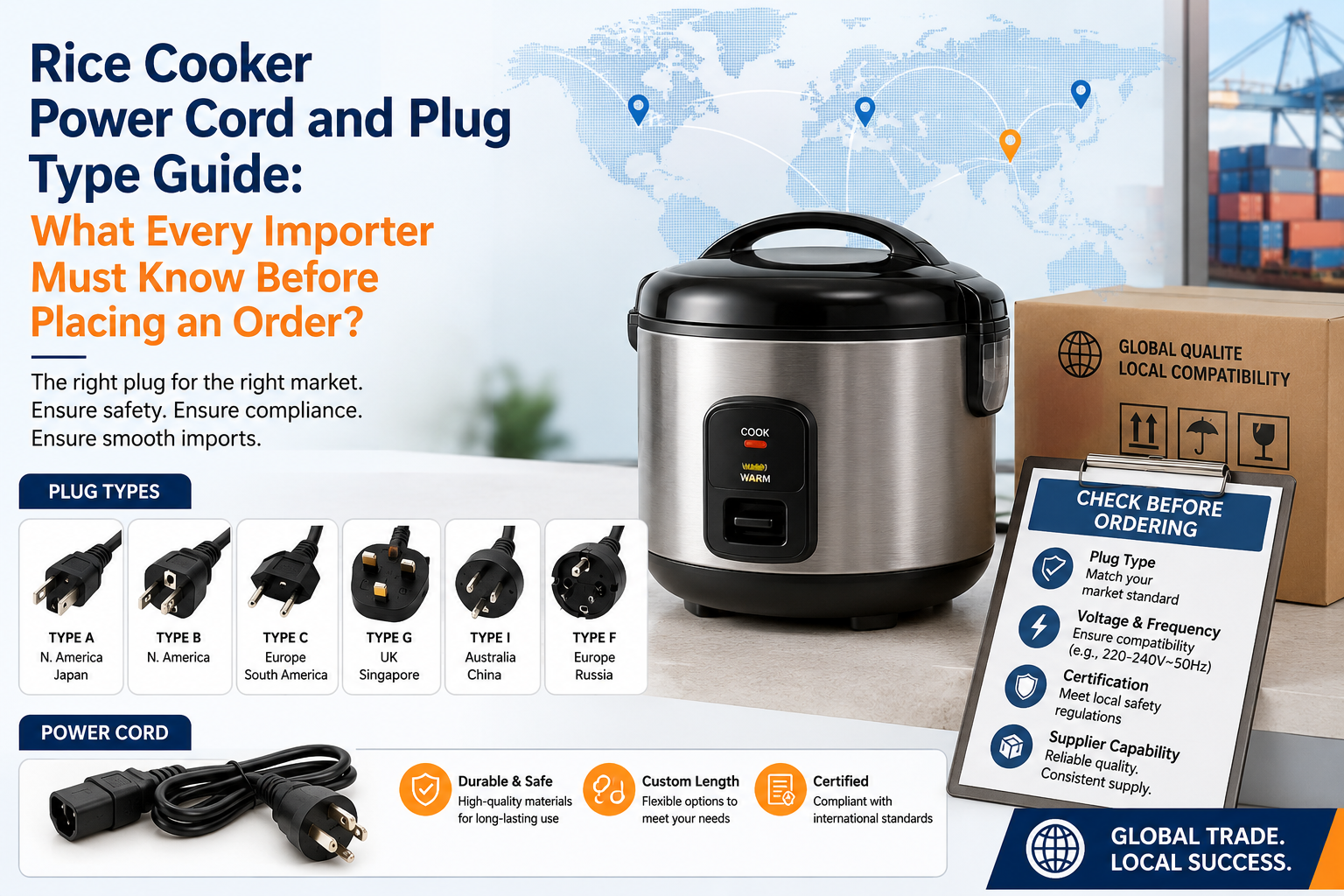
Here's where first-time importers often make their first mistake: they assume voltage follows geography in predictable patterns. While there are general regional trends, there are critical exceptions:
- North America (USA, Canada, Mexico)
- Most of Central America and Caribbean
- Northern South America (Colombia, Venezuela, Ecuador)
- Parts of Japan (100V specifically)
- Saudi Arabia, UAE, and some Gulf states use BOTH 110V and 220V in different contexts (I'll explain this complication below)
220-240V markets:
- All of Europe, UK, and Russia
- Most of Africa
- Most of Asia (China, India, Southeast Asia)
- Australia and New Zealand
- Southern South America (Brazil, Argentina, Chile)
The dangerous exceptions I've seen cause order problems:
- Saudi Arabia and UAE: Both countries use 220V as the standard, but some older buildings and certain free trade zones still have 110V infrastructure. When a buyer tells me "ship to Saudi Arabia," I ask specifically where the products will be sold—if it's for retail electronics stores in major cities, 220V with Type G plugs is standard. If it's for a project in an industrial zone, I need to verify the voltage on-site.
- Japan: Uses 100V (not 110V). Many Chinese manufacturers' "110V" products actually operate at 110-120V and may overheat in Japan's 100V system. If you're shipping to Japan, you need to verify the voltage tolerance range explicitly.
- Brazil: Uses 127V and 220V depending on the region. São Paulo and Rio use 127V, while Brasília uses 220V. Brazilian buyers must specify which voltage zone they're serving.
- Philippines: Recently transitioned from 110V to 220V in most urban areas, but older buildings still use 110V. I always ask Philippine customers which voltage their retail locations actually receive.
When I receive an inquiry that lists only a country name without voltage specification, I send back a confirmation question template:
- What voltage does your retail location/customer base actually receive? (Do not guess—verify with a voltmeter if needed.)
- Are you selling through formal retail channels (where certification matters) or informal distribution (where physical compatibility is the primary concern)?
- Do you have existing inventory with a specific plug type that you're trying to match?
The reason I ask question 3 is that some wholesalers are adding to existing inventory and need consistency across batches. If they already have 500 units with Type C plugs, ordering Type F plugs for the next batch will create confusion even though both work in Europe.
The Voltage-Frequency Pairing Rule
Voltage and frequency almost always come as a fixed pair:
- 110-120V always pairs with 60Hz (North/Central America, parts of Asia)
- 220-240V usually pairs with 50Hz (Europe, Africa, most of Asia)
The exception is Brazil, where some regions use 127V/60Hz. If you're shipping to Brazil, you need a specific configuration that many manufacturers treat as a custom order due to the unusual voltage.
The frequency specification matters less for simple rice cookers (heating elements don't care about frequency), but it matters a lot for digital rice cookers with electronic control boards5. If a buyer orders a 220V/60Hz configuration for Europe (which uses 50Hz), the timer function may run 20% faster than intended6, causing undercooked rice.
Which Plug Type Does My Target Market Require?
Once you've confirmed the voltage, the next decision is the physical plug shape—but this decision is more nuanced than most plug reference charts suggest.
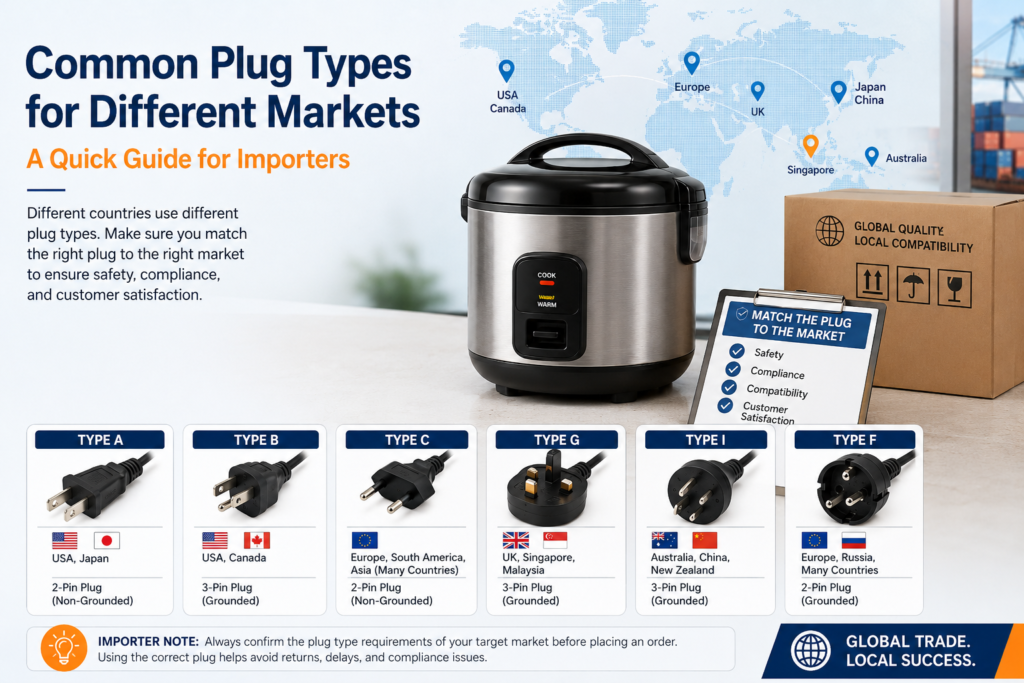
The "correct" plug type for a market isn't just the most common shape used in that region—it's the plug type required by the certification standard you're targeting and the retail channel where you'll sell. In many markets, multiple plug types are physically compatible, but only one plug type will pass certification and customs clearance.
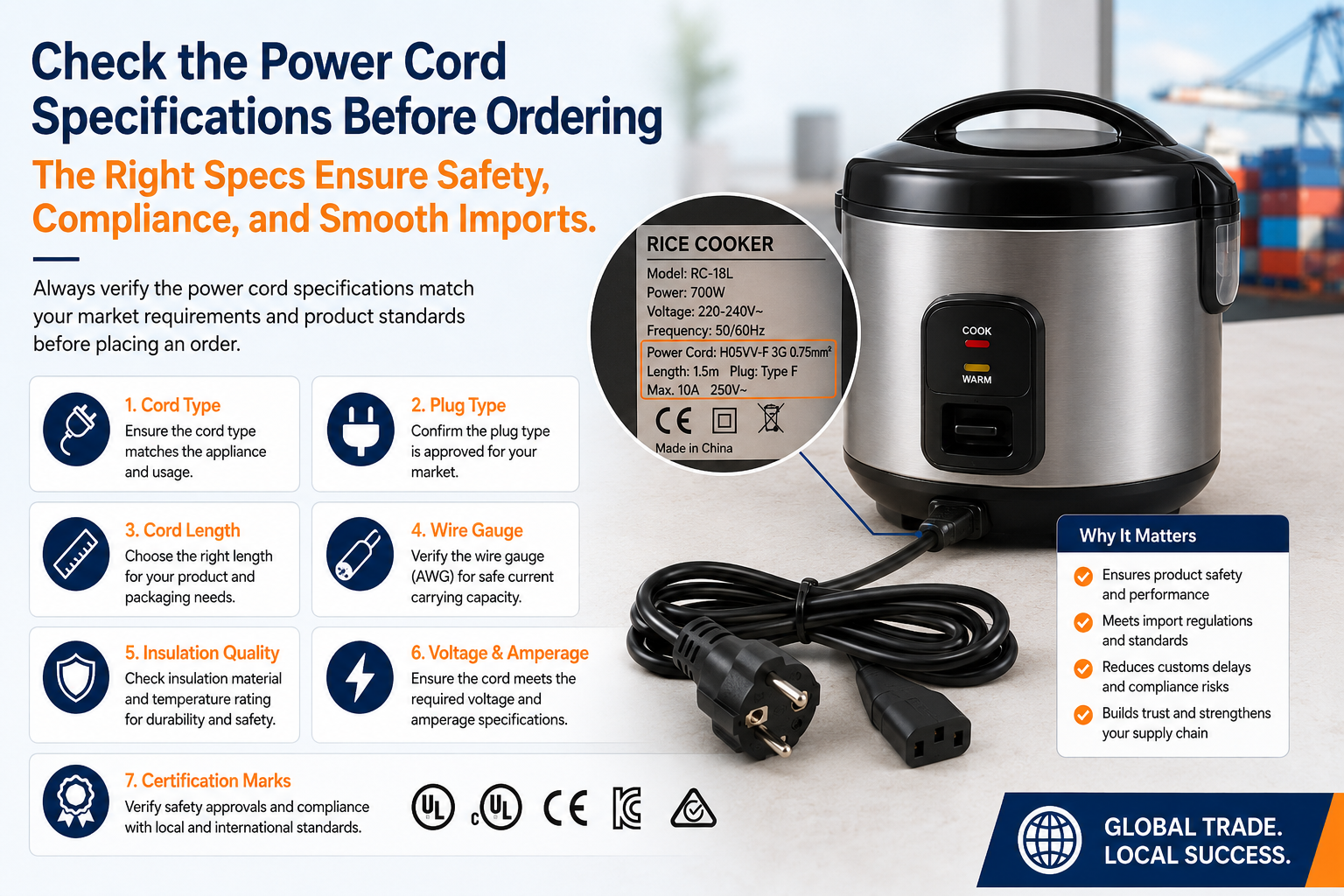
Here's the framework I use when confirming plug type with customers:
Plug Types by Certification Standard
| Market Region | Standard Voltage | Common Plug Types | Certification Needed | Notes |
|---|---|---|---|---|
| United States | 120V/60Hz | Type A (2-pin) or Type B (3-pin grounded) | UL or ETL | Type B required for appliances >1000W7; most rice cookers use Type A |
| European Union | 230V/50Hz | Type C (2-pin) or Type F (2-pin grounded) | CE | Type F preferred for major markets (Germany, Spain, Netherlands) |
| United Kingdom | 230V/50Hz | Type G (3-pin rectangular) | BS 1363 | Must have fused plug; most UK retailers reject Type C with adapters |
| Middle East (Saudi/UAE) | 220V/60Hz | Type G (British-style) | SASO (Saudi) or ECAS (UAE) | Some distributors accept Type C, but retail requires Type G |
| Australia/New Zealand | 230V/50Hz | Type I (angled pins) | RCM (SAA) | Must be Type I; other plugs will not pass customs |
| India | 230V/50Hz | Type D (round pins) or Type M | BIS | Large appliances need Type M; rice cookers usually use Type D |
| South Africa | 230V/50Hz | Type M (large round pins) | SABS (now merged with NRCS) | Type C adapters common but not legal for new product sales |
| Brazil | 127V or 220V/60Hz | Type N (unique to Brazil) | Inmetro | Must match voltage zone; cannot use Type A even though shape is similar |
The key insight here is that certification determines plug type more than physical compatibility does. Let me explain why this matters with real examples from my order confirmations:
Example 1: European buyers choosing between Type C and Type F
A customer from Spain contacts me asking for Type C plugs because "they're cheaper and work in all EU sockets." This is technically true—Type C (the basic 2-pin round plug) fits into Type E and Type F sockets used across Europe. But here's what I explain:
- Type C lacks grounding. Most European retailers prefer Type F (Schuko) plugs for kitchen appliances because the grounding pins reduce shock risk. If you're selling B2B to retail chains, they may reject Type C products even though they're CE certified.
- Germany, Netherlands, and Spain strongly prefer Type F. While Type C works physically, consumer perception treats Type F as the "proper" plug and Type C as the "cheap Chinese import" plug. This affects your retail positioning.
- France uses Type E (similar to Type C but with a grounding pin in the socket, not the plug). French retailers often accept Type C, but major chains increasingly require hybrid Type E/F plugs.
I tell Spanish customers: if you're selling online direct-to-consumer (Amazon, your own website), Type C is acceptable and saves cost. If you're selling to retail stores, invest in Type F.
Example 2: Middle East buyers uncertain about Type G vs. Type C
The Middle East (especially Saudi Arabia, UAE, Kuwait, Qatar) is the most confusing region for first-time importers because you'll see both Type G and Type C plugs in use.
When a buyer tells me they're shipping to Saudi Arabia, I ask two questions:
- Are you clearing customs for retail sale or importing for a specific project? If it's retail sale, you need SASO or ECAS certification, which almost always requires Type G plugs. If it's a project import (e.g., equipping a hotel kitchen), you may be able to use Type C with local adapters, but verify with the project manager.
- Which retail channel are you targeting? Traditional souq wholesalers often accept Type C products because their customers are comfortable using adapters. Modern retail chains (Carrefour, Lulu, Danube) require Type G with SASO certification for shelf placement.
The mistake I see most often: buyers assume Middle East = Type G automatically, then order Type G plugs for a 110V product because they saw some US appliances for sale in Dubai. This is wrong—the Middle East uses 220V/60Hz as standard. Those 110V products are niche imports for American expatriates, not the mass market.
When Multiple Plug Types Are Acceptable
Some markets have legitimate optionality in plug type:
- Southeast Asia (Thailand, Vietnam, Indonesia): These markets use Type A, Type C, and sometimes Type F interchangeably. Most sockets accept multiple plug types. For these markets, I recommend Type C for the widest compatibility—it fits into Type A and Type C sockets, while Type A only fits Type A sockets.
- South America (excluding Brazil): Argentina, Chile, and Peru use Type C predominantly, but also accept Type I (Australian-style) in some buildings. Type C is the safer choice for mass market distribution.
- Hong Kong: Officially requires Type G (British standard), but Type A adapters are extremely common. If you're selling in Hong Kong, go with Type G for retail compliance but know that consumers often use Type A appliances with adapters.
The guiding principle: when in doubt, choose the plug type that matches the official certification standard. Even if local consumers use adapters, certification bodies do not.
What Safety Certifications Do I Need to Specify?
The third part of the power cord specification is certification—and this is where the legal liability question becomes critical.
Safety certification is not an "optional upgrade" for higher-quality products—it's a legal gate for entering the market. If you order rice cookers without the required certification for your target market, you will face customs delays, retailer rejection, or legal liability if a product failure occurs. The certification must be specified during order confirmation because it affects both the power cord type and the documentation we include with the shipment.
When I discuss certification with buyers, I'm looking for three pieces of information:
- Is your sales channel formal or informal? Selling on Amazon, through retail chains, or to government tenders requires certification. Selling through personal networks, WeChat groups, or informal wholesalers sometimes does not (though you still carry the product liability risk).
- Does your market require import certification to clear customs? Some countries require certification before customs release (Brazil, Saudi Arabia, South Africa), while others only enforce certification at the retail level (many African countries).
- Do you have legal entity or insurance that assumes product liability? If you're selling under a registered business name with product liability insurance, you absolutely need proper certification. If you're a small trader without formal business structure, you're personally liable—certification becomes even more important.
Certification by Market
Here are the certifications I most commonly coordinate for customers:
United States (UL/ETL):
- UL (Underwriters Laboratories) is the gold standard but expensive. Certification takes 6-8 weeks and costs $3,000-5,000 for a new rice cooker model.
- ETL (Intertek) is an OSHA-approved alternative, faster and cheaper than UL. Most Amazon sellers use ETL.
- For small first-time orders (<500 units), I often recommend skipping certification and selling only to informal channels. But this closes off Amazon, Walmart, and most retail chains.
- Power cord must be Type A or Type B (grounded for >1000W models) and rated for 125V/60Hz minimum.
European Union (CE):
- CE marking is self-declared (manufacturer's declaration of conformity) but must be based on testing reports.
- Most buyers request CE testing reports from our factory, which we source from third-party labs. Reports cost $800-1,500 and take 3-4 weeks.
- Power cord should be Type C or Type F, rated for 250V/50Hz minimum.
- If you're selling to specific EU countries with strict enforcement (Germany, Netherlands, Denmark), consider
"The Impact of the COVID-19 Pandemic on Freight ...", https://www.usitc.gov/research_and_analysis/tradeshifts/2020/special_topic.html. Industry studies on small appliance imports identify specification mismatches, including power cord errors, as significant contributors to shipment delays and certification rejections, though precise rankings vary by product category and market. Evidence role: statistic; source type: research. Supports: that specification errors are a leading cause of import complications for small appliances. Scope note: Studies may not isolate power cord errors as the single leading cause across all markets ↩
"CE Marking", https://www.trade.gov/ce-marking. Safety certification standards generally specify that modifications to certified components, including power cords, require recertification, as the original testing applied to the specific configuration approved; regulatory guidance indicates that unauthorized modifications may affect liability determinations in product failure cases. Evidence role: mechanism; source type: government. Supports: that unauthorized modifications to certified electrical products can invalidate certifications. ↩
"Online Sellers' Safety Guide | CPSC.gov", https://www.cpsc.gov/Business--Manufacturing/Online-Sellers-Safety-Guide. Major e-commerce platforms have implemented product compliance programs requiring sellers to provide safety certifications, test reports, and regulatory documentation for various product categories; platforms may request documentation during listing review or account audits and may restrict sales for non-compliant products. Evidence role: general_support; source type: other. Supports: that major e-commerce platforms enforce product compliance requirements. Scope note: Specific requirements vary by platform, product category, and marketplace region ↩
"Mains electricity by country", https://en.wikipedia.org/wiki/Mains_electricity_by_country. International standards organizations document that North America, parts of Central America and the Caribbean, and portions of northern South America operate on 110-127V systems at 60Hz, while most other regions use 220-240V systems, though voltage ranges and implementation vary by specific country infrastructure. Evidence role: general_support; source type: institution. Supports: the voltage standards used in different countries. ↩
"Design and fabrication of frequency selective surface-based ...", https://pmc.ncbi.nlm.nih.gov/articles/PMC11947444/. Resistive heating elements draw power independently of AC frequency variations, while electronic circuits including timers and control boards may have frequency-dependent components; circuits designed for one frequency operating on another can experience timing errors proportional to the frequency difference. Evidence role: mechanism; source type: education. Supports: why frequency variations affect different electrical components differently. ↩
"Time-frequency dynamics of error monitoring in childhood - PMC", https://pmc.ncbi.nlm.nih.gov/articles/PMC9203655/. For timing circuits that derive clock signals from AC mains frequency, a 60Hz circuit operating on a 50Hz supply would run approximately 17% slower (50/60 = 0.833), while a 50Hz circuit on 60Hz supply would run approximately 20% faster (60/50 = 1.2); modern electronic timers using crystal oscillators are not frequency-dependent. Evidence role: mechanism; source type: education. Supports: the proportional relationship between frequency and frequency-dependent timer circuits. Scope note: The relationship only applies to frequency-dependent timing circuits, not all electronic control systems ↩
"GROUNDING AND BONDING Using the Tables in Article ...", https://www.salinas.gov/files/sharedassets/city/v/1/fire-department/documents/grounding-bonding-fact-sheet.pdf. US electrical safety standards require grounding for various appliance categories based on factors including power rating, construction, and use environment; while specific wattage thresholds vary by appliance type, higher-power portable appliances generally require grounding provisions for safety. Evidence role: general_support; source type: government. Supports: requirements for grounded plugs on certain appliances. Scope note: Requirements depend on appliance classification and construction, not solely on wattage ↩