Rice Cooker Voltage Guide for Different Countries: How to Avoid Costly Purchasing Mistakes?
Last month, a distributor from Nigeria called me frustrated because his 220V rice cookers wouldn't work in a coastal region with 110V supply. He'd already shipped 500 units. The return cost alone wiped out his margin on the entire order. He asked me, "Why didn't anyone tell me voltage matters this much?" I told him what I'm about to tell you: voltage isn't just a technical specification—it's a purchasing risk you can't afford to ignore.
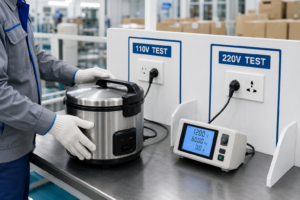
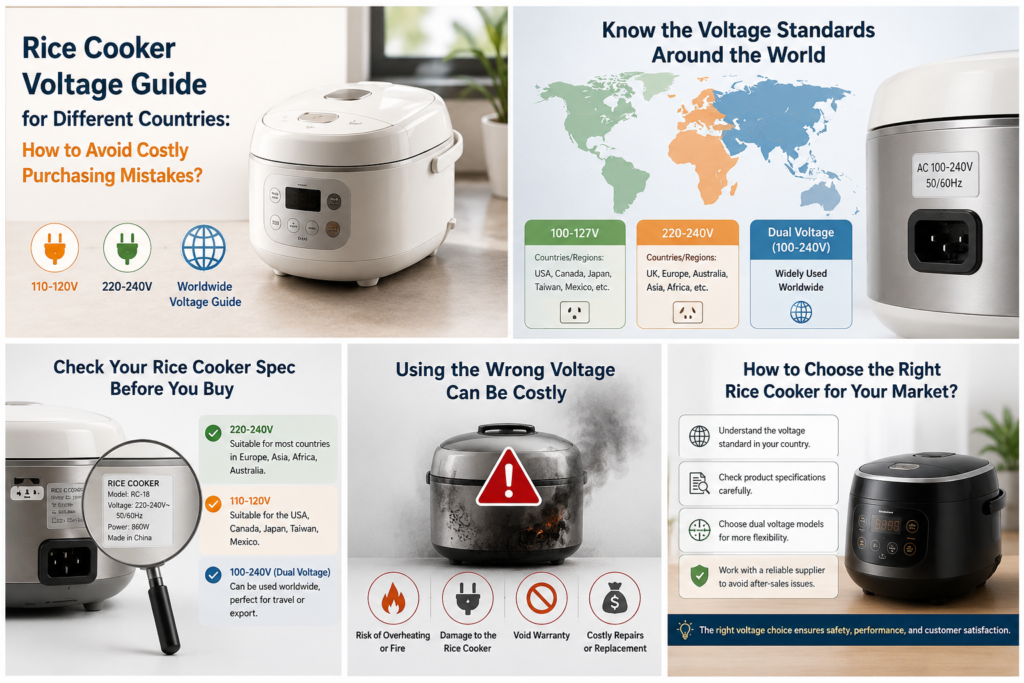
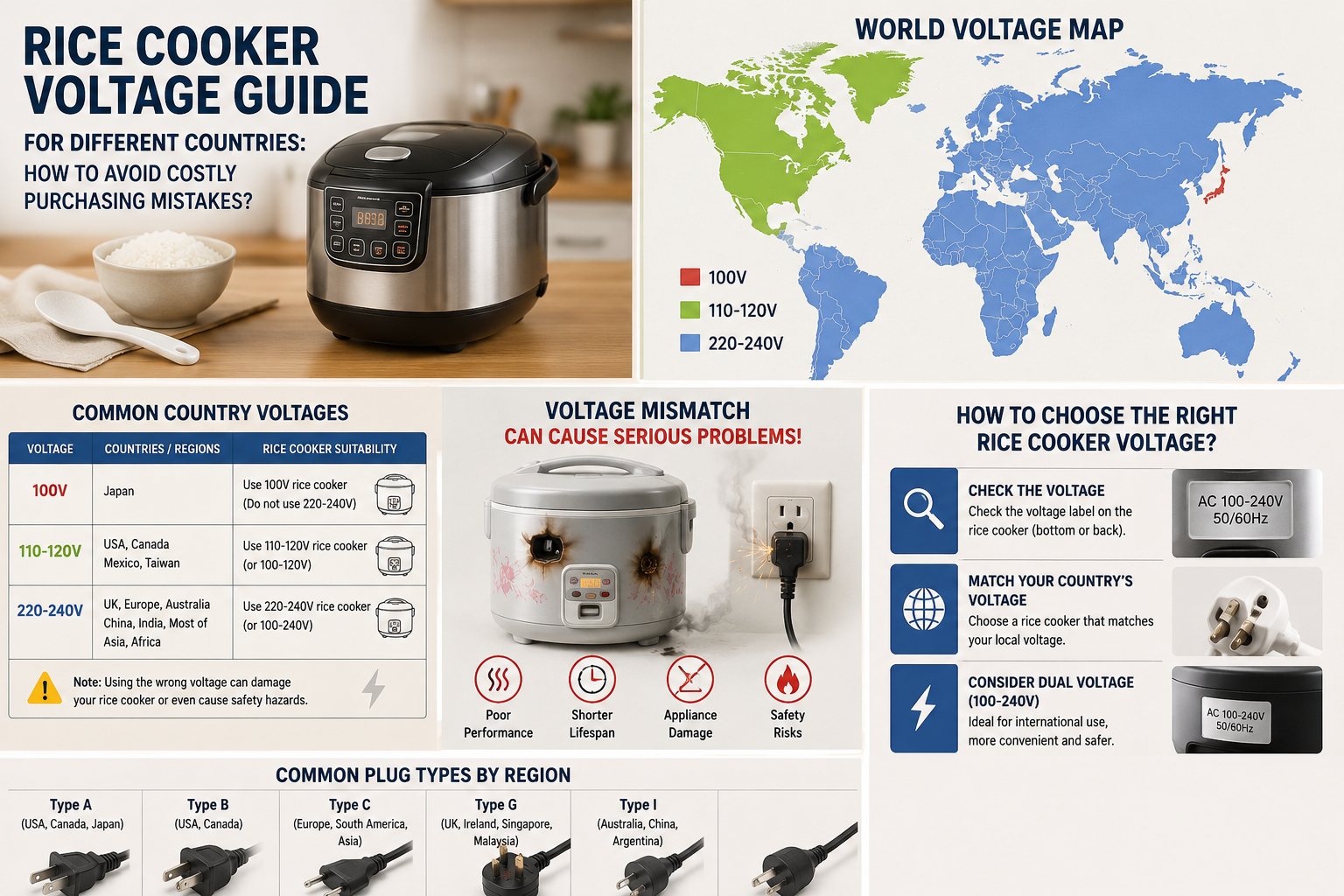
Rice cookers operate on specific voltage systems: 110-120V (used in most of the Americas and parts of Asia) or 220-240V (standard in Africa, Europe, and most of Asia)1. Ordering the wrong voltage version for your target market creates immediate return costs, customer complaints, and inventory dead stock. Unlike plug adapters that change physical connection, voltage mismatch damages internal components and creates performance failures that transformers can't fully solve.
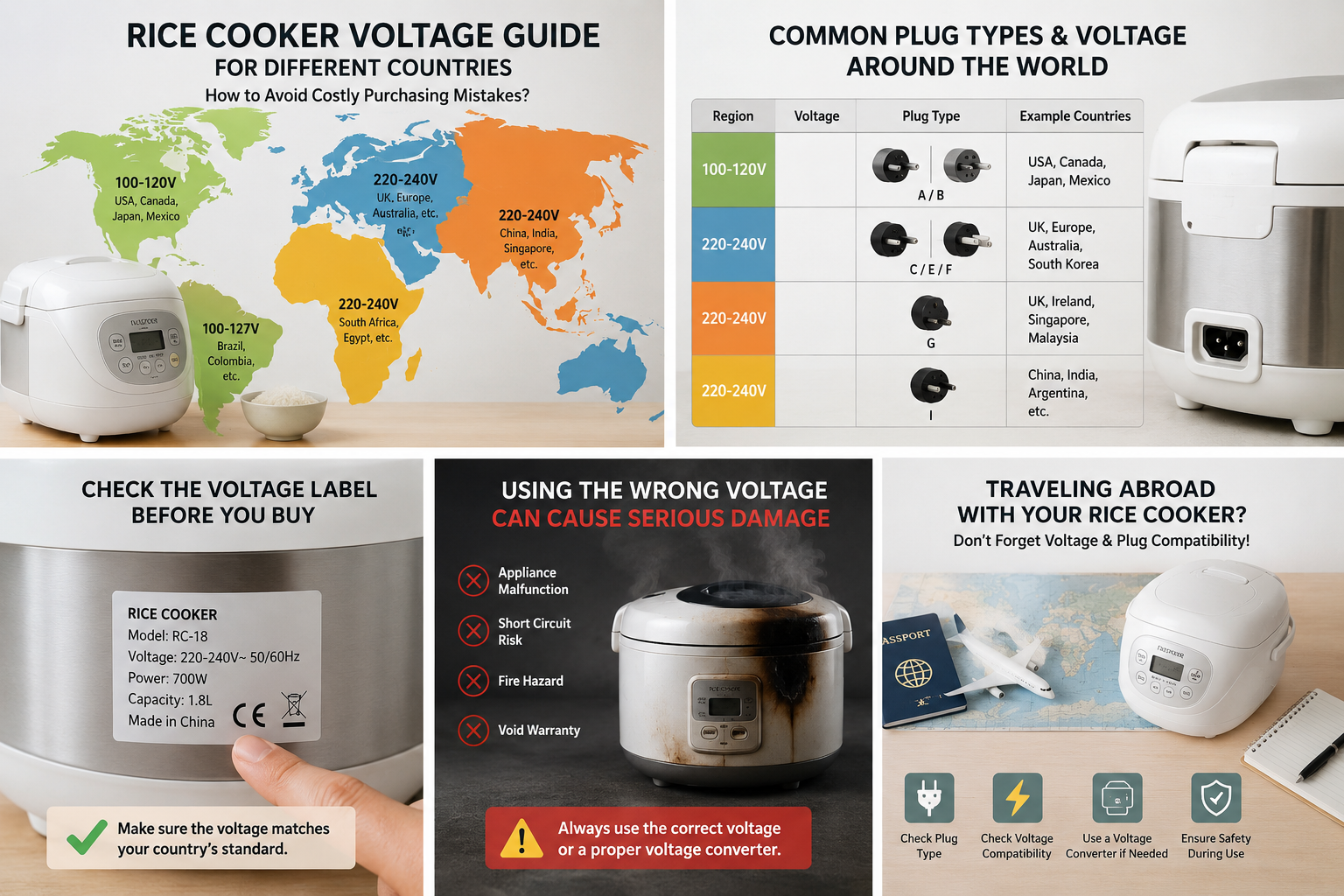
Here's what most buyers don't realize until it's too late: your customers won't forgive you for selling them a product that doesn't work in their wall socket, even if "technically" a transformer could make it work. When you're making procurement decisions for wholesale or e-commerce inventory, voltage specification determines whether you'll sell through your stock profitably or handle refund requests for six months. Let me show you how to match product versions to your markets correctly.
What Rice Cooker Voltage Do I Need for My Target Market?
You've found a supplier with good prices and you're ready to place an order. Then you see the voltage specification and realize there are different versions. Most buyers at this point make one of two mistakes: they assume voltage works like plug adapters (just buy an accessory to convert), or they order based on their own country's voltage instead of their customer's actual electrical system.
To select the correct rice cooker voltage, identify your target market's standard household voltage: 110-120V systems (North America, parts of South America, Japan, Taiwan, Philippines) require 110V-rated rice cookers; 220-240V systems (most of Africa, Europe, Middle East, China, Southeast Asia) require 220V-rated models. Order the product version that matches your customers' wall outlets—not voltage with conversion accessories.
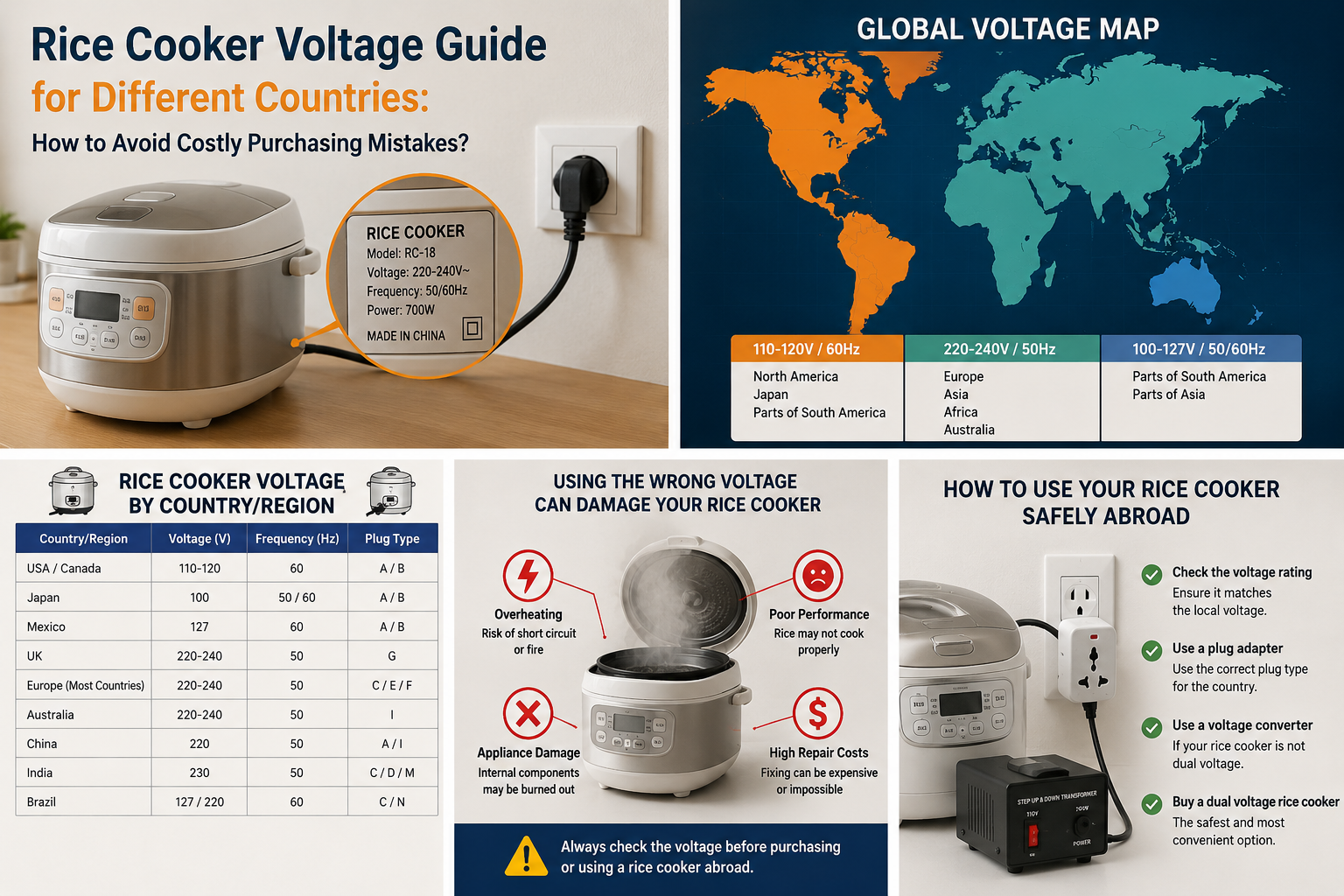
The Real Cost of Getting Voltage Wrong
Three months ago, I had a call with an e-commerce seller in Kenya who bought 220V rice cookers for export to a buyer in Colombia. He assumed Latin America was "all the same voltage" because he'd successfully sold to Brazil before. Colombia uses 110V. His customer refused the shipment. He lost the deposit, shipping cost, and the relationship.
The hidden costs of voltage mismatch extend beyond obvious return shipping:
- Return logistics cost: International return shipping often costs more than the product value2, making returns a complete loss
- Customer trust damage: Buyers who receive non-working products don't just return—they leave negative reviews and warn others in their network
- Inventory carrying cost: Dead stock in the wrong voltage sits in your warehouse generating zero revenue while tying up capital
- Opportunity cost: The time you spend managing returns could have been spent sourcing your next profitable order
I've watched buyers try to salvage wrong-voltage orders by bundling transformers with each unit. The transformer cost eats the margin. Worse, customers still complain about the bulk and complexity. One buyer told me his Amazon ratings dropped 0.8 stars after adding transformers to his 110V rice cookers sold in a 220V market.
Why "I'll Just Include a Transformer" Doesn't Work
Buyers who've never dealt with voltage problems assume transformers are a simple fix. After all, if a transformer can convert voltage, why not just add one to every order and sell to any market?
I'll tell you what I've seen happen: A Philippines distributor ordered 220V units for his domestic 220V market but wanted to expand to the U.S. without reordering. He bought bulk transformers and bundled them with rice cookers for U.S. customers. Three problems emerged within weeks:
- Shipping weight and size increased significantly, raising logistics cost and making his per-unit pricing uncompetitive
- Customer confusion multiplied—half of them didn't understand how to use the transformer correctly, leading to support calls and setup complaints
- Product appearance lost appeal—customers saw his rice cooker + transformer bundle as "complicated" compared to competitors selling native 110V models
Beyond these operational problems, transformers don't actually solve all voltage-related issues. They convert voltage, but they don't change frequency3. The U.S. uses 60Hz; much of Africa and Asia uses 50Hz4. A 220V 50Hz rice cooker running on a transformer in a 110V 60Hz system will heat properly but timers and automatic shut-off circuits may behave unpredictably. I've had buyers report that their customers complained about undercooked or overcooked rice even when voltage conversion was "correct."
The Plug vs. Voltage Confusion Trap
Here's the mistake I see most often: Buyers verify that their rice cookers have the right plug type for their target country, then assume the product is compatible. Plug adapters are cheap and easy to source, so buyers think they've solved the compatibility problem. They haven't.
Last year, a Ghanaian wholesaler ordered rice cookers with UK-style 3-pin plugs for his local market. The plugs matched Ghana's outlets. The voltage didn't—he'd accidentally ordered 110V models. Every single unit needed to be sold at a loss or returned to us for replacement. He'd checked plug compatibility carefully but skipped the voltage specification entirely.
The distinction buyers need to understand:
| Compatibility Factor | What It Controls | Can You Fix It Cheaply? |
|---|---|---|
| Plug type | Physical connection to wall outlet | Yes—plug adapters cost $1-2 |
| Voltage rating | Internal components and safe operation | No—requires different product version or expensive transformer |
| Frequency (Hz) | Motor speed, timer accuracy, heating cycles | No—fixed by electrical grid, can't be converted |
When you order rice cookers, verify both plug type AND voltage specification match your market. Don't assume plug compatibility means voltage compatibility. We've had buyers insist "the plug fits, so it must work"—until their customers try to use the product and it either doesn't heat properly or fails immediately.
How Do I Match Rice Cooker Voltage to Different Regional Markets?
You're not just buying rice cookers for one country—you're building inventory strategy across multiple markets or planning to expand. Each market has different voltage standards, and carrying multiple product versions increases complexity. How do you decide which versions to stock?
Match rice cooker voltage versions to your market portfolio using a decision framework: for single-market buyers, order only the exact voltage used in your target country; for multi-market operations, separate inventory by voltage zone (110V Americas/Asia cluster vs. 220V Africa/Europe/Asia cluster) rather than trying to stock one version with converters. Volume concentration in your primary market should determine your main inventory version.
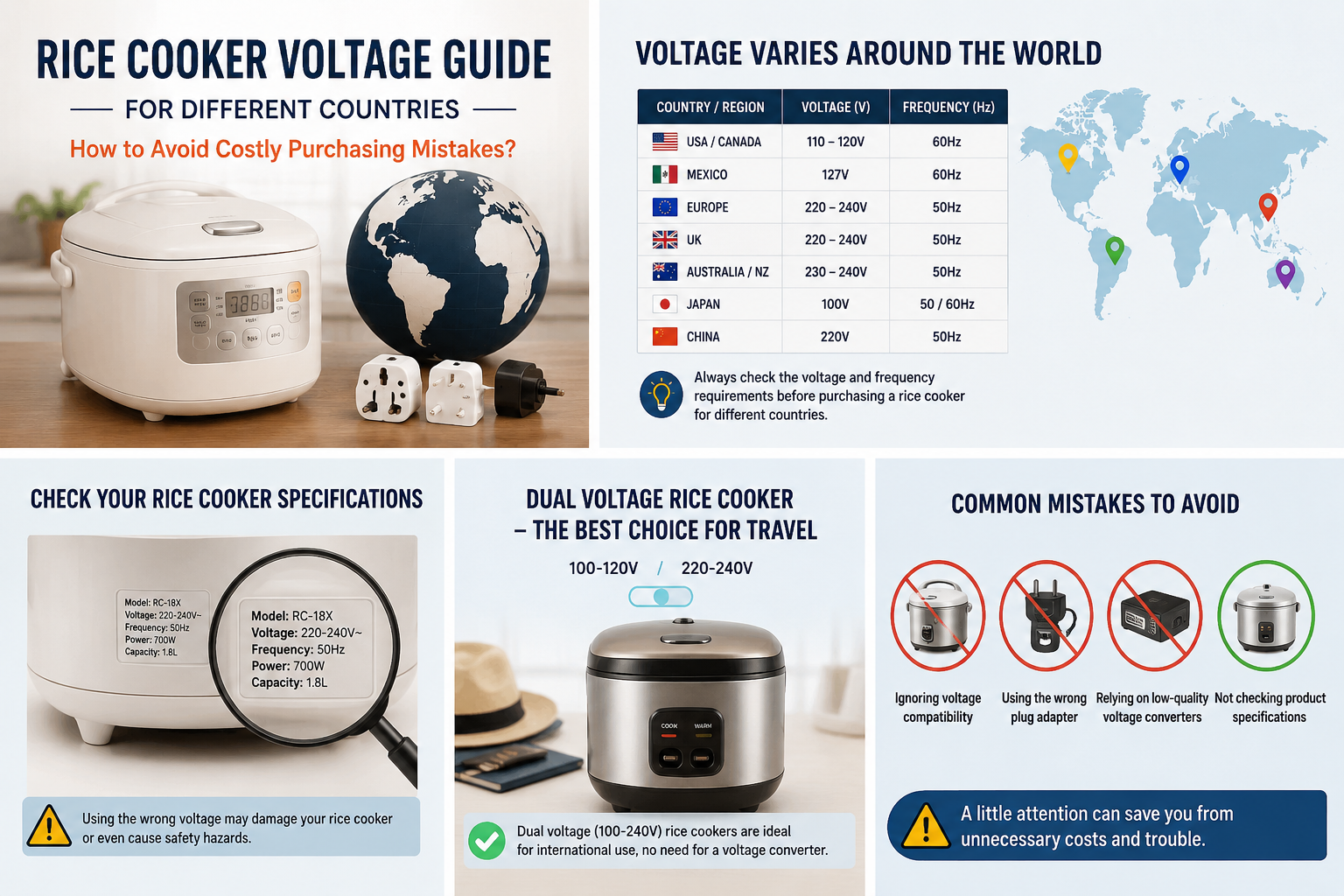
Major Market Voltage Zones and What They Mean for Your Inventory
When I consult with buyers planning regional expansion, I show them how to think in voltage zones instead of individual countries. This simplifies procurement and reduces version-management overhead.
110-120V Zone (60Hz dominant):
- North America: United States, Canada, Mexico
- Central America: Costa Rica, Panama, Guatemala, Honduras
- Caribbean: Cuba, Jamaica, Haiti
- South America: Colombia, Venezuela, Ecuador, parts of Brazil
- Asia: Japan, Taiwan, Philippines
220-240V Zone (50Hz dominant):
- Africa: Nearly universal (Nigeria, Kenya, Ghana, South Africa, Egypt, Ethiopia, Tanzania)5
- Europe: All countries6
- Middle East: Saudi Arabia, UAE, Kuwait, Jordan, Lebanon
- Asia: China, India, Indonesia, Malaysia, Thailand, Vietnam, Bangladesh, Pakistan
- Oceania: Australia, New Zealand
Mixed/Transition Markets:
- Brazil: 110V and 220V both exist depending on region7—verify buyer's specific location
- Saudi Arabia: Officially 220V but some older areas have 110V supply
- Philippines: 220V standard, but some rural areas have 110V—verify distribution location
If you're selling to Sub-Saharan Africa, your inventory should be 100% 220V. If you're targeting North and Central America, stock 110V versions. If you're covering both regions, maintain separate inventory pools—don't try to serve both with one version plus transformers.
Volume-Based Version Selection Strategy
One of the smartest buyers I work with operates in both West Africa and the Philippines. Both regions use 220V, but he also saw opportunity in Colombia (110V). Instead of stocking both versions equally, he analyzed his sales data:
- 75% of his volume came from Nigeria, Ghana, and Kenya (220V)
- 15% came from the Philippines (220V)
- 10% came from Colombia (110V)
His decision: Maintain deep 220V inventory and fulfill Colombian orders as special small-batch purchases with longer lead time. He didn't try to keep both versions in stock at equal depth. This reduced his working capital requirement and eliminated the risk of being stuck with slow-moving 110V inventory.
Your version selection should follow sales concentration:
- If 80%+ of revenue comes from one voltage zone: Stock only that version; treat other markets as special orders
- If you have 60-40 or closer split between zones: Maintain separate inventory for each zone with depth proportional to sales velocity
- If you're launching in a new market: Order minimum quantity in the correct voltage to test demand before committing to deep inventory
I've seen too many buyers order mixed-voltage containers because they wanted "flexibility." What they got was complexity, slower inventory turnover, and picking errors during fulfillment that sent wrong-voltage products to customers.
Customer Education Cost: The Hidden Decision Factor
Here's something most buyers don't consider when deciding between native voltage products and transformer-based solutions: how much customer education will you need to provide?
A Brazilian e-commerce seller tried to expand his product line by offering 110V rice cookers with transformers to 220V regions. His support ticket volume tripled. Customers asked:
- "How do I connect this transformer?"
- "Why is this so much bigger than my neighbor's rice cooker?"
- "Can I use this without the transformer?"
- "The instructions are confusing—can you send someone to set it up?"
He calculated that each transformer-related support interaction cost him $3-5 in staff time. With 15% of customers needing help, his "cost-saving" transformer strategy actually added $4.50 per unit in post-sale support cost.
Compare this to selling native-voltage products: customers plug into the wall and start cooking. No explanation needed. No setup complexity. No support tickets asking why the product looks different from what they expected.
When you're deciding whether to use transformers to serve a market with "wrong" voltage inventory, factor in:
- Setup explanation cost: Will you need to create instruction videos or multilingual setup guides?
- Support ticket volume increase: What percentage of customers will contact you with voltage/transformer questions?
- Return rate impact: How many customers will return the product because they find it "too complicated"?
In my experience, customer education cost makes transformer-based solutions uneconomical for B2C and small-business buyers unless you're selling high-value commercial equipment where complexity is expected.
What Happens If I Use a Rice Cooker with Wrong Voltage?
You've received an order, but you realize you shipped the wrong voltage version—or your customer is asking if they can "just try it anyway" with their wall outlet. What actually happens when voltage doesn't match?
Using a rice cooker with incorrect voltage causes immediate functional failure or component damage: 220V rice cookers plugged into 110V outlets will underheat (rice stays uncooked or takes 3-4x longer)8, while 110V rice cookers in 220V outlets will overheat instantly, burning heating elements and potentially creating fire hazards9. There is no safe way to operate rice cookers outside their rated voltage without proper conversion equipment.
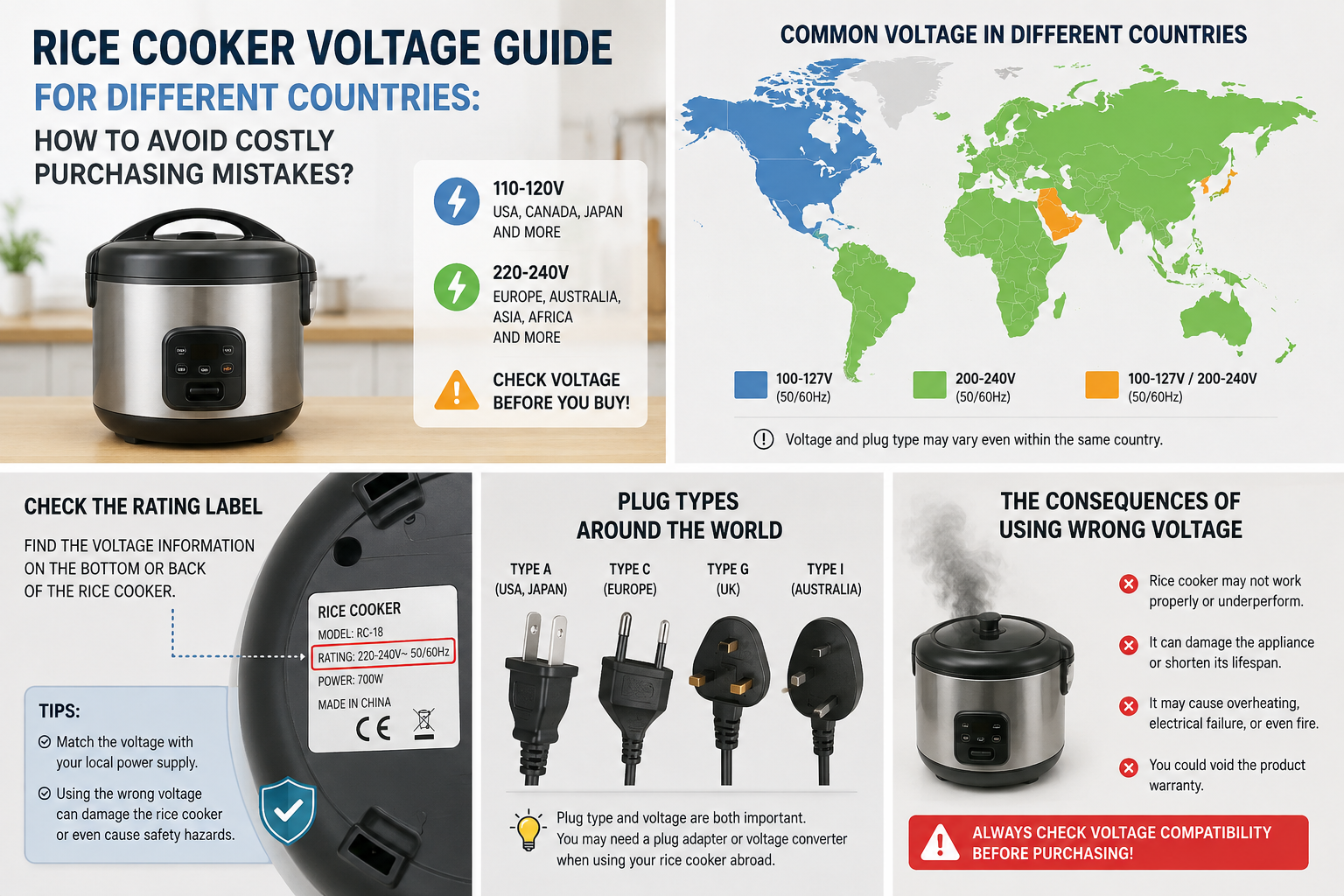
220V Rice Cooker in 110V Outlet: The Underperformance Problem
When buyers accidentally send 220V units to 110V markets, the product doesn't explode or spark—it just doesn't work properly. This creates a different kind of problem: customers use it, get frustrated, and blame product quality.
What actually happens:
- Heating element receives half the designed power: A 700W rice cooker becomes effectively a 175W device10
- Cooking time extends dramatically: Normal 20-minute cooking cycle becomes 60-80 minutes
- Rice texture suffers: Uneven heating leads to partially cooked grains, mushy texture, or undercooked centers
- Automatic shut-off may never trigger: Sensors designed for 220V heating curves don't detect completion at 110V heating rates
I've had buyers tell me their customers complained that "the rice cooker doesn't work" when actually it was just painfully slow and produced poor results. The customer doesn't know it's a voltage issue—they think the factory sent defective products. Your reputation suffers even though technically the product has no defect.
110V Rice Cooker in 220V Outlet: The Damage Problem
This scenario is more dangerous and more immediate. When 110V products receive 220V power, they fail fast and sometimes dramatically.
What happens within seconds:
- Heating element receives 4x the designed power: A 700W rice cooker suddenly tries to draw 2800W
- Internal wiring overheats: Insulation melts, connections fail, thermal fuses blow (if present)
- Electronic components burn out: Control boards designed for 110V input fail catastrophically
- Fire risk increases significantly: Overheated components can ignite plastic housing or surrounding materials
Last year, a customer in the Philippines received a shipment we sent to the wrong address—110V units meant for a U.S. buyer. One of his staff members plugged a rice cooker in to test it. The unit smoked within 10 seconds. Fortunately, no fire started, but the product was completely destroyed.
This is why I tell buyers: if you've made a voltage mistake, don't let customers "try it anyway." The risk isn't worth it. Arrange return or replacement immediately.
Frequency Mismatch: The Subtle Performance Degradation
Even when buyers use transformers to convert voltage correctly, they often overlook frequency differences between electrical grids. This creates problems that are harder to diagnose.
Frequency mismatch effects:
| Component | 50Hz Design in 60Hz System | 60Hz Design in 50Hz System |
|---|---|---|
| Heating element | No impact (purely resistive) | No impact (purely resistive) |
| Timer circuits | Runs 20% faster than set time | Runs 20% slower than set time |
| Motor-driven stirrers | Rotates 20% faster | Rotates 20% slower |
| Electronic controls | Timing loops may malfunction | Timing loops may malfunction |
A distributor in Saudi Arabia used transformers to operate 110V 60Hz rice cookers in 220V 50Hz environments. Voltage conversion worked perfectly. But his customers reported that rice was consistently overcooked and the "keep warm" mode turned off earlier than advertised. The timer circuits were running at the wrong speed because of frequency mismatch.
We had to explain that transformers convert voltage, not frequency—and that solving his problem required ordering the correct regional version, not better transformers.
How to Specify Voltage Requirements When Ordering Rice Cookers from Factories?
You're ready to place an order with a factory. You know which markets you're targeting, and you've decided which voltage version you need. How do you communicate your requirements clearly to avoid receiving the wrong specification?
Specify rice cooker voltage in your purchase order using exact voltage rating and frequency: state "220V 50Hz" or "110V 60Hz" explicitly rather than assuming the factory knows your target market requirements. Request voltage specification confirmation in the proforma invoice before payment, and require product label photos before shipment to verify correct version production.
Purchase Order Specification Language
I've seen buyers lose time and money because they didn't specify voltage clearly enough in their initial order. The factory assumes one version; the buyer expects another; both parties discover the mismatch after production is complete.
Use this specification format in your purchase order:
Clear specification (correct):
- Product: 1.8L multi-function rice cooker
- Voltage: 220V 50Hz
- Plug type: UK 3-pin (BS 1363)
- Quantity: 1,000 units
- Target market: Nigeria
Vague specification (leads to errors):
- Product: 1.8L multi-function rice cooker
- "For African market"
- Quantity:
"Mains electricity by country", https://en.wikipedia.org/wiki/Mains_electricity_by_country. International standards organizations document that household electrical systems worldwide predominantly use either 110-127V (common in the Americas and parts of East Asia) or 220-240V (standard across Europe, Africa, most of Asia, and Oceania), though the article's regional categorization should be verified against current country-specific data. Evidence role: general_support; source type: institution. Supports: the global distribution of household voltage standards across continents. Scope note: The source provides general voltage distribution patterns but may not reflect recent infrastructure changes in specific countries or regions with mixed systems. ↩
"How to Handle International Returns: A Guide for E- ...", https://us.meest.com/news/international-returns-ecommerce-guide. E-commerce and logistics research indicates that international return shipping for low-to-mid-value consumer goods often approaches or exceeds the original product cost due to customs processing, international freight rates, and handling fees, making returns economically unviable for many cross-border transactions. Evidence role: general_support; source type: research. Supports: the economic challenge of international product returns. Scope note: Return cost ratios vary significantly based on product value, shipping method, trade agreements, and specific country pairs involved. ↩
"Does frequency changes when transformers steps down a ...", https://www.facebook.com/groups/electricalengineeringquestion/posts/1059798540792512/. Electrical engineering principles confirm that conventional transformers change voltage through electromagnetic induction but cannot alter the frequency of alternating current, which remains determined by the input power source. Evidence role: mechanism; source type: education. Supports: the technical limitation that standard voltage transformers cannot alter electrical frequency. ↩
"Mains electricity by country", https://en.wikipedia.org/wiki/Mains_electricity_by_country. International electrical standards documentation shows that 60Hz is standard in the Americas and parts of East Asia (including the United States, Canada, and Japan), while 50Hz predominates in Europe, most of Africa, and much of Asia, though specific country verification is recommended for procurement decisions. Evidence role: general_support; source type: encyclopedia. Supports: the distribution of 50Hz and 60Hz electrical frequency standards across different regions. ↩
"Mains electricity by country", https://en.wikipedia.org/wiki/Mains_electricity_by_country. International electrical standards documentation confirms that virtually all African countries use 220-240V household electrical systems, largely inherited from European colonial-era infrastructure standards, making voltage uniformity across the continent an exception to global voltage diversity. Evidence role: general_support; source type: institution. Supports: the predominance of 220-240V systems across African nations. ↩
"Mains electricity by country", https://en.wikipedia.org/wiki/Mains_electricity_by_country. European electrical standards have been harmonized to a nominal 230V (with tolerance ranges accommodating former 220V and 240V systems) across all EU member states and most other European countries, representing one of the world's most uniform regional voltage standards. Evidence role: general_support; source type: institution. Supports: the standardization of electrical voltage across European countries. ↩
"Electricity sector in Brazil", https://en.wikipedia.org/wiki/Electricity_sector_in_Brazil. Brazil maintains a historically complex electrical infrastructure with both 127V and 220V systems distributed across different regions and cities, a legacy of independent early electrification that makes it an exception to typical single-voltage national standards. Evidence role: historical_context; source type: encyclopedia. Supports: Brazil's unusual dual-voltage electrical system. Scope note: Voltage distribution within Brazil continues to evolve, and specific locations should be verified rather than relying on regional generalizations. ↩
"Why can I use P = I²R but not P=V²/R when calculating ...", https://electronics.stackexchange.com/questions/273727/why-can-i-use-p-i%C2%B2r-but-not-p-v%C2%B2-r-when-calculating-energy-lost-in-a-circuit. According to electrical power principles, power in resistive loads follows P=V²/R, meaning a device designed for 220V operating at 110V receives approximately one-quarter of its rated power, though the article's specific 3-4x cooking time estimate represents a practical approximation rather than a precise calculation. Evidence role: mechanism; source type: education. Supports: the relationship between voltage and power in resistive heating elements. Scope note: The exact cooking time increase depends on multiple factors including thermal mass, insulation, and ambient temperature, not solely on power reduction. ↩
"Appliance and Electrical Fire Safety - USFA.FEMA.gov", https://www.usfa.fema.gov/prevention/home-fires/prevent-fires/appliance-and-electrical/. Electrical safety principles indicate that applying double the rated voltage to a resistive device quadruples power dissipation (per P=V²/R), causing rapid overheating that can damage insulation, melt components, and create fire risks in devices lacking adequate overvoltage protection. Evidence role: mechanism; source type: education. Supports: the mechanism by which overvoltage causes equipment damage and safety hazards. ↩
"3TM - Voltage Drop Calculator", https://www.southwire.com/calculator-vdrop. Using the electrical power formula P=V²/R for resistive heating elements, a 700W device rated for 220V operating at 110V would theoretically produce approximately 175W (one-quarter power), assuming constant resistance. Evidence role: mechanism; source type: education. Supports: the mathematical relationship showing that halving voltage reduces power to one-quarter in resistive loads. Scope note: This calculation assumes purely resistive heating elements; actual performance may vary with temperature-dependent resistance changes and control circuit behavior. ↩