What Rice Cooker Export Documents Do You Really Need from China?
Many overseas buyers ask us the same question before placing an order: "What export documents will you provide?" But I have learned that this question often comes too early. The real issue is not what papers the factory can give you, but whether those papers will let your rice cookers clear customs, pass inspection, and legally reach store shelves in your market.
You need to match documents to your destination country, product model, voltage, plug type, and packaging language before you order. Basic export papers support shipment, but market-specific certificates and test reports determine whether your rice cookers can be cleared, labeled, and sold legally where you plan to sell them.
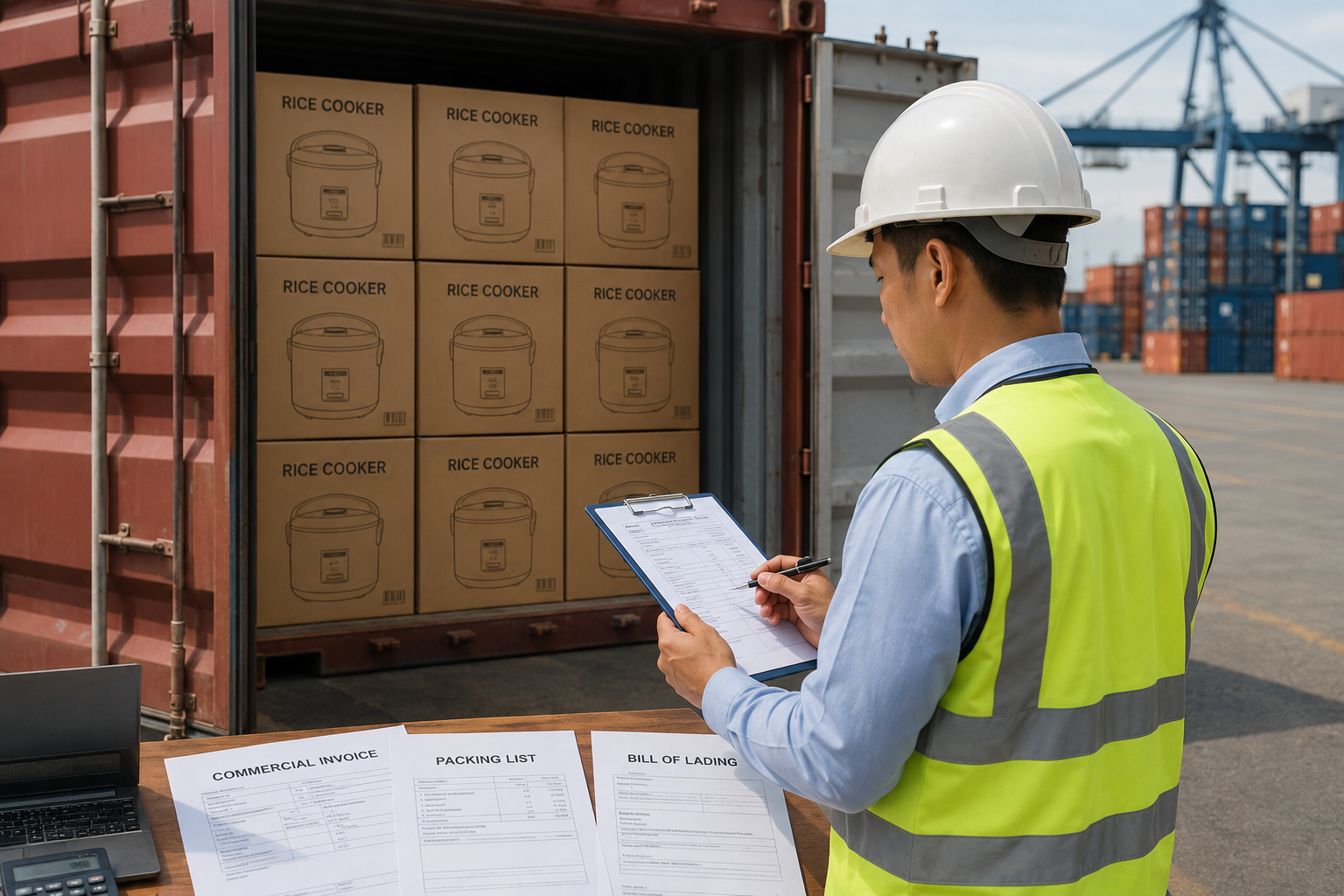
I work in a rice cooker factory in Lianjiang, Guangdong, China. We ship to Africa, Latin America, and Asia. Every week, importers ask us for a document list. But when I send a standard list, many buyers later discover the certificates do not match their model, voltage, or market rules. Some goods clear customs but cannot be sold. Some are rejected because the plug or label language is wrong. This article will show you what to confirm before you ask for documents.
Why Does Every Market Need Different Rice Cooker Export Documents?
Buyers often assume that one set of export documents works everywhere. They believe a factory document list will solve all import problems. But rice cooker import rules are not universal. Each country has different safety standards, voltage requirements, plug types, labeling laws, and customs procedures.1
Different countries require different product certificates, test reports, labeling formats, and sometimes pre-shipment inspection or import licenses. Basic export documents support shipping, but they do not replace market-entry compliance documents required by your destination country.
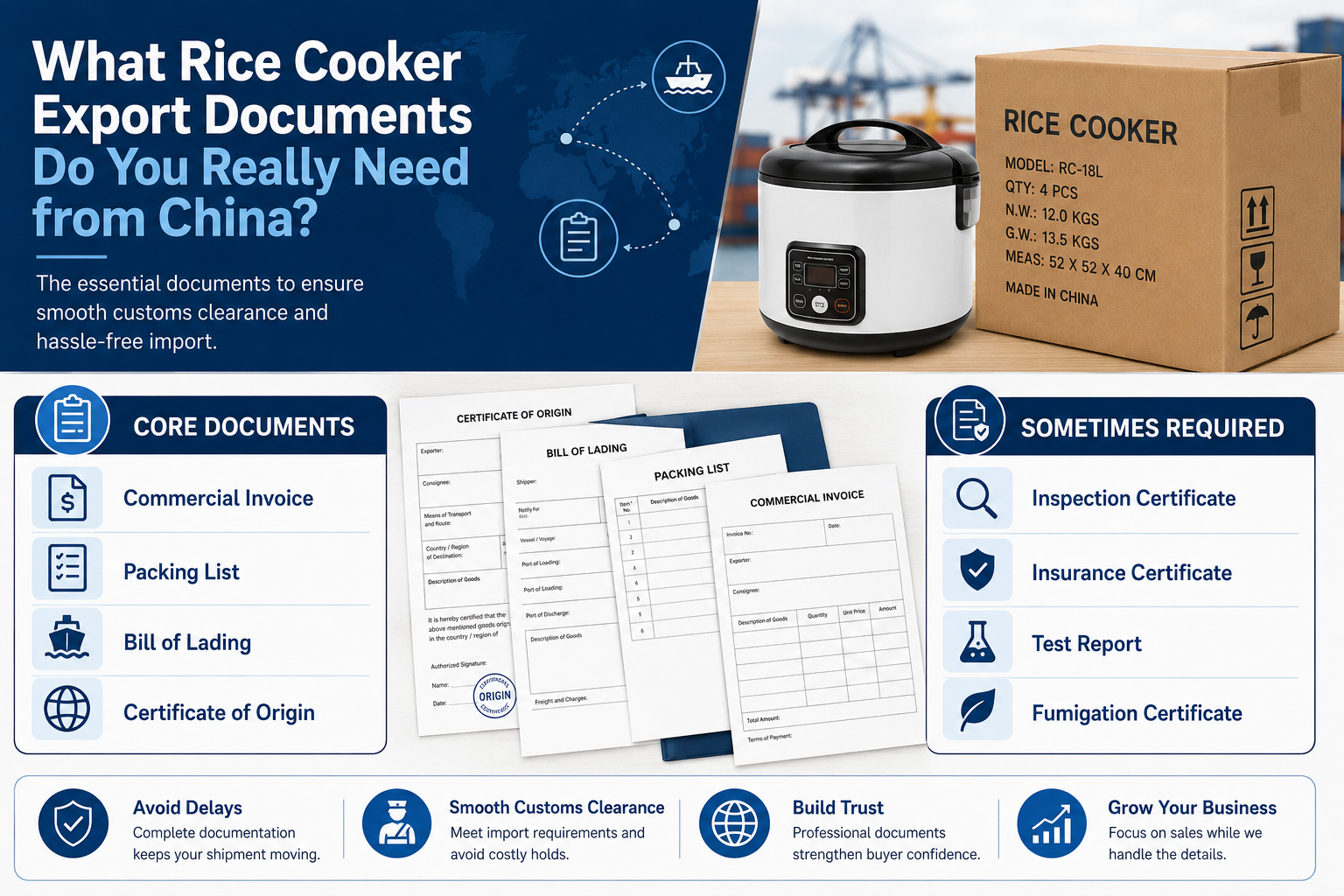
When I talk to buyers from Kenya, Brazil, or Indonesia, I hear the same mistake: they focus only on customs clearance documents and ignore product compliance. Customs may release the goods with a commercial invoice, packing list, and bill of lading. But if your rice cookers lack the correct safety certificate, test report, voltage label, or local-language user manual, they may be stopped by product inspection authorities, returned by retailers, or banned from sale.
Here is a simple comparison of what different markets typically require beyond basic export documents:
| Market Region | Typical Compliance Documents | Common Additional Requirements |
|---|---|---|
| European Union | CE certificate, RoHS/REACH test reports, DoC2 | Energy label, user manual in local language, WEEE symbol3 |
| United States | UL/ETL certificate, FCC test report4 | Energy Guide label, voltage/frequency match (120V/60Hz) |
| Middle East (GCC) | SASO/ESMA/GSO certificate5 | Arabic label, specific plug type (BS1363/Type G common) |
| Africa (various) | SONCAP, COC, or PVOC certificate6 | Pre-shipment inspection, specific voltage (220V or 240V) |
| Latin America | NOM (Mexico), INMETRO (Brazil), or local certificate7 | Voltage match (110V or 220V), Spanish/Portuguese manual |
| Southeast Asia | Country-specific safety mark (e.g., SIRIM, SNI)8 | Voltage/frequency match, local-language label |
You must confirm destination-market rules before you order. Do not assume factory documents will cover all local requirements.
What Are the Basic Rice Cooker Export Documents from China?
Basic export documents support shipment and customs declaration. They do not prove product safety or market compliance. These documents help your freight forwarder and customs broker process the shipment, but they do not guarantee your rice cookers can be sold legally in your market.
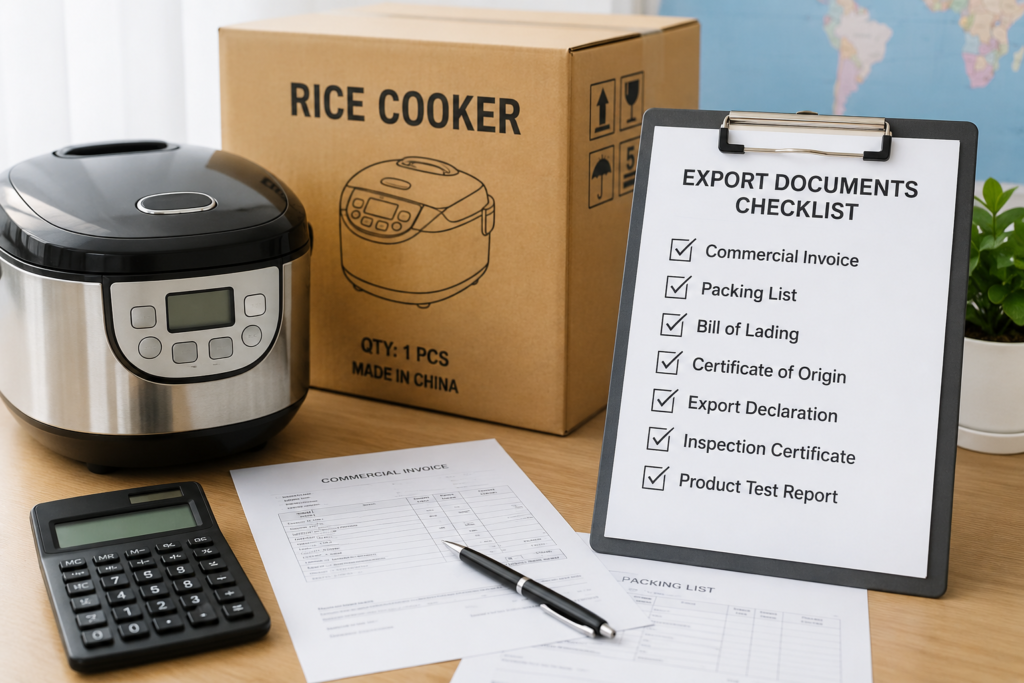
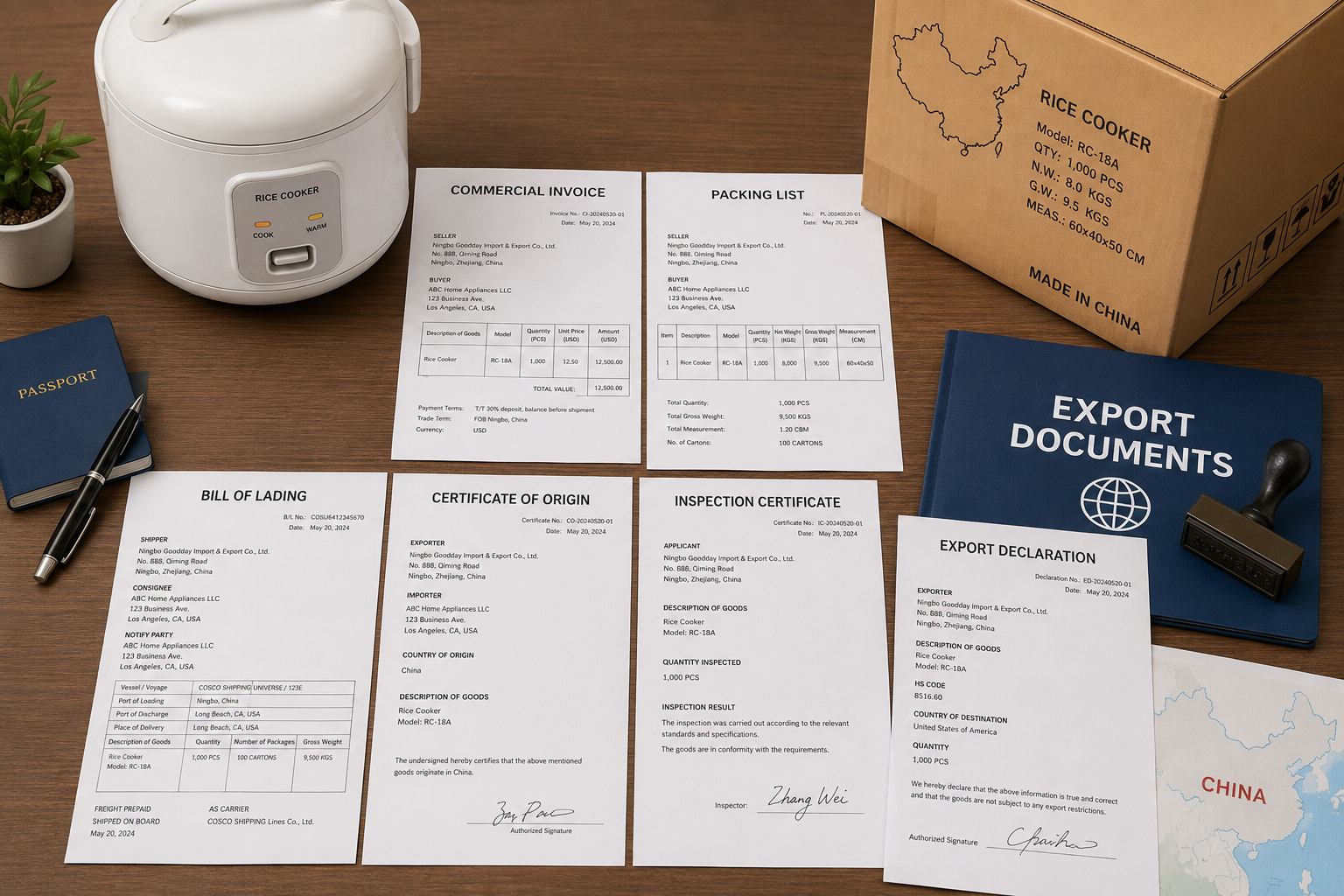
Basic export documents include the commercial invoice, packing list, bill of lading (or air waybill), certificate of origin, and sometimes a fumigation certificate or Form E/Form A for tariff preference. These documents support shipping and customs clearance but do not replace product compliance certificates.
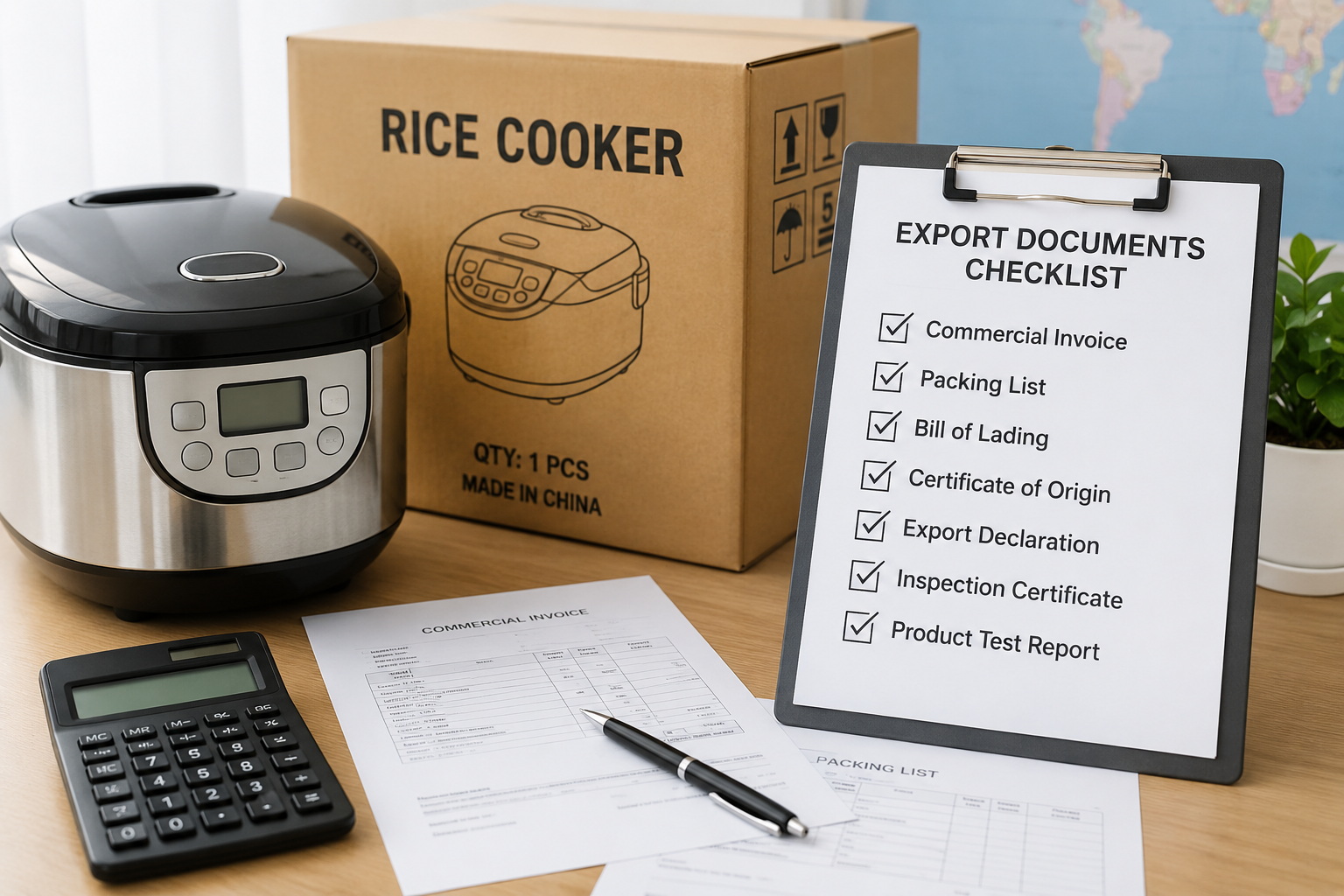
I will explain each document and what risk it addresses:
Commercial Invoice: This is the seller's bill. It lists product description, quantity, unit price, total value, payment terms, and HS code9. Customs uses this to calculate import duty. If the invoice description or value is unclear or incorrect, customs may delay your shipment or reassess duty. We always confirm the exact product name, model number, and HS code with the buyer before we issue the invoice.
Packing List: This document shows how goods are packed: carton count, net weight, gross weight, carton dimensions, and product quantity per carton. Customs and your warehouse need this to verify the shipment and plan unloading. If the packing list does not match the actual cartons, customs may open every box and delay clearance.
Bill of Lading (B/L) or Air Waybill (AWB): This is the transport contract and proof of shipment. The B/L (for sea freight) or AWB (for air freight) shows shipper, consignee, port of loading, port of discharge, container number, and freight terms. You need the original B/L to collect goods at the port. If there is any error in consignee name or destination, you may not be able to release the cargo.
Certificate of Origin (CO): This document certifies the country where the rice cookers are made. Some countries require a CO to apply preferential tariff rates under trade agreements (such as Form E for ASEAN, Form A for GSP). If your market offers lower duty for Chinese goods under a trade agreement, you should request the correct form of CO before shipment.
Fumigation Certificate: If your shipment uses wooden pallets or wooden packaging, some countries (such as Australia, New Zealand, or the U.S.) require an IPPC-stamped fumigation certificate10 to prove the wood is treated and pest-free. Without this, customs may reject the shipment or require re-fumigation at the port.
These documents are necessary but not sufficient. They do not prove your rice cooker is safe, certified, or legal to sell in your market.
What Product Compliance Documents Should You Confirm Before You Order?
Product compliance documents prove your rice cooker meets safety, electrical, electromagnetic compatibility (EMC), and environmental standards in your destination market. Basic export documents do not cover this. If you order rice cookers without confirming compliance documents, you may face customs rejection, product recalls, or sales bans.
Product compliance documents include safety certificates (such as CE, UL, SASO), test reports (safety, EMC, RoHS), Declaration of Conformity (DoC), user manuals, and product labels in the required language. These documents prove your rice cooker is legal to enter and be sold in your market.
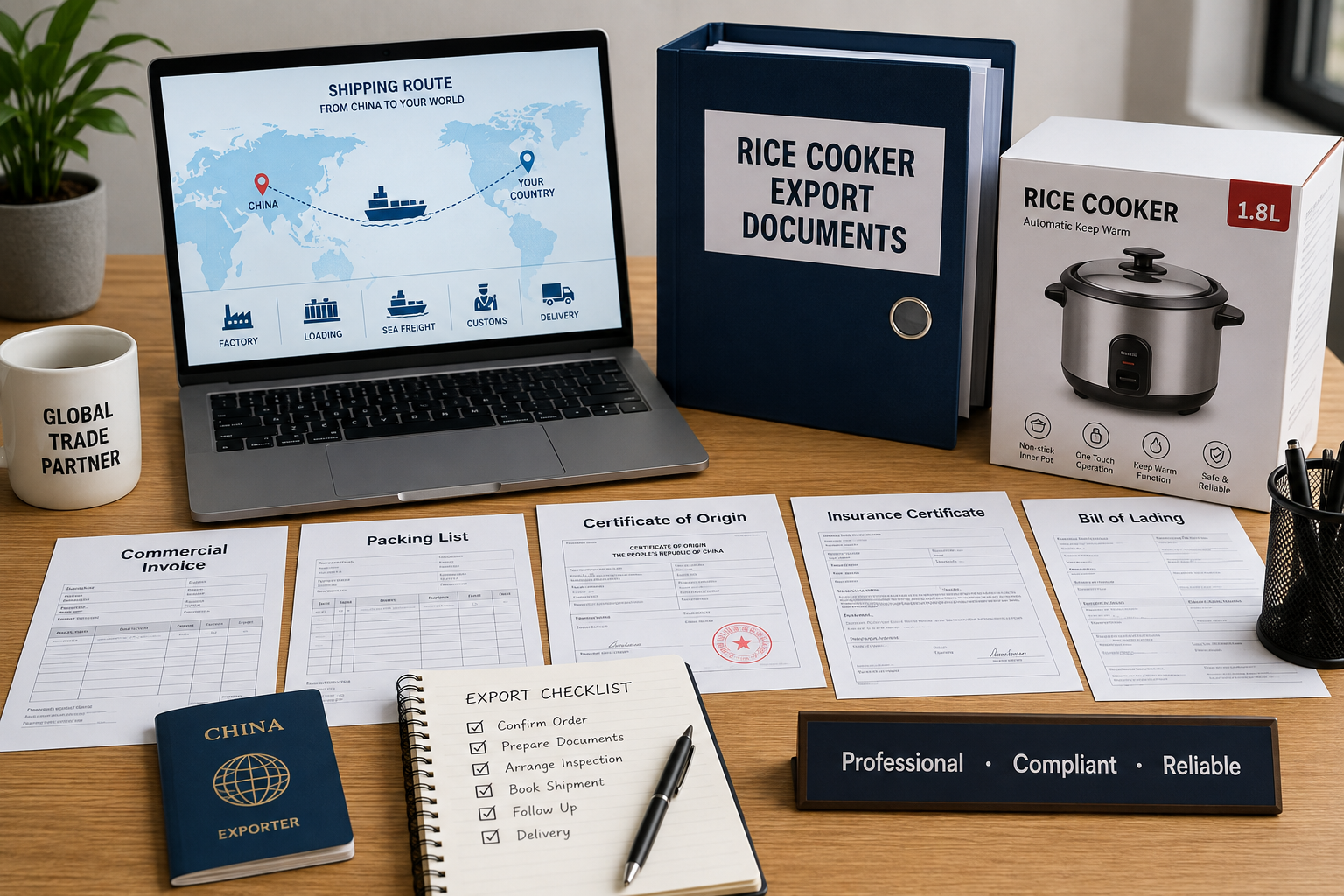
I have seen many buyers order rice cookers based only on price and factory photos. They do not ask about certificates until the goods are ready to ship. Then they discover the factory certificate is for a different model, voltage, or plug type. The buyer must either accept non-compliant goods or delay shipment and pay for re-testing and re-certification. Both options cost time and money.
Here is what you should confirm before you order:
Safety Certificate: This proves the rice cooker meets electrical safety standards. Common certificates include CE (Europe), UL/ETL (USA), SASO/ESMA (GCC countries), SONCAP (Nigeria), PVOC (Kenya), INMETRO (Brazil), or country-specific marks. You must confirm the certificate covers your exact model, voltage, and plug type. A certificate for a 220V/50Hz rice cooker with a European plug does not cover a 110V/60Hz version with a U.S. plug.
Test Reports: Certificates are often issued based on test reports from accredited labs11. The test report shows detailed safety, EMC, or RoHS test results. Some countries require you to submit the test report with the certificate during customs clearance or product registration. Ask the factory for a copy of the test report and check that the model number, voltage, frequency, and tested sample match your order.
Declaration of Conformity (DoC): In the EU, the manufacturer or importer must issue a DoC stating the product meets all applicable EU directives (such as Low Voltage Directive, EMC Directive, RoHS Directive12). The DoC must list the product model, applicable standards, and the party responsible. As an importer, you may need to hold a copy and present it to authorities if asked.
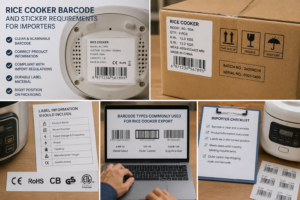
User Manual and Product Label: Many countries require the user manual and product label to be in the local language, include specific safety warnings, show correct voltage and frequency, display certification marks, and list the importer or responsible party. If your rice cooker label is in Chinese or English only, and your market requires Spanish, Arabic, or French, customs or product inspectors may stop your goods.
RoHS/REACH Compliance: The EU and some other markets restrict hazardous substances in electrical products. You may need a RoHS test report or a supplier's declaration confirming the rice cooker does not contain banned substances such as lead, mercury, cadmium, or certain phthalates.
Pre-shipment Inspection Certificate (if required): Some African and Middle Eastern countries require a pre-shipment inspection company (such as SGS, Intertek, or Bureau Veritas) to inspect the goods and issue a Certificate of Conformity (COC) or Clean Report of Findings (CRF) before shipment. Without this certificate, customs will not release the goods. You must arrange this inspection before the goods leave China.
I recommend you create a compliance checklist with your freight forwarder or local import agent before you place the order. Do not assume the factory's standard document package will meet your market's rules.
How Do You Make Sure Certificates Match Your Rice Cooker Model and Market?
One of the most common problems I see is certificate mismatch. The factory shows a CE certificate, but the certificate is for a different model, voltage, or plug type. The buyer assumes the certificate is valid for all rice cookers from that factory. Then customs or product inspectors reject the goods because the certificate does not match the actual product.
Certificates are issued for specific models, voltage ratings, frequency, plug types, and sometimes packaging or labeling details. You must confirm the certificate scope covers your exact product configuration. If your order uses a different voltage, plug, or model number, the factory may need a new certificate or an extension to the existing certificate.
When a buyer asks for a CE certificate, I always ask: what is your destination country, what voltage do you need, what plug type, and what product model? If the buyer wants 220V with a European plug for Germany, I can provide a CE certificate that matches. If another buyer wants 110V with a U.S. plug for Panama, the same CE certificate does not apply. The buyer may need a different certificate or a UL listing.
Here is a step-by-step process I use with buyers to avoid certificate mismatch:
Step 1: Confirm Destination Market: Tell the factory which country or region you will import to. Different markets have different certification systems. A SASO certificate works in Saudi Arabia but not in Brazil.
Step 2: Confirm Product Model, Voltage, and Frequency: Tell the factory the exact rice cooker model, voltage (110V, 220V, or dual voltage), and frequency (50Hz, 60Hz, or both). The certificate must list these specifications.
Step 3: Confirm Plug Type: Tell the factory the plug type your market uses (Type A, Type C, Type G, etc.). The certificate and safety testing often include the plug and cord. If you change the plug, the certificate may become invalid.
Step 4: Check Certificate Scope and Model List: Ask the factory for a copy of the certificate. Check the model number, voltage, frequency, and plug type listed on the certificate. Make sure they match your order exactly. If the certificate lists "Model XYZ-220V" and you order "Model XYZ-110V", the certificate does not cover your product.
Step 5: Confirm Label and Packaging Language: Some certificates require the product label and user manual to be in a specific language or format. If your market requires a Spanish manual and the certificate assumes an English manual, you may need to update the certificate or issue a new DoC.
Step 6: Ask About Certificate Validity Period: Certificates often have expiry dates or are valid as long as the product design does not change. If the factory updated the rice cooker's circuit board or housing, the old certificate may no longer be valid. Ask when the certificate was issued and whether the current production matches the certified sample.
I have worked with buyers who ordered 10,000 rice cookers based on a certificate photo, only to discover at customs that the certificate was for a different model. The goods were held, and the buyer had to pay for storage and eventually re-export. Confirm certificate details before you pay the deposit.
What Should You Ask Your Freight Forwarder or Local Agent Before Ordering?
Your freight forwarder or local import agent knows your destination market's rules better than the Chinese factory. The factory can provide export documents and product certificates, but your forwarder or agent can confirm whether those documents are enough for customs clearance, product registration, and legal sales.
Before you order, ask your freight forwarder or local import agent what documents, certificates, product labels, and packaging requirements are needed for rice cooker import in your market. Get a written checklist and share it with the factory. Do not rely only on the factory's standard document list.
I recommend you ask your forwarder or agent these questions before you confirm the order:
| Question | Why It Matters |
|---|---|
| What certificates or test reports are required to clear customs and sell rice cookers in my market? | Some markets require product registration or certificate submission before or during customs clearance. If you do not have the correct certificate, goods may be rejected or held. |
| Do I need a pre-shipment inspection or Certificate of Conformity (COC)? | Many African and Middle Eastern countries require COC from SGS, Intertek, or Bureau Veritas before shipment. If you ship without it, customs will not release the goods. |
| What must the product label include (language, voltage, certification mark, importer name)? | Incorrect labels can trigger rejection by product safety authorities even if customs clears the goods. |
| What must the user manual include (language, warnings, voltage, frequency)? | Some markets require the manual to be in the local language and include specific safety warnings. English-only manuals may not be acceptable. |
| What is the correct HS code and import duty rate for rice cookers? | Using the wrong HS code can cause customs delays, duty reassessment, or penalties. Your forwarder can confirm the correct code. |
| Do I need an import license or product registration before I can import or sell rice cookers? | Some markets require you to register the product or obtain an import license before you ship. If you do not, goods may be held or returned. |
| Are there energy efficiency or environmental labeling requirements? | The EU and some other markets require energy labels or recycling symbols (such as WEEE). Your factory may need to add these to the packaging or product. |
Once you have clear answers, send the checklist to the factory and ask them to confirm they can meet all requirements. If the factory cannot provide a required certificate or document, you may need to find a different supplier or pay for new testing and certification.
I have seen buyers who skip this step and rely only on the factory's promises. Later, they discover the factory's standard documents do not meet local rules. The buyer must either accept non-compliant goods or cancel the order and lose the deposit.
Can a Factory Provide All Compliance Documents, or Do You Need to Arrange Some Yourself?
Buyers often ask me: "Can you provide all the documents I need?" The honest answer is: we can provide export documents and product certificates that we have already obtained for our rice cooker models. But we cannot guarantee those certificates are valid for your specific market, voltage, plug, or sales channel. And we cannot provide documents that must be issued by the importer, such as a DoC or import license.
A factory can provide basic export documents (invoice, packing list, B/L, CO) and any product certificates or test reports the factory has already obtained (such as CE, SASO, or test reports from accredited labs). But the importer is often responsible for issuing the Declaration of Conformity, registering the product with local authorities, obtaining import licenses, and confirming labeling compliance.
Here is a clear breakdown of who typically provides what:
Factory Responsibilities:
- Prepare and issue the commercial invoice, packing list, and any other shipping documents.
- Arrange the Bill of Lading or Air Waybill with the freight forwarder or shipping line.
- Apply for and provide the Certificate of Origin (CO, Form E, Form A) if needed.
- Provide copies of any product certificates (CE, UL, SASO, etc.) that the factory has already obtained for the product model, voltage, and plug type you ordered.
- Provide copies of test reports from accredited labs
"International Electrotechnical Commission - Wikipedia", https://en.wikipedia.org/wiki/International_Electrotechnical_Commission. International standards organizations and trade bodies document significant variation in national electrical safety standards, voltage systems, and product certification requirements across markets, though harmonization efforts through IEC standards have achieved partial alignment in some regions. Evidence role: general_support; source type: institution. Supports: International variation in electrical product safety standards and regulatory frameworks. Scope note: General regulatory landscape rather than rice-cooker-specific requirements ↩
"European Union Reduction of Hazardous Substances RoHS and ...", https://www.waru.edu/artifact/european-union-reduction-hazardous-substances-rohs-and-waste-electrical-and-electronic. EU directives including the Low Voltage Directive (2014/35/EU), EMC Directive (2014/30/EU), and RoHS Directive (2011/65/EU) establish conformity assessment requirements for electrical household appliances placed on the EU market, requiring manufacturers to issue declarations of conformity and affix CE marking. Evidence role: general_support; source type: government. Supports: EU regulatory requirements for electrical household appliances including conformity assessment. ↩
"Waste Electrical and Electronic Equipment Directive - Wikipedia", https://en.wikipedia.org/wiki/Waste_Electrical_and_Electronic_Equipment_Directive. The EU Waste Electrical and Electronic Equipment Directive (2012/19/EU) requires electrical and electronic equipment to be marked with the crossed-out wheeled bin symbol to indicate that the product should not be disposed of as unsorted municipal waste and is subject to separate collection requirements. Evidence role: general_support; source type: government. Supports: EU requirements for waste electrical equipment marking. ↩
"Equipment Authorization – RF Device | Federal Communications ...", https://www.fcc.gov/oet/ea/rfdevice. While UL and ETL certifications are not federally mandated for household cooking appliances in the US, many retailers and jurisdictions require products to meet UL standards or equivalent; FCC regulations apply to devices that may cause electromagnetic interference, though simple resistive heating appliances may be exempt. Evidence role: general_support; source type: government. Supports: US safety and electromagnetic compatibility requirements for electrical appliances. Scope note: UL/ETL certification is often market-driven rather than legally required; FCC applicability depends on product design ↩
"New Electrical/Electronic Device Regulations in Saudi Arabia", https://www.ul.com/insights/new-electricalelectronic-device-regulations-saudi-arabia. Gulf Cooperation Council member states operate national conformity assessment schemes (such as SASO in Saudi Arabia and ESMA in the UAE) that require certification of electrical appliances against GSO standards before import, with specific requirements varying by country. Evidence role: general_support; source type: government. Supports: GCC member states' certification requirements for electrical appliances. ↩
"Kenya Pre-Verification of Conformity (PVOC) Program", https://www.trade.gov/market-intelligence/kenya-pre-verification-conformity-pvoc-program. Several African countries operate mandatory pre-shipment inspection programs: Nigeria's SONCAP (Standards Organisation of Nigeria Conformity Assessment Programme), Kenya's PVOC (Pre-Export Verification of Conformity), and similar Certificate of Conformity schemes in other nations require third-party inspection and certification before goods can be imported. Evidence role: general_support; source type: government. Supports: Pre-shipment inspection and conformity assessment programs in African markets. ↩
"[PDF] A Guide to United States Electrical and Electronic Equipment ...", https://www.govinfo.gov/content/pkg/GOVPUB-C13-0682938c1e1905c4b41b333ce781ef9c/pdf/GOVPUB-C13-0682938c1e1905c4b41b333ce781ef9c.pdf. Mexico's NOM (Normas Oficiales Mexicanas) system and Brazil's INMETRO (National Institute of Metrology, Quality and Technology) operate mandatory certification programs for electrical household appliances, requiring products to meet national standards and obtain certification before they can be legally sold in these markets. Evidence role: general_support; source type: government. Supports: Mandatory certification schemes in Mexico and Brazil for electrical products. ↩
"SIRIM Certification For Malaysia | SIRIM Mark - C-PRAV", https://c-prav.com/sirim-certification-mark-malaysia/. Southeast Asian nations maintain individual certification schemes: Malaysia's SIRIM (Standards and Industrial Research Institute of Malaysia) and Indonesia's SNI (Standar Nasional Indonesia) certification are examples of mandatory conformity marks required for electrical appliances in their respective markets. Evidence role: case_reference; source type: government. Supports: National certification requirements in Southeast Asian countries. Scope note: Examples rather than comprehensive coverage of all Southeast Asian requirements ↩
"Harmonized System (HS) Codes - International Trade Administration", https://www.trade.gov/harmonized-system-hs-codes. The Harmonized Commodity Description and Coding System (HS) is an international nomenclature developed by the World Customs Organization for the classification of products in international trade, used by over 200 countries and economies as the basis for customs tariffs and trade statistics. Evidence role: definition; source type: institution. Supports: The Harmonized System as an international product classification standard. ↩
"[PDF] ISPM 15: Regulation of wood packaging material in international trade", https://www.ippc.int/static/media/files/publication/en/2019/02/ISPM_15_2018_En_WoodPackaging_Post-CPM13_Rev_Annex1and2_Fixed_2019-02-01.pdf. The International Plant Protection Convention's ISPM 15 standard establishes requirements for wood packaging material used in international trade, requiring treatment (heat treatment or fumigation) and marking with an IPPC-approved stamp to prevent pest transmission; many countries mandate compliance with this standard. Evidence role: general_support; source type: institution. Supports: International standards for wood packaging material in trade. ↩
"Electrical Product Testing & Engineering Evaluation", https://lni.wa.gov/licensing-permits/electrical/electrical-installation-information/electrical-product-testing-and-engineering-evaluation. Testing laboratories can obtain accreditation to ISO/IEC 17025 from national accreditation bodies, demonstrating technical competence to perform specific tests; regulatory authorities and certification bodies often require test reports from accredited laboratories to ensure reliability and international recognition of test results. Evidence role: general_support; source type: institution. Supports: Laboratory accreditation systems for product testing. ↩
"RoHS - Wikipedia", https://en.wikipedia.org/wiki/RoHS. The EU Restriction of Hazardous Substances Directive (2011/65/EU, as amended) restricts the use of specific hazardous materials including lead, mercury, cadmium, hexavalent chromium, and certain brominated flame retardants and phthalates in electrical and electronic equipment placed on the EU market. Evidence role: mechanism; source type: government. Supports: EU restrictions on hazardous substances in electrical and electronic equipment. ↩