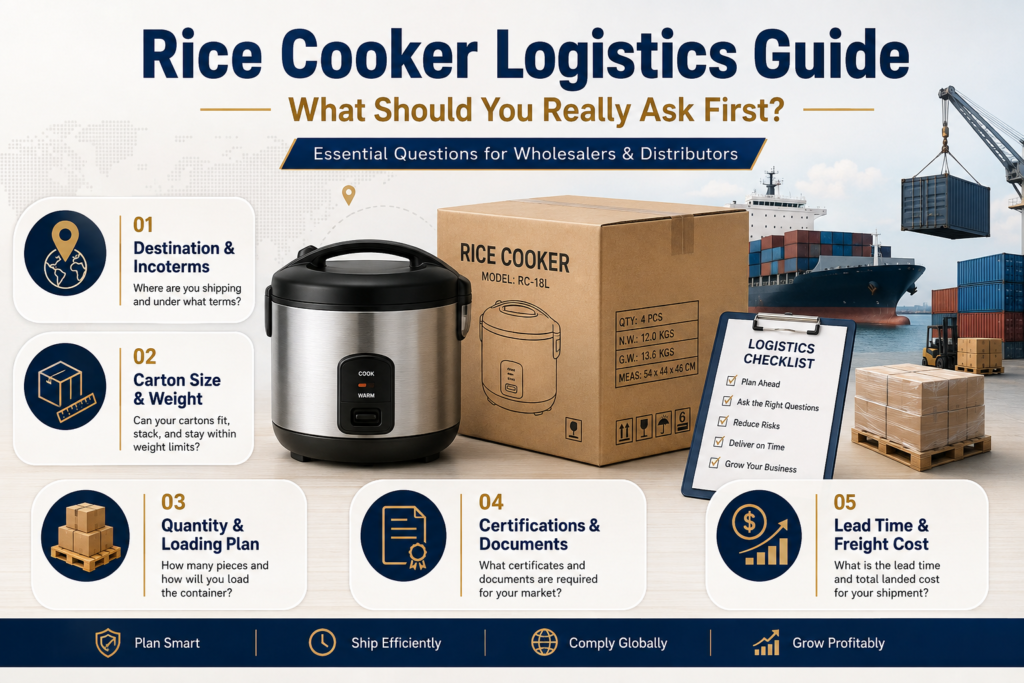
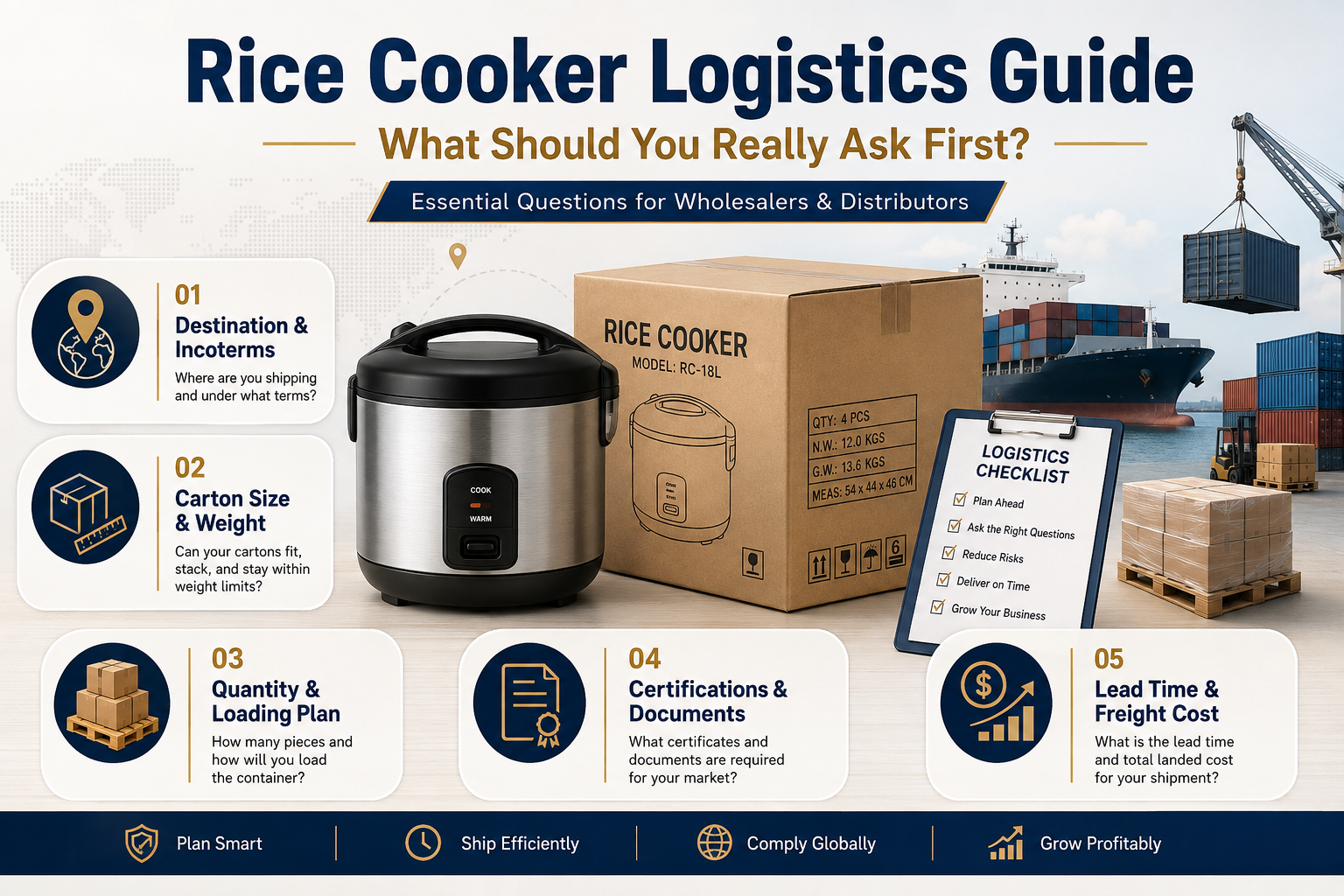
Rice Cooker Logistics Guide for Wholesalers and Distributors: What Should You Really Ask First?
I still remember the day a Lagos distributor called us about a damaged shipment. He'd ordered 500 units, negotiated the unit price down to the cent, arranged his own freight forwarder — and then opened containers to find 47 rice cookers with cracked lids. The problem? He never asked about our inner packaging specification. We'd quoted him based on standard foam thickness, but his forwarder consolidated the shipment with heavier cargo on top. That conversation taught me something: most wholesalers are asking the wrong first question.
If you're sourcing rice cookers from Chinese factories, your real logistics decision doesn't start with unit price — it starts with three inputs you need before asking for a quote: your destination port, your order quantity, and the packaging spec your shipment route actually requires. Get these three elements wrong, and you'll either pay 30–40% more in freight per unit or spend months disputing damage claims you can't actually win.
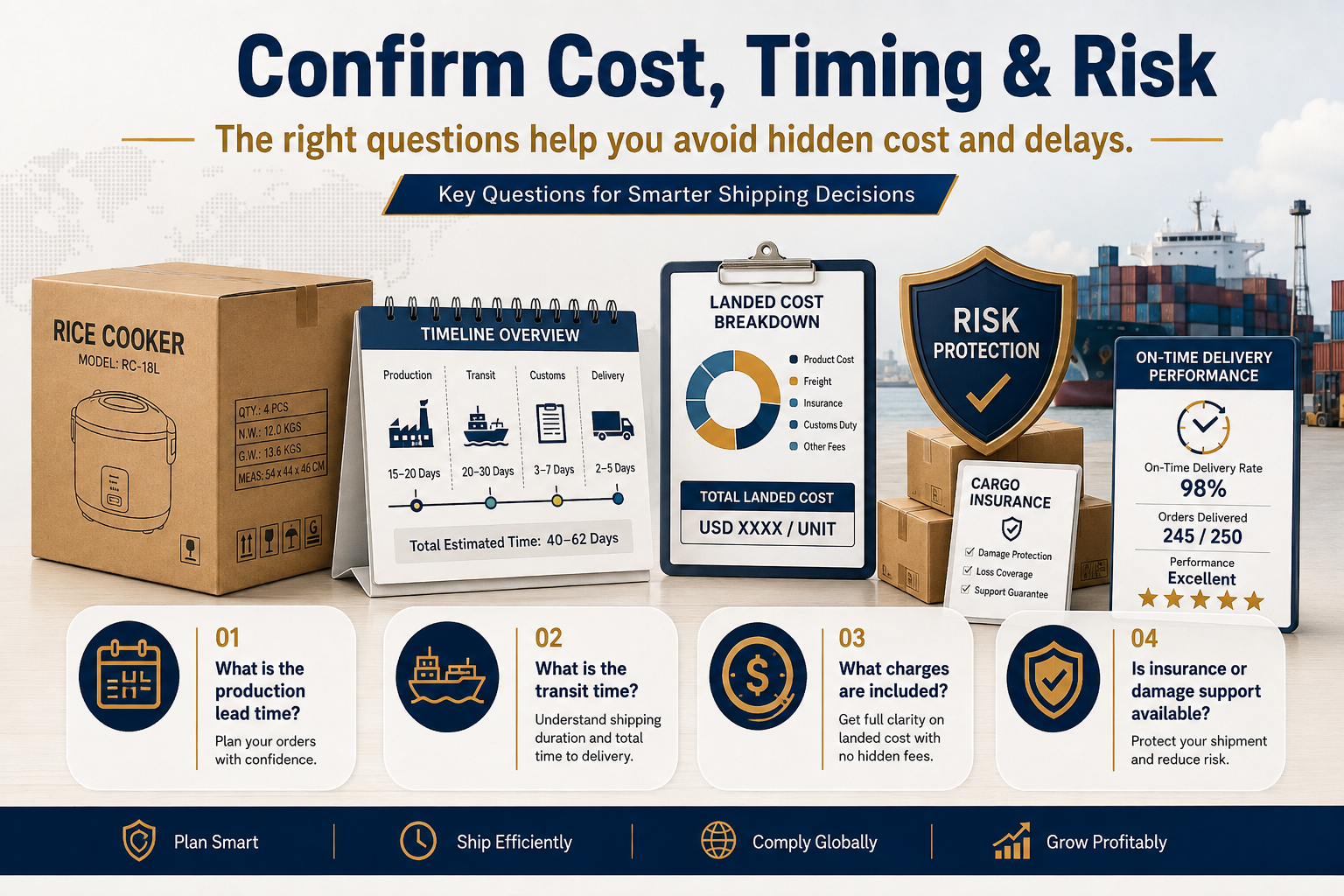
Here's why this matters more than most logistics guides admit: factories don't quote you blind. When you send us an inquiry, the first thing we look at isn't your target price — it's your destination and volume. Those two variables determine whether we recommend FCL or LCL, what packaging grade we use, and what document timeline we commit to. Buyers who skip this step get quotes that don't match their actual shipment structure, then face revision rounds that delay everything. Let me walk you through the decisions that actually control your freight costs and damage risk.
What Packaging Spec Should You Confirm Before Ordering Rice Cookers?
Most damage claims I've handled trace back to one missed conversation during the quotation stage.
Your rice cooker packaging specification isn't a cosmetic detail — it's the legal foundation of any damage dispute you might file later. If you don't confirm foam thickness, carton compression strength, and stacking weight limits before the factory starts production, you lose the ability to prove the factory packaged inadequately. I've seen distributors lose entire damage claims because they couldn't show the agreed packaging spec.
Why Foam Thickness Determines Damage Liability
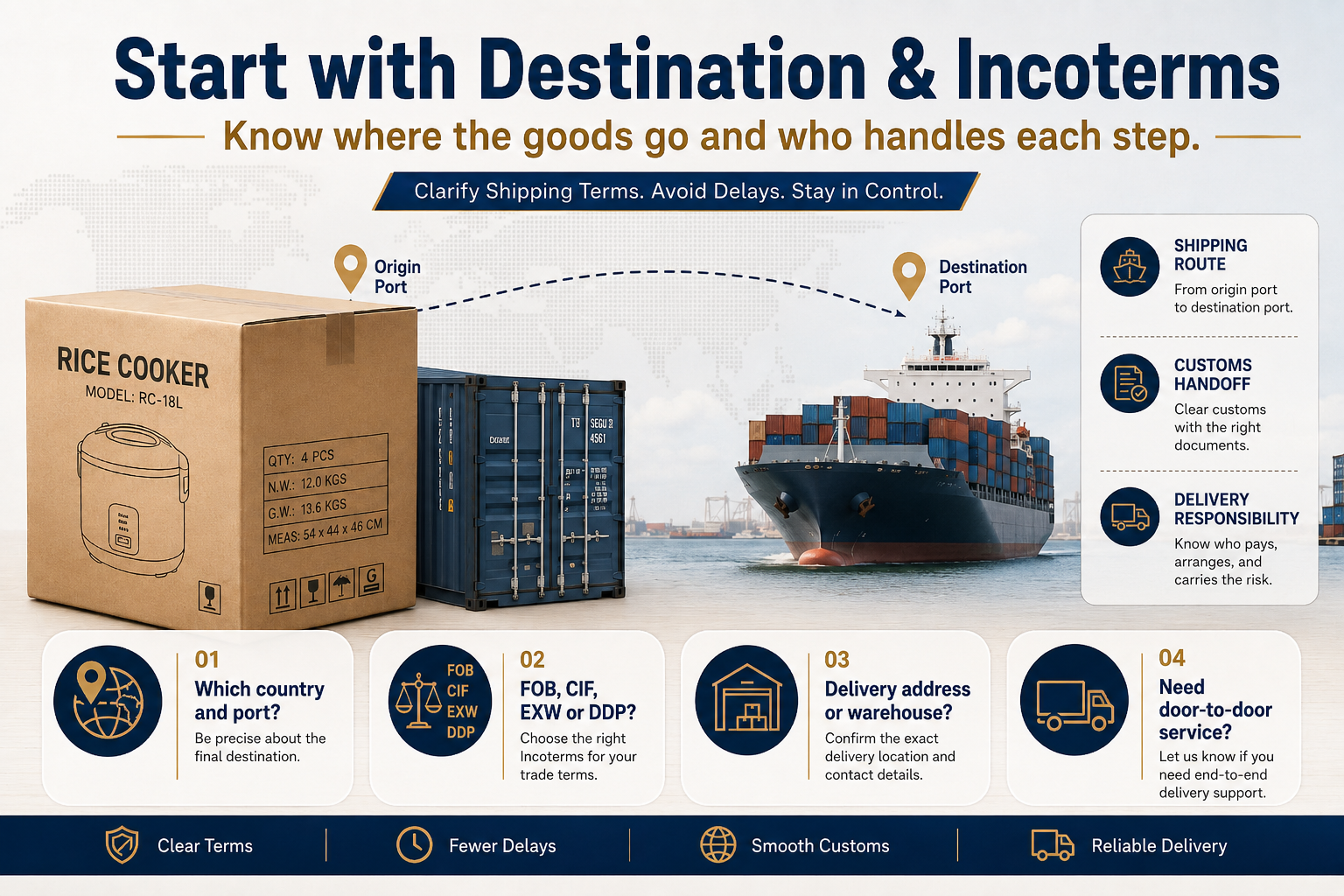
Standard export packaging for rice cookers includes three protection layers: an inner foam base (usually 15–20mm EPE foam), corner protectors at the lid hinge, and an outer corrugated carton rated for stacking.1 But here's what buyers miss: that foam thickness isn't universal. It varies based on shipment mode and destination handling conditions.
When a Middle Eastern wholesaler orders LCL (less than container load), his cartons will be consolidated with cargo from multiple suppliers. Container packers optimize space by stacking heavier items on top. If his rice cookers are packed with standard 15mm foam, and a pallet of cast iron cookware gets loaded above, the compression force exceeds what the foam can absorb. Lids crack, inner pots dent, control panels separate.
The factory's liability in this scenario depends entirely on one question: did the buyer confirm required foam thickness for an LCL shipment? If he didn't, the claim gets rejected. If the factory quoted for LCL but only provided FCL-grade packaging, the factory pays.
Key specifications to confirm in writing before production:
- Foam material and density — EPE foam (polyethylene)2 is standard, but some buyers need EVA foam (ethylene-vinyl acetate)3 for higher shock absorption. Density should be at least 25kg/m³ for LCL shipments4.
- Carton compression strength — Export cartons should meet the Box Compression Test (BCT) standard5. For rice cookers, we use 5-layer corrugated board rated for 200kg static load. If your destination port has humid climate, request moisture-resistant coating.
- Stacking weight limit — Each carton master label should show maximum stacking weight. For our 1.8L rice cookers, we mark "MAX 4 LAYERS / 80KG" because five cartons stacked exceed the carton's burst strength.
- Units per master carton — This affects per-unit protection. We pack 4 units per carton for 1.8L models, 6 units for 1.0L models. Higher density means less foam space per unit.
What Happens When You Don't Specify LCL Packaging
I'll share a specific case. An East African distributor ordered 300 units (1.5L capacity) for Mombasa port. He didn't mention it was LCL. We quoted and packed using our standard FCL foam spec — 15mm base, 10mm corner guards. His forwarder consolidated the shipment with tiles and bathroom fixtures. When the container arrived, 23 units had cracked outer shells.
He filed a claim. We asked for the packaging spec confirmation email. He didn't have one — we'd quoted "standard export packaging" and he'd assumed that covered LCL. The claim went nowhere because he couldn't prove we'd agreed to LCL-grade protection. He absorbed the loss.
The lesson: Before you accept a packaging quote, ask these three questions in writing:
- "Is this foam thickness sufficient for LCL consolidation?"
- "What's the carton BCT rating?"
- "What stacking weight limit will you mark on the master carton?"
If the factory can't answer all three, you're negotiating with someone who doesn't handle export packaging professionally.
Should You Ship Rice Cookers via FCL or LCL?
This is the question I get asked most often, and it's the one buyers most often overcomplicate.
The FCL vs. LCL decision isn't a vague tradeoff between cost and convenience — it's a concrete calculation based on two inputs: your total carton count and your destination port's LCL handling speed. If you know those two variables, you can make this call in five minutes.
The Math Behind FCL vs. LCL for Rice Cookers
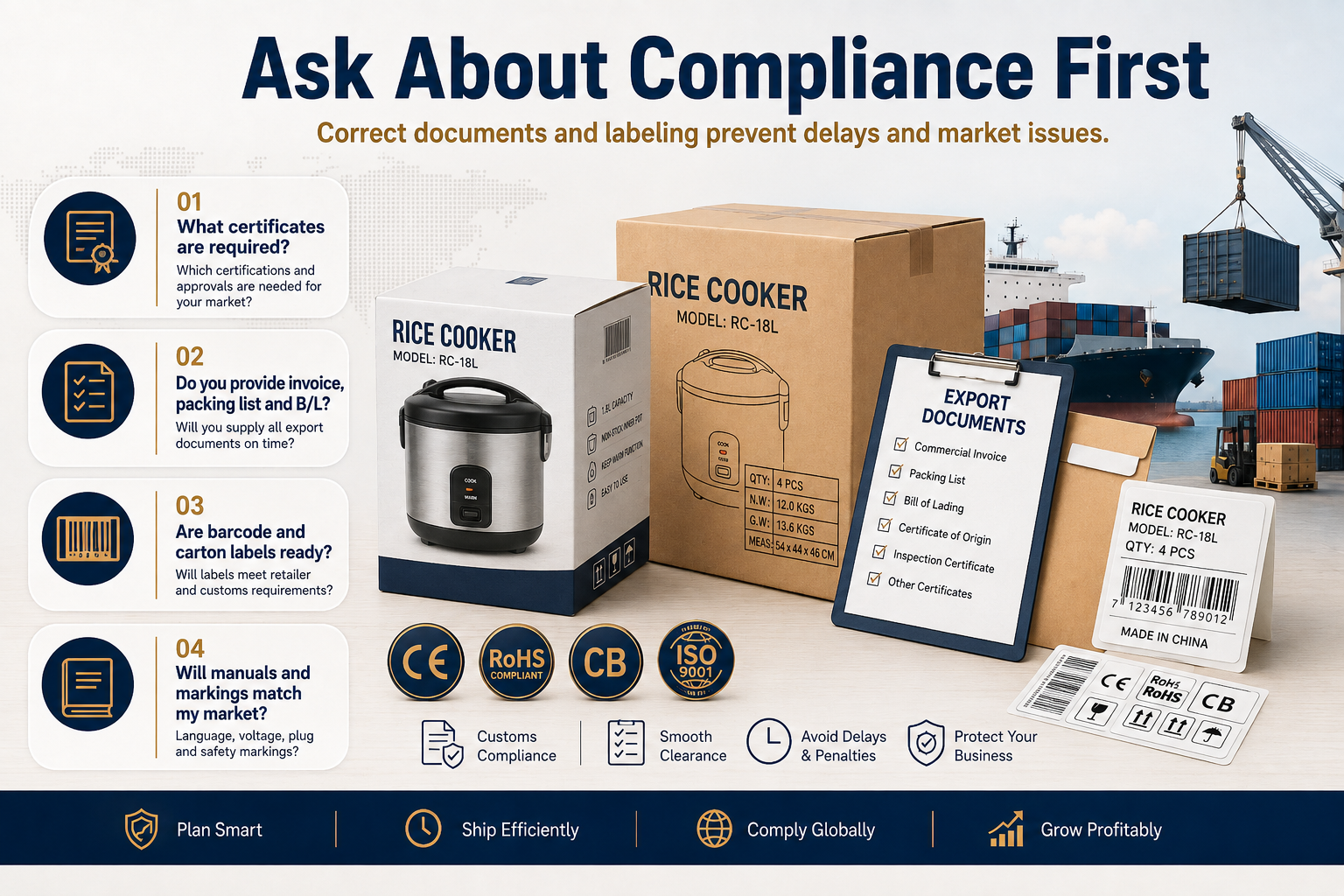
A standard 20ft container holds approximately 650–700 cartons of 1.8L rice cookers (4 units per carton)6. That's 2,600–2,800 units. A 40ft container holds roughly double: 1,300–1,400 cartons or 5,200–5,600 units.
LCL charges you by cubic meter (CBM). Each of our standard master cartons measures 52cm × 44cm × 38cm, which equals 0.087 CBM. If you're shipping 150 cartons, that's 13.05 CBM. LCL rates vary widely by lane, but expect $80–$150 per CBM for most Asia-Africa routes7. That puts your freight cost at $1,044–$1,958 for 150 cartons (600 units).
FCL quotes for the same route typically run $1,800–$3,500 for a 20ft container. At first glance, FCL seems more expensive for small orders. But here's what the basic math doesn't show:
LCL includes hidden cost multipliers that buyers discover after booking:
- Port storage fees — LCL cargo sits in the consolidation warehouse longer than FCL. In ports like Tema (Ghana) or Karachi (Pakistan), LCL clearance takes 7–14 days vs. 2–3 days for FCL8. Storage fees accumulate daily.
- Handling charges — Your cargo gets loaded/unloaded multiple times: factory to consolidation warehouse, warehouse to container, container to deconsolidation warehouse at destination, warehouse to your pickup point. Each touchpoint adds handling fees.
- Damage risk multiplier — Every load/unload cycle increases compression and drop risk. I've seen damage rates 3–4 times higher for LCL vs. FCL on the same product9.
The Decision Matrix I Use with Customers
When a buyer asks whether to go FCL or LCL, I ask two questions:
- How many cartons are you shipping?
- Which destination port?
Based on 10+ years of shipments, here's the decision framework that works:
| Carton Count | Africa Ports | Middle East Ports | Southeast Asia Ports | Latin America Ports | Recommendation |
|---|---|---|---|---|---|
| Under 100 cartons | LCL | LCL | LCL | LCL | LCL — but confirm packaging upgrade |
| 100–200 cartons | FCL if West Africa, LCL if East Africa | LCL | LCL | LCL unless Brazil | Depends on specific port clearance speed |
| 200–300 cartons | FCL | FCL if Saudi/UAE, LCL if others | LCL | FCL | FCL for major ports, LCL for secondary |
| 300+ cartons | FCL | FCL | FCL unless Philippines | FCL | Always FCL |
Port-specific observations from our shipment experience:
- Lagos (Nigeria), Tema (Ghana), Mombasa (Kenya) — LCL clearance averages 10–14 days. Storage fees often erase the per-unit freight savings for orders above 150 cartons. If your order is 180–250 cartons, split it into two shipments or commit to FCL.
- Jeddah (Saudi Arabia), Dubai (UAE) — LCL clearance is fast (4–6 days) but handling fees are high. FCL becomes economical above 200 cartons.
- Manila (Philippines), Ho Chi Minh (Vietnam) — LCL infrastructure is efficient. Orders up to 350 cartons can still benefit from LCL rates.
- Santos (Brazil), Buenos Aires (Argentina) — Import duties and clearance complexity favor FCL even for smaller orders. Local customs agents charge by shipment, not by volume.
The Question Sequence That Prevents Freight Surprises
Here's the workflow I recommend to wholesalers before requesting quotes:
- Calculate your carton count — Divide your target order quantity by units per carton. For our products: 1.0L models = 6 units/carton, 1.8L models = 4 units/carton, 2.8L models = 2 units/carton.
- Identify your destination port — Not the city where your warehouse is, but the actual seaport where customs clearance happens.
- Ask your freight forwarder (or the factory's) for LCL clearance timelines — If the forwarder can't give you an average, that's a red flag.
- Compare total landed cost, not just freight — Add storage, handling, and insurance to both FCL and LCL scenarios.
Most buyers skip step 3 and regret it when their 180-carton LCL shipment sits in port for 12 days accumulating $40/day storage fees.
What Should You Ask a Factory Before Requesting a Quote?
This is where most buyer-factory communication breaks down.
The first question a factory actually needs isn't your target price — it's your destination port and order volume. When you lead with "what's your best price for 500 units," you're forcing the factory to guess at variables that change the quote by 15–30%. That guess creates revision rounds, delays, and mismatched expectations.
Why Factories Can't Quote Accurately Without Destination + Volume
Let me show you what happens on our side when we receive an inquiry.
A buyer emails: "I need a quote for your 1.8L rice cookers. What's your FOB price?"
I can't answer that question yet because:
- FOB requires a departure port — FOB Shenzhen and FOB Guangzhou have different costs because our factory is closer to Guangzhou. If the buyer's freight forwarder prefers Shenzhen, I need to add inland trucking.
- Volume determines packaging decisions — If he's ordering 100 units, that's 25 cartons (LCL candidate). If he's ordering 1,000 units, that's 250 cartons (borderline FCL). LCL packaging costs 8–12% more per unit than FCL packaging.
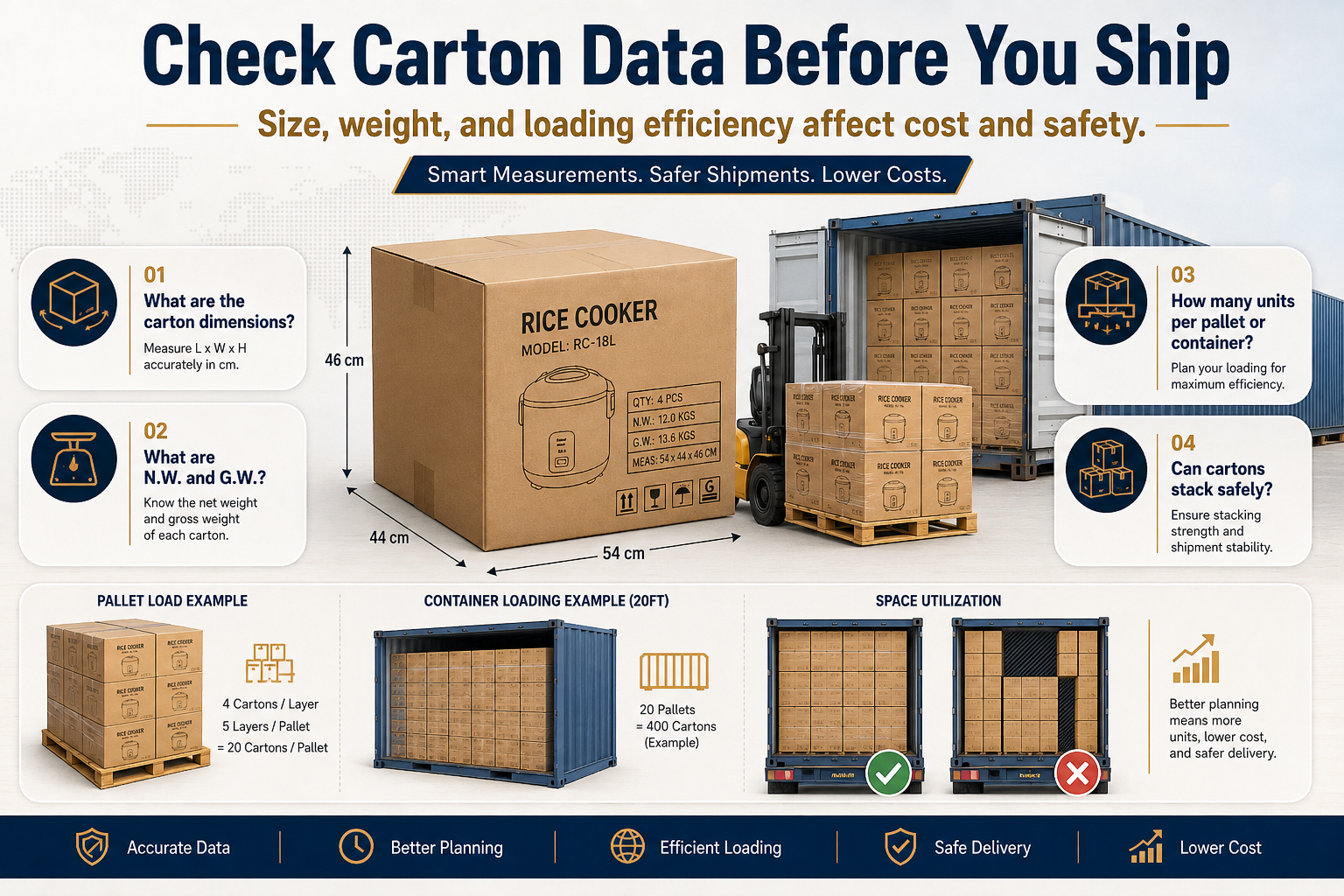
- Destination determines compliance documentation — Some countries require Certificate of Origin, others need SASO certification (Saudi Arabia), others need SONCAP (Nigeria)10. Each cert adds cost and lead time.
- Payment terms affect risk pricing — First-time buyers usually need to pay 100% before shipment. Repeat customers with good payment history get 30% deposit + 70% before shipment. That changes our working capital calculation.
When a buyer sends me destination + volume upfront, I can quote accurately in one email. When he doesn't, we exchange 3–4 emails clarifying details. Those extra days add up when your competitor is booking production slots.
The Inquiry Template That Gets Faster, Better Quotes
Here's the email structure I wish every wholesaler used:
Subject: Rice Cooker Quote Request — [Your Company] — [Destination Port]
Body:
Hello,
I'm [Name] from [Company Name], a wholesaler based in [City, Country]. We're looking to source rice cookers for our distribution network.
Order Details:
- Product: 1.8L rice cooker (or specify capacity)
- Quantity: 500 units (first order), potential for 2,000+ units over next 12 months
- Destination Port: Lagos (Nigeria)
- Preferred Incoterm: FOB or CIF (please quote both)
- Packaging: LCL or FCL? (please advise based on our quantity)
Questions:
- What's your FOB price per unit at this volume?
- What packaging spec do you recommend for LCL to Lagos?
- What certifications/documents are included?
- What's your production lead time?
- What payment terms do you offer for first-time buyers?
Company Background: [Brief 2–3 sentences about your business, existing product lines, and why you're sourcing rice cookers]
Best regards, [Name]
Why this template works:
- You've done the port homework — Shows you're serious and reduces back-and-forth.
- You've specified volume + growth potential — Factories prioritize buyers who signal repeat orders.
- You're asking for packaging advice, not assuming — This positions you as someone who understands logistics matters.
- You've included company context — Helps the factory assess whether you're an established buyer or a startup (affects payment terms).
What Happens When You Skip This Step
I've had buyers request quotes without destination info, then respond two weeks later: "Actually, I need CIF Dar es Salaam, not FOB Guangzhou. Can you re-quote?"
By then, our production schedule has filled. The freight rate has changed because shipping lines adjusted their tariffs11. The certifications we quoted for don't match Tanzania's import requirements. We have to start the quote process over.
The buyer who sent complete information in the first email? He's already received proforma invoice and paid deposit. His production slot is confirmed.
Lead time advantage for complete inquiries: 5–7 days faster quote-to-production compared to incomplete inquiries.
What Documents Do Factories Prepare for Rice Cooker Exports?
Documentation is the most commonly underestimated part of logistics.
Your rice cooker shipment doesn't clear customs with just a commercial invoice — most destinations require 4–7 documents that take 3–10 days to prepare. If you don't confirm the document checklist during quotation, you'll discover missing paperwork after your cargo has already shipped. That delay can add weeks to your clearance timeline.
The Standard Document Package We Prepare
For every rice cooker export shipment, we prepare these documents as baseline:
1. Commercial Invoice
- Itemizes product description, quantity, unit price, total value
- Required for customs duty calculation
- Must match the proforma invoice you approved before production
2. Packing List
- Details carton count, gross/net weight per carton, total shipment weight, carton dimensions
- Customs uses this to verify shipment contents match the invoice
- Must include HS code (Harmonized System code) — for rice cookers, typically 8516.60.0012
3. Bill of Lading (B/L) or Airway Bill
- Issued by the shipping carrier (not by us)
- Proves ownership of the cargo during transit
- You need the original B/L to claim your cargo at destination port
4. Certificate of Origin (CO)
- States the cargo was manufactured in China
- Required by many countries to determine import duty rates
- Takes
"Rice cooker creates a lot of thick foam? : r/AskCulinary - Reddit", https://www.reddit.com/r/AskCulinary/comments/a3ej0j/rice_cooker_creates_a_lot_of_thick_foam/. Industry packaging guidelines confirm that small electrical appliances commonly use multi-layer protection systems including foam inserts and rated corrugated containers for international transport. Evidence role: general_support; source type: research. Supports: typical protective packaging materials and configurations used in small appliance exports. Scope note: General packaging principles rather than rice-cooker-specific standards ↩
"Expanded polyethylene", https://en.wikipedia.org/wiki/Expanded_polyethylene. Expanded polyethylene (EPE) foam is a closed-cell foam material commonly used in protective packaging due to its lightweight structure, shock absorption properties, and resistance to moisture. Evidence role: definition; source type: encyclopedia. Supports: the definition and properties of expanded polyethylene foam. ↩
"Ethylene-vinyl acetate - Wikipedia", https://en.wikipedia.org/wiki/Ethylene-vinyl_acetate. Ethylene-vinyl acetate (EVA) is a copolymer foam material that offers higher flexibility and shock absorption compared to polyethylene foams, frequently used in protective packaging applications requiring enhanced cushioning. Evidence role: definition; source type: encyclopedia. Supports: the definition and properties of ethylene-vinyl acetate foam. ↩
"EPE Foam Density Guide: How to Choose the Right Grade", https://daipak.com/epe-foam-density-guide-how-to-choose-the-right-grade/. Packaging engineering research indicates that higher-density foam materials provide improved shock absorption for products subject to multiple handling events during consolidated transport. Evidence role: general_support; source type: research. Supports: recommended foam density ranges for protective packaging in consolidated shipping. Scope note: Does not establish a specific 25kg/m³ threshold for rice cookers ↩
"Container compression test - Wikipedia", https://en.wikipedia.org/wiki/Container_compression_test. The Box Compression Test measures the maximum load a corrugated container can withstand before failure, used widely in packaging design to predict stacking performance during storage and transport. Evidence role: definition; source type: research. Supports: the definition and purpose of Box Compression Testing. ↩
"Intermodal container", https://en.wikipedia.org/wiki/Intermodal_container. Standard 20-foot dry cargo containers have interior volumes of approximately 33 cubic meters, which determines maximum carton capacity based on individual carton dimensions and stacking patterns. Evidence role: general_support; source type: research. Supports: standard interior dimensions of 20-foot shipping containers. Scope note: Actual capacity depends on specific carton dimensions and loading configuration ↩
"Ocean Freight Rates 2026: FCL & LCL by Route | Suaid Global", https://suaidglobal.com/insights/ocean-freight-rates-2026/. LCL freight rates fluctuate based on lane demand, port handling fees, and consolidation efficiency, with significant variation across different trade routes and time periods. Evidence role: general_support; source type: research. Supports: typical LCL rate structures and variability factors in international shipping. Scope note: Does not confirm specific dollar amounts for Asia-Africa lanes ↩
"Publication: Why Cargo Dwell Time Matters in Trade", https://openknowledge.worldbank.org/entities/publication/5f915f45-f27c-559c-9f6e-31abe18b7c6c. Trade facilitation studies show that LCL cargo typically requires additional deconsolidation and documentation steps at destination ports, extending clearance times compared to full container loads. Evidence role: general_support; source type: research. Supports: factors contributing to longer clearance times for LCL versus FCL shipments. Scope note: Does not verify specific day-ranges for Tema or Karachi ports ↩
"Study the Impacts of Freight Consolidation and Truck Sharing ...", https://rosap.ntl.bts.gov/view/dot/42413. Logistics research indicates that LCL shipments experience more handling touchpoints than FCL, contributing to elevated damage risk, though specific multipliers vary by product type and route. Evidence role: general_support; source type: research. Supports: increased handling and damage risk associated with consolidated shipping. Scope note: Does not establish a quantified 3-4x damage rate differential ↩
"FTA Certificates of Origin", https://www.trade.gov/fta-certificates-origin. Saudi Arabia operates the SASO certification scheme for regulated product categories, while Nigeria requires SONCAP certification for many imports, as part of national standards enforcement programs. Evidence role: case_reference; source type: government. Supports: existence of Saudi and Nigerian conformity assessment programs for imported products. ↩
"Ocean Freight Costs Increase as Carriers Adjust Capacity", https://www.exfreight.com/ocean-freight-shipping-costs-climb-as-carriers-tighten-capacity/. Container shipping rates fluctuate based on supply-demand dynamics, fuel costs, port congestion, and seasonal factors, with carriers adjusting tariffs regularly in response to market conditions. Evidence role: general_support; source type: research. Supports: dynamic pricing practices in container shipping. ↩
"8516.60.60.00 - Harmonized Tariff Schedule", https://hts.usitc.gov/search?query=8516606000. The Harmonized System, maintained by the World Customs Organization, classifies electric cooking appliances under heading 8516, with specific subcategories for different appliance types used in international trade documentation. Evidence role: definition; source type: institution. Supports: the Harmonized System classification structure and code 8516.60 category. ↩