How to Ship Rice Cooker Samples from China?
You found a rice cooker factory in China, you want to order a sample, but you worry about the cost, the time, and whether the sample will work in your country when it arrives.
To ship a rice cooker sample from China, you must first confirm the voltage, plug type, capacity, and functions for your target market with the factory, then arrange international express shipping through DHL, FedEx, or UPS, and pay both the sample fee and freight cost. Delivery usually takes 5 to 10 days, depending on your destination.1
Shipping a rice cooker sample is not just about paying and waiting for the parcel. If you skip the configuration check, you may receive a sample that cannot be plugged in, cannot cook the rice your customers eat, or cannot pass the safety standards in your country. Let me walk you through the right process.
What Should You Confirm Before You Ask for Shipping Cost?
You are excited to see a rice cooker model that looks perfect for your business. You want to ask the factory: "How much to ship one sample to my address?"
Before you ask that question, you should confirm whether the sample configuration will match your target market. If the sample arrives with the wrong voltage or plug, you wasted money and time, and you still do not know if the product is right.
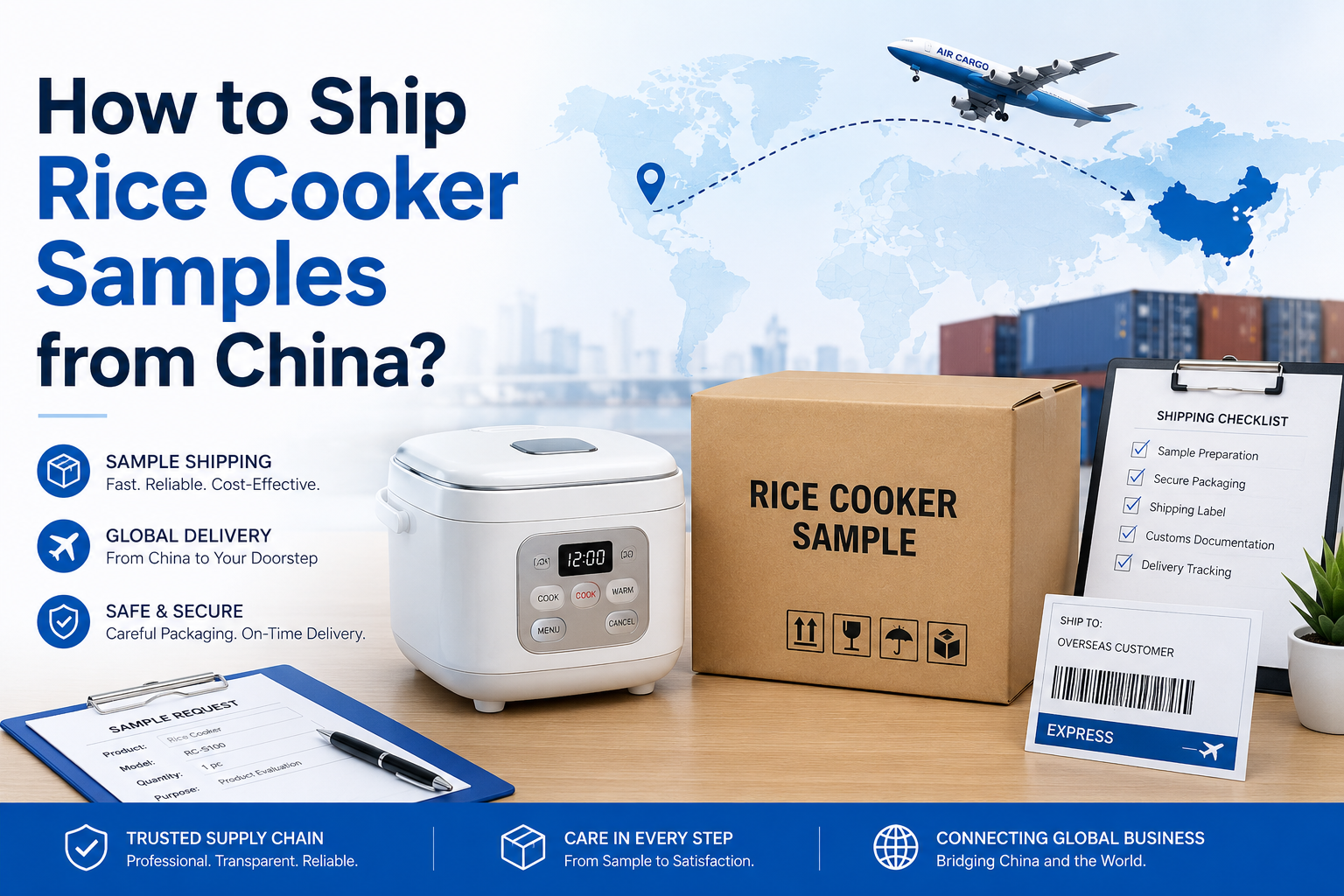
I have worked with many buyers who ordered a sample, received it fast, plugged it in, and then realized it does not work because the voltage is 220V but their country uses 110V. Or the plug does not fit the socket. Or the capacity is too small for local cooking habits. These mistakes are common because buyers focus on shipping speed but skip the configuration conversation.
Here is what you must confirm with the factory before you arrange shipment:
| Configuration Item | Why It Matters | What to Confirm |
|---|---|---|
| Voltage | If the voltage does not match your country, the rice cooker will not work or may be damaged.2 | Check your country's standard voltage (110V, 220V, or dual voltage3). |
| Plug Type | A wrong plug means the buyer cannot test the sample without an adapter, and adapters are not safe for high-power appliances4. | Specify the plug type used in your target market (Type A, Type G, Type I, etc.). |
| Capacity | Different markets prefer different rice cooker sizes. If the sample is too small or too big, it will not represent your future order. | Tell the factory the typical household size or meal portion in your market. |
| Functions | Some markets need steaming trays, some need porridge mode, some only need basic cooking. If the sample does not have the functions your customers want, the test is meaningless. | List the functions you need, and ask the factory if the sample can include them. |
| Certification | Some countries require CE, UL, or local safety marks5. If the sample does not have the right certification, you cannot sell the future batch. | Ask the factory if the sample matches the certification requirement for your country. |
I always ask buyers: "Which country or region is the sample going to?" and "What voltage, plug, capacity, and functions do you need for that market?" These two questions prevent most configuration mistakes. If you answer these questions clearly, the factory can prepare the right sample, and the shipping process becomes simple.
How Does the Factory Prepare the Sample?
You confirmed the configuration with the factory. Now the factory starts to prepare the sample for shipment.
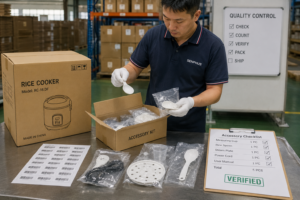
The factory selects a unit that matches your configuration request, tests it to make sure it works, packs it with protective materials, and prepares the commercial invoice and packing list for the courier.
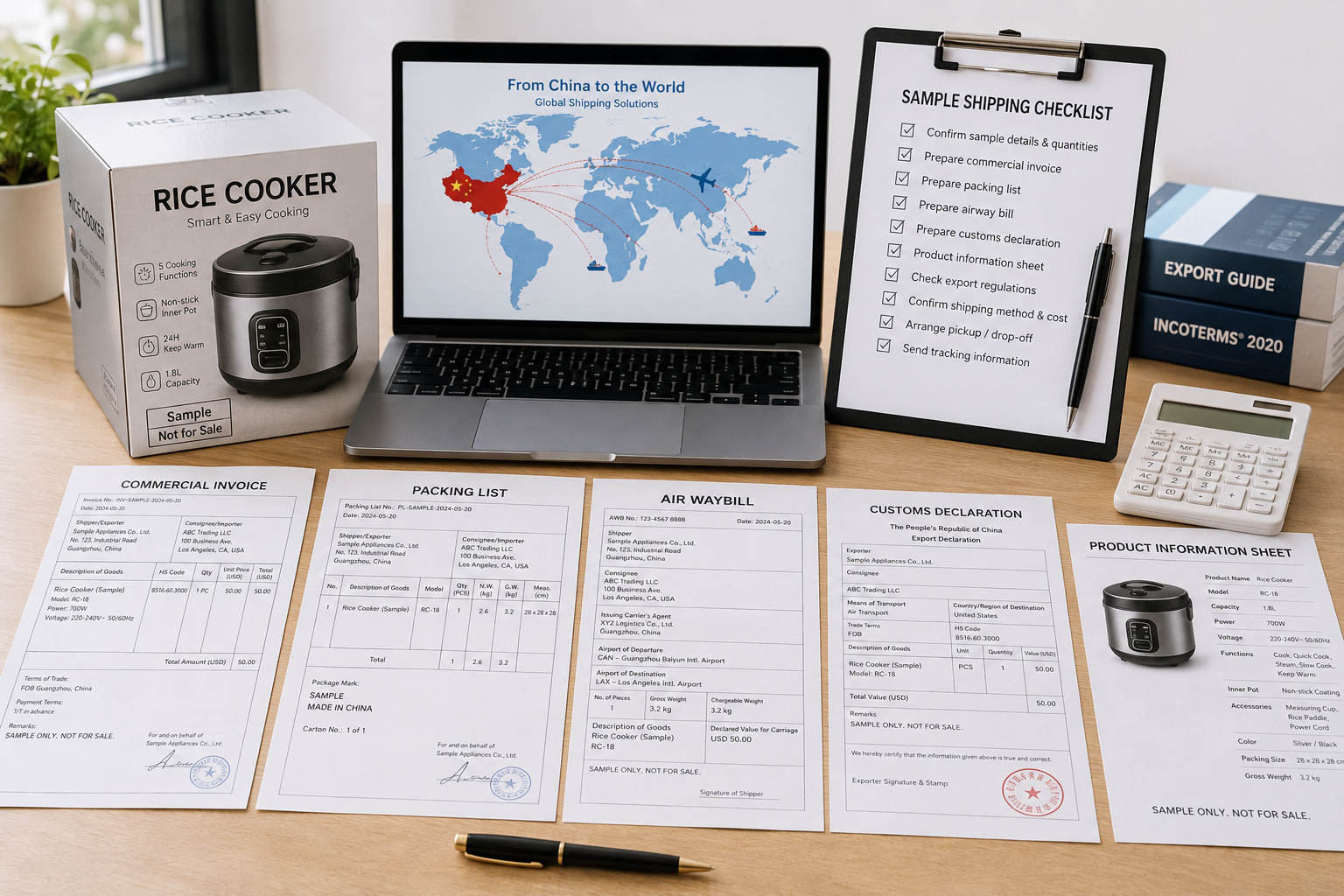
At our factory, we follow this preparation process:
Step 1: Select the right unit. We check our inventory or production line for a rice cooker that matches the voltage, plug, capacity, and functions you requested. If we do not have a ready unit, we may need 3 to 7 days to customize the plug or voltage board.
Step 2: Test the sample. We plug in the rice cooker, cook a small batch of rice, and check that all functions work correctly. We also check the plug, the cable, and the control panel. This step ensures you receive a working sample, not a defective one.
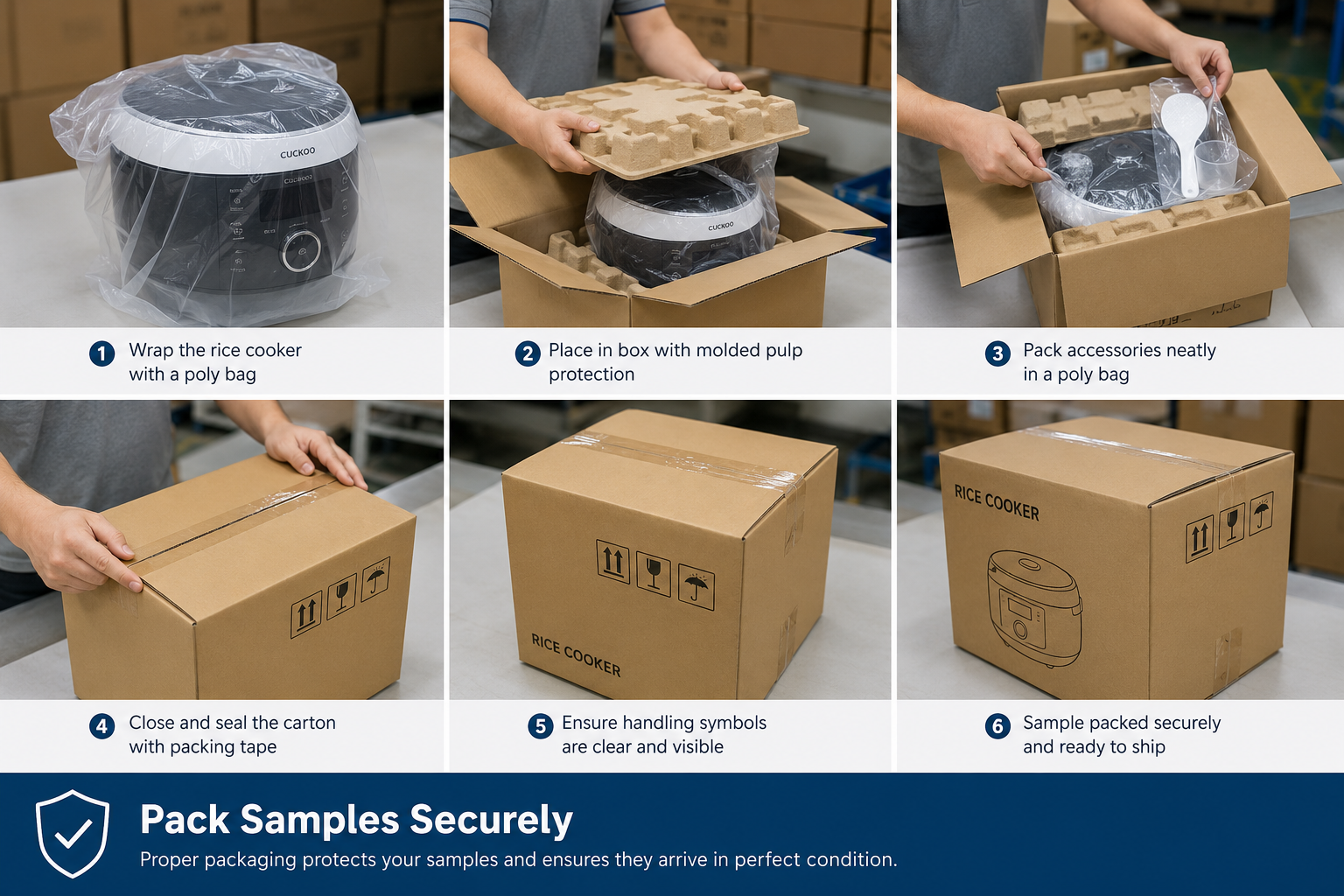
Step 3: Pack the sample securely. Rice cookers have non-stick inner pots, glass lids, and electronic control boards. These parts can be damaged during shipping if the packing is weak.6 We use bubble wrap for the inner pot, cardboard corners for the outer body, and a strong corrugated box for the whole unit. We also add foam if the box has extra space.
Step 4: Prepare shipping documents. The courier needs a commercial invoice that lists the product name, value, quantity, and HS code. We also prepare a packing list. These documents help customs officers understand what is inside the box. If the documents are incomplete or incorrect, the sample may be delayed or returned.
The preparation time depends on whether we have the exact configuration in stock. If we do, we can finish in 1 to 2 days. If we need to customize the plug or voltage, it may take up to 1 week.7
Which Shipping Method Should You Use?
You have a working sample ready to ship. Now you need to choose how to send it from China to your address.
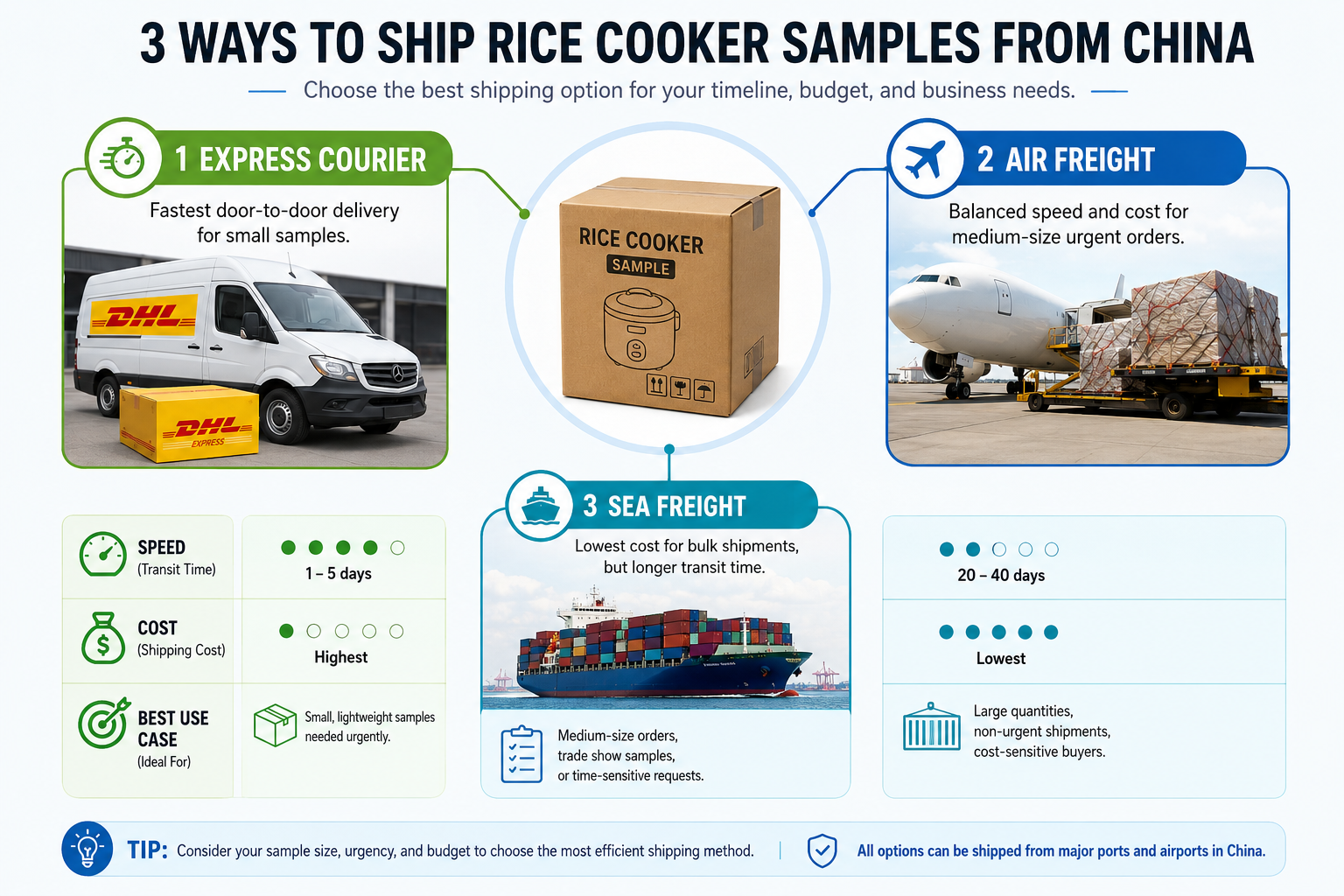
For a single rice cooker sample, international express shipping through DHL, FedEx, or UPS is the most common method. Air freight and sea freight are not practical for one small parcel.
Here is a comparison of the main shipping methods for rice cooker samples:
| Shipping Method | Delivery Time | Cost Range (Estimate) | Best For | Limitations |
|---|---|---|---|---|
| DHL Express | 5 to 7 days | $50 to $150 per sample | Fast delivery to most countries, good tracking | Higher cost, may have strict battery or liquid restrictions |
| FedEx Express | 5 to 8 days | $50 to $140 per sample | Reliable delivery to North America and Europe | Similar cost to DHL, may be slower to some regions |
| UPS Express | 5 to 9 days | $50 to $130 per sample | Good for USA and some European countries | Less coverage in Africa and Latin America |
| China Post EMS | 10 to 20 days | $30 to $80 per sample | Lower cost, but slower and less reliable tracking | Risk of delays, not suitable if you need the sample urgently |
| Air Freight | 7 to 15 days (plus customs clearance) | May be cheaper for multiple samples, but requires customs broker | Best for 5+ samples in one shipment | Not practical for one small parcel, requires more paperwork |
| Sea Freight | 30 to 60 days | Very low per-unit cost, but high minimum charge | Only for bulk orders, not for samples | Too slow, not suitable for a single sample |
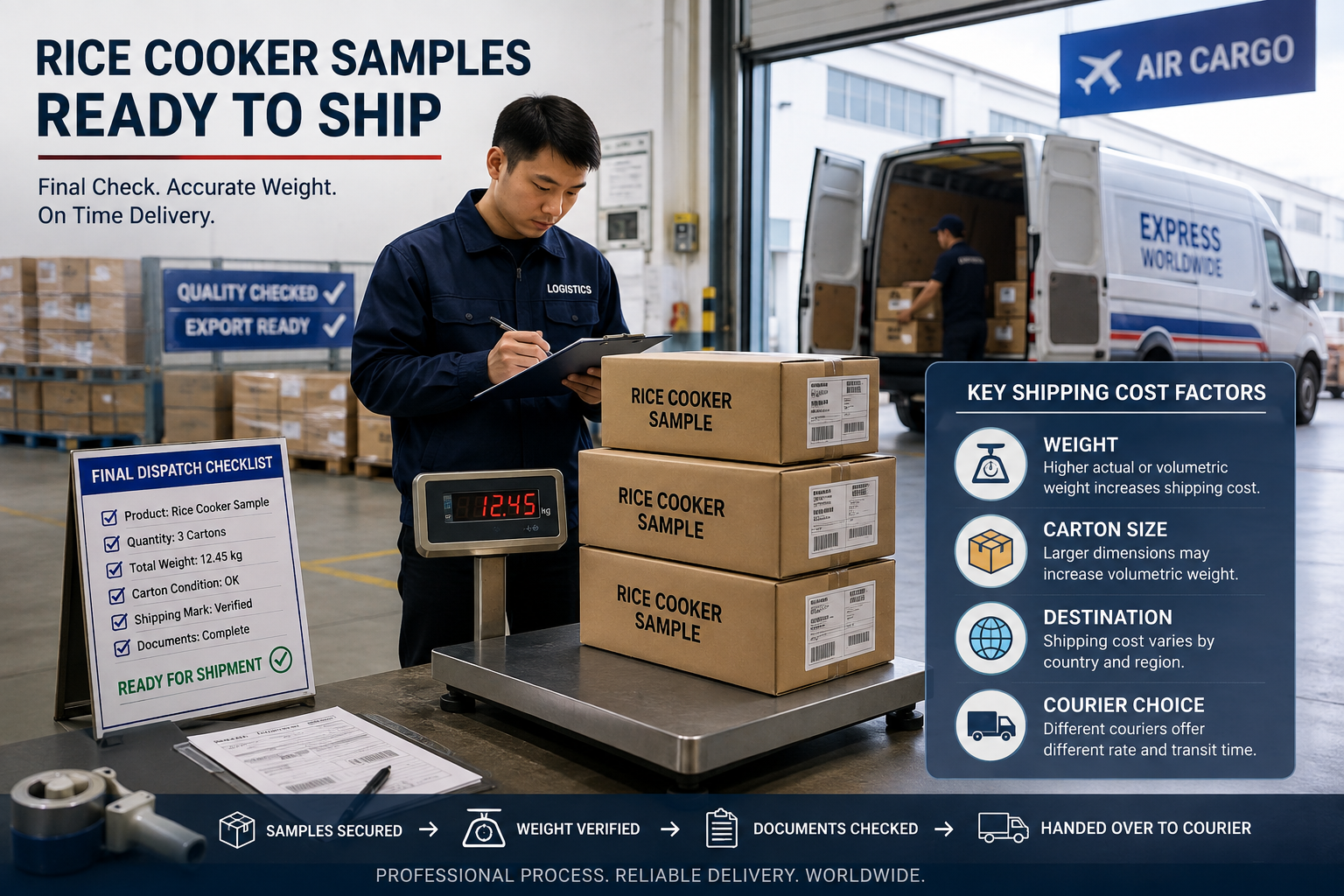
I recommend DHL, FedEx, or UPS for most buyers. These couriers are fast, they offer door-to-door service, and they handle customs paperwork for you. The cost depends on the weight of the package (a rice cooker sample usually weighs 3 to 5 kg including packing materials8), the destination country, and the service speed you choose.
The factory usually arranges the courier pickup and provides you with a tracking number. You pay the freight cost plus the sample fee. Some factories include freight in the sample quotation, but most charge it separately so you can see the real cost.
One important note: do not assume the cheapest option is the best. If you use a slow courier and the sample arrives after your customer deadline, you lose the business opportunity. If you use a courier with poor tracking and the sample gets lost, you waste money and time. Choose a courier that balances cost, speed, and reliability.
What Documents Does the Courier Need?
You chose a courier and the factory is ready to hand over the sample. But the courier cannot pick up the parcel without the right documents.
The courier needs a commercial invoice, a packing list, and sometimes a proforma invoice or product safety declaration. Without these documents, the sample may be stuck at customs.
Here are the key documents and what they must include:
Commercial Invoice. This document describes the product, the value, and the quantity. It must list the HS code (Harmonized System code) for rice cookers, which is usually 8516.609. The invoice must also show the sender's address (the factory) and the receiver's address (you or your company). If the declared value is too high, you may pay high import duties. If the declared value is too low, customs may reject the shipment or fine you.
Packing List. This document lists the contents of the box, including the product name, quantity, gross weight, net weight, and carton dimensions. It helps customs officers and couriers understand what is inside without opening the box.
Proforma Invoice (if needed). Some countries require a proforma invoice for customs clearance. This document is similar to the commercial invoice but is used for valuation before the goods arrive. Your factory or courier can prepare this if your country requires it.
Product Safety Declaration (if needed). Some countries require a declaration that the product meets local safety standards. For example, if you ship a rice cooker to the European Union, you may need a declaration of conformity for CE marking. If you ship to the USA, you may need a statement that the product complies with UL or FDA standards. Not all couriers ask for this, but it is safer to confirm with your courier or customs broker.
I always prepare these documents carefully because one missing document can delay the sample by several days or even cause the shipment to be returned to China. If you are not sure what your country requires, ask your courier or check with your local customs authority before the factory ships the sample.
Who Pays for Shipping and How Much Does It Cost?
You know the sample is ready and the documents are prepared. Now you need to know who pays and how much.
The buyer usually pays both the sample fee and the international freight cost. The total cost depends on the rice cooker model, the destination, and the shipping speed.
Here is a typical cost breakdown for a rice cooker sample shipment:
Sample Fee. This is the cost of the rice cooker unit itself. For a standard model, the sample fee may range from $15 to $50, depending on the capacity, functions, and materials. If you request a customized sample (for example, a special plug or a specific color), the sample fee may be higher because the factory needs to make changes to the standard production.
International Freight Cost. This is the cost charged by the courier (DHL, FedEx, UPS, etc.) to ship the sample from China to your address. The freight cost depends on the weight of the package, the destination country, and the service speed. For a 3 to 5 kg rice cooker package, the freight cost usually ranges from $50 to $150. Remote areas or countries with strict customs may have higher freight costs.
Customs Duties and Taxes. In most countries, you (the buyer) must pay import duties and VAT when the sample arrives. The courier will calculate these charges based on the declared value of the sample and your country's tariff rate. Some countries have a minimum value threshold (for example, $100 or $200) below which you do not pay duties.10 Check your country's customs website to find out the exact rate.
Sample Refund (if applicable). Some factories agree to refund the sample fee if you place a future order above a certain quantity (for example, 500 units or 1,000 units). This policy varies by factory. At our factory, we refund the sample fee if the buyer places an order above 1,000 units. If you do not place an order, the sample fee is not refunded.
Here is an example: You are in Kenya and you want a 1.8-liter rice cooker sample with a British plug and 220V. The sample fee is $25. The DHL freight cost is $90. Kenya's import duty on rice cookers is 25% and VAT is 16%.11 The total cost you pay is approximately $25 (sample) + $90 (freight) + $10 (duty) + $6 (VAT) = $131. This is a realistic estimate, but the actual cost may vary depending on DHL's exact rate and Kenya customs' valuation.
I always recommend that buyers ask the factory for a complete quotation before they agree to pay. The quotation should clearly list the sample fee, the freight cost, and the estimated delivery time. If the factory does not provide a clear quotation, ask them to send it in writing.
How Long Does the Sample Take to Arrive?
You paid for the sample and the factory handed it over to the courier. Now you want to know when it will arrive.
For international express shipping, a rice cooker sample usually takes 5 to 10 days to arrive, depending on your destination and customs clearance speed. Remote areas or countries with strict customs may take longer.
Here is a typical delivery timeline:
Day 1-2: Courier pickup and processing. The courier picks up the sample from the factory and processes it at the local sorting center in China. You receive a tracking number during this period.
Day 3-5: Air transportation. The sample is loaded onto an airplane and flown to your country. This is usually the fastest part of the process.
Day 6-8: Customs clearance. The sample arrives at your country's customs office. Customs officers check the documents, calculate the duties and taxes, and release the sample. This is the part that can cause delays. If the documents are incomplete or if customs officers have questions, the sample may be held for additional days.
Day 9-10: Final delivery. The courier delivers the sample to your address. You sign for the package and the delivery is complete.
In some countries, such as the USA, Canada, or the UK, customs clearance is fast and the sample may arrive in 5 to 7 days. In other countries, such as some African or Latin American countries, customs clearance can take several extra days and the total delivery time may be 10 to 15 days.
One important note: do not assume the tracking information is always accurate. Sometimes the tracking shows "Delivered" but you did not receive the package. Sometimes the tracking shows "Customs Clearance in Progress" for several days without updates. If you have concerns, contact the courier's customer service team and ask them to check the status.
I always tell buyers to plan for at least 10 days from the day the factory ships the sample to the day you receive it. If you need the sample urgently (for example, for a trade show or a customer meeting), tell the factory in advance so they can choose the fastest courier option and prepare the documents quickly.
What Can Go Wrong During Shipping?
You did everything right: you confirmed the configuration, you paid the costs, you waited for the delivery. But sometimes problems still happen.
The most common problems during rice cooker sample shipping are customs delays, incorrect declared value, damaged packaging, and lost parcels. Most of these problems can be avoided with clear communication and proper preparation.
Here are the problems I have seen and how to handle them:
Problem 1: Customs delays. Customs officers may hold the sample for inspection if they have questions about the product type, the declared value, or the safety certification. This can add several days or even weeks to the delivery time. Solution: Make sure the factory provides complete and accurate documents, including the commercial invoice, packing list, and any required safety declarations. If customs contacts you, respond quickly with the information they request.
Problem 2: Incorrect declared value. If the factory declares the sample value too low to reduce duties, customs may reject the shipment or fine you. If the factory declares the value too high, you pay unnecessary duties. Solution: Agree with the factory on a realistic declared value that matches the actual product cost. Do not ask the factory to under-declare or over-declare.
Problem 3: Damaged packaging. Rice cookers are fragile, especially the inner pot and the glass lid. If the factory uses weak packaging, the sample may arrive broken. Solution: Ask the factory to use strong packing materials (bubble wrap, foam, double-layer carton). You can also request photos of the packed sample before the courier picks it up.
Problem 4: Lost parcel. Sometimes the courier loses the parcel during transportation or delivery. This is rare but it can happen. Solution: Choose a courier with good tracking and insurance. If the parcel is lost, file a claim with the courier. Most couriers offer compensation up to the declared value if they lose the parcel.12
Problem 5: Wrong configuration delivered. Despite your clear request, the factory may ship a sample with the wrong voltage, plug, or capacity. This usually happens because of miscommunication. Solution: Before the factory ships the sample, ask them to send
"FedEx vs UPS vs DHL Rates: Which Is Cheaper from China in 2026?", https://ddpchain.com/fedex-vs-ups-vs-dhl-rates-china/. Major international express carriers report average delivery times of 5-10 business days for shipments from China to most destinations, though actual times vary by service level and destination customs procedures. Evidence role: general_support; source type: other. Supports: typical delivery timeframes for international express courier services from China. Scope note: Timeframes represent typical service standards and do not account for customs delays or remote area surcharges ↩
"Connect 220V to 110V Safely - Imba Missouri Insights", https://imba.missouri.edu/connect-220v-to-110v-2657229153.html. Electrical appliances designed for specific voltage ranges will malfunction or sustain component damage when operated outside their rated voltage, as lower voltage results in insufficient power delivery while higher voltage can cause overheating, insulation breakdown, and component failure in heating elements and control circuits. Evidence role: mechanism; source type: education. Supports: the effects of voltage mismatch on electrical appliances. ↩
"Mains electricity by country - Wikipedia", https://en.wikipedia.org/wiki/Mains_electricity_by_country. International standards recognize two primary voltage ranges: approximately 100-127V (used in North America, parts of South America, and Japan) and 220-240V (used in Europe, Asia, Africa, and Oceania), with specific voltages varying by country. Evidence role: general_support; source type: encyclopedia. Supports: the global distribution of electrical voltage standards. ↩
"Safety Warning: Double Adaptors and High-Current Appliances", https://www.facebook.com/groups/birkenheadnorthcotecommunity/posts/10160910332888733/. Electrical safety guidance distinguishes between simple plug adapters (which only change plug configuration without voltage conversion) and transformers, noting that high-wattage heating appliances require proper voltage conversion and adequate current-handling capacity, as simple adapters may overheat or fail when used with devices drawing significant current. Evidence role: general_support; source type: education. Supports: safety concerns with using simple plug adapters for high-power appliances. Scope note: Safety depends on whether the adapter includes voltage conversion and its power rating relative to the appliance ↩
"CE marking - Wikipedia", https://en.wikipedia.org/wiki/CE_marking. CE marking indicates conformity with European Union safety, health, and environmental protection standards for products sold in the EEA, while UL certification from Underwriters Laboratories indicates testing to North American safety standards, both serving as market access requirements in their respective jurisdictions. Evidence role: definition; source type: institution. Supports: the regulatory significance of CE and UL marks for electrical appliances. ↩
"Electronics Packaging Regulations & Compliance Guide | 2026", https://epackfactory.com/electronics-packaging-regulations-compliance/. Shipping standards for small appliances with glass, ceramic, or electronic components recommend multi-layer protection including bubble wrap or foam for fragile parts, corner reinforcement, and void fill to prevent movement within the outer carton, as inadequate packaging can result in cracked glass, dented surfaces, or damaged circuit boards from impact and vibration during transit. Evidence role: general_support; source type: other. Supports: packaging requirements for appliances with fragile components. ↩
"How to Navigate Transformer Lead Times - ELSCO", https://elscotransformers.com/blog/how-to-navigate-transformer-lead-times/. Modifying electrical specifications for appliance samples typically requires sourcing region-specific power cords, plugs, and potentially voltage-appropriate heating elements or circuit boards, with lead times depending on component availability, ranging from immediate assembly if parts are in stock to several days for procurement and testing of non-standard configurations. Evidence role: general_support; source type: other. Supports: typical lead times for electrical component customization in appliance manufacturing. Scope note: Timeline varies based on component inventory, supplier relationships, and complexity of electrical modifications required ↩
"Rice Cooker Capacity Guide - Yum Asia USA", https://yum-asia.com/us/rice-cooker-capacity-guide/?srsltid=AfmBOopWlgC3JmIwCmCfeb-95vRjMl5cSxGx0x1H7vu1f8RL4cqAMNfF. Standard household rice cookers typically weigh 2-4 kg for the unit itself, with protective packaging materials adding approximately 0.5-1.5 kg, resulting in total shipping weights commonly in the 3-5 kg range for single-unit samples. Evidence role: general_support; source type: other. Supports: typical weight ranges for household rice cookers including packaging. Scope note: Weight varies significantly based on capacity, materials, and feature complexity ↩
"956227 - CROSS Ruling - U.S. Customs and Border Protection", https://rulings.cbp.gov/ruling/956227. The World Customs Organization's Harmonized System classifies electric rice cookers under heading 8516.60, which covers 'Other ovens; cookers, cooking plates, boiling rings, grillers and roasters' for tariff and statistical purposes. Evidence role: definition; source type: institution. Supports: the official HS classification code for rice cookers. ↩
"Customs Duty Information - U.S. Customs and Border Protection", https://www.cbp.gov/travel/international-visitors/know-before-you-visit/customs-duty-information. De minimis thresholds, below which countries do not collect customs duties or taxes on imported goods, vary widely internationally, ranging from zero in some countries to $800 in the United States, with many countries setting thresholds between $20 and $200. Evidence role: general_support; source type: institution. Supports: the existence and variation of de minimis thresholds for import duties. Scope note: Thresholds change periodically and may differ for duties versus taxes within the same country ↩
"Kenya - Import Tariffs | Privacy Shield", https://www.privacyshield.gov/ps/article?id=Kenya-import-tariffs. Kenya's customs tariff schedule applies duty rates to electric cooking appliances based on their HS classification, with VAT charged at the standard rate on the sum of CIF value plus applicable duties, though specific rates should be verified with current Kenya Revenue Authority schedules as tariffs are subject to change. Evidence role: statistic; source type: government. Supports: Kenya's import duty and VAT rates applicable to rice cookers. Scope note: Tax rates may be affected by trade agreements, tariff schedule updates, or product-specific classifications ↩
"Declared Value - Transtream - Colorado State University", https://transtream.colostate.edu/declared-value/. International express carriers typically provide limited liability coverage for lost or damaged shipments, with standard coverage often capped at a specific amount per kilogram or package, while declared value coverage (purchased separately) extends protection up to the declared shipment value subject to maximum limits and exclusions defined in the carrier's terms of service. Evidence role: general_support; source type: other. Supports: standard liability coverage provided by international express couriers. Scope note: Coverage terms, limits, and exclusions vary by carrier and service type, and claims require documentation ↩